
Why are Serbian documents in the hands of The Hague judges a “thorn in the side” for Pristina?
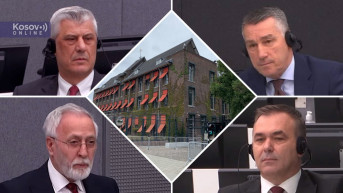
For the authorities in Pristina, it is unacceptable that certain documents submitted by the Serbian authorities to the Specialist Court in The Hague have been accepted as evidence in the case “Hashim Thaçi et al.” Legal experts interviewed by Kosovo Online believe that all evidence should be presented before the Specialist Court in order to determine responsibility for the crimes committed, and they are convinced that Serbia’s archives contain high-quality documentation.
Written by: Dusica Radeka Djordjevic
The news that the Specialist Chambers in The Hague accepted as material evidence documents submitted by Serbian state institutions was met “with concern,” according to Kosovo’s acting Minister of Justice, Albulena Haxhiu.
Acceptance of materials which, as she put it, were “produced by a criminal state apparatus” constitutes a serious distortion of justice and cannot be trusted.
At the same time, it should be recalled that, in the context of resolving the issue of missing persons, the Pristina authorities are demanding that Belgrade open precisely the archives of the Serbian police and army.
The decision of the Specialist Chambers to accept Serbian documents was also criticized by lawyer Tom Gasi, who called it catastrophic, and it was deemed unacceptable by the President of the KLA War Veterans’ Organization, Hysni Gucati. Gucati was convicted by this court in 2022 for obstruction of justice, having unlawfully disclosed information protected under the Law on the Specialist Chambers, including data on potential witnesses.
The message from The Hague regarding the accepted documents from Belgrade is as follows: it is for the judges to decide how much weight to give them.
“Whether the Panel will rely on these documents in the judgment and how much weight it will give them is a matter for the judges to decide in their deliberations when they consider the admitted evidence as a whole at the end of the case, pursuant to Rule 139 of the Rules of Procedure and Evidence,” the Specialist Chambers stated.
Legal expert Milan Antonijevic believes that anyone with a shred of humanity should be interested in seeing all evidence presented before the court in The Hague, which is determining the responsibility—primarily of the KLA—for crimes against both Serbs and Albanians.
He also hopes that, in the long run, there will be no major resistance to using the documents in Serbia’s possession that prove crimes, and that the critical voices now being heard are “just a small amount of noise.”
“Our forensic experts were in Kosovo during these crimes, conducting on-site investigations. There is also much other data that Serbia possesses, obtained in a legal and proper manner, which should be presented to this court in The Hague so that we may achieve reconciliation, but above all establish the responsibility of specific individuals and KLA members,” Antonijevic told Kosovo Online.
Lawyer Goran Petronijevic also says that Serbia’s archives contain exceptionally high-quality documentation.
“A large portion of it was already provided to the Hague Tribunal in the trial of Ramush Haradinaj and several other KLA members. I do not know whether, in this case, it is that same documentation—perhaps taken from the Hague Tribunal—or whether it comes directly from our state authorities. Whether it is military, police, judicial, state, or even private documents, they are extremely strong evidence and every court must evaluate them,” Petronijevic is convinced.
Speculating on whether these documents can be considered evidence, he added for Kosovo Online, amounts to “an escape from reality by the institutions of self-proclaimed Kosovo, especially the Minister of Justice.”
“She should be the first to care that those Albanians and the families of those Albanians who were killed receive justice or redress. This is an unfair attitude—not only toward Serbia and the Serbs but also toward her own people—and a kind of irresponsibility toward her own people. The documentation is certainly good and of high quality, and I am almost certain there is no court that would not accept it,” Petronijevic said, noting that the charges before the Specialist Chambers in The Hague are largely based on events in which Albanians were the majority of victims.
Bekim Blakaj of the Humanitarian Law Center stresses that the Specialist Prosecutor’s Office in The Hague has the right to collect evidence regardless of where it is located.
“Evidence is evidence, and of course the Prosecutor’s Office has the right to collect it wherever it is found. As long as this documentation is not fabricated, the evidence should be gathered from anywhere,” Blakaj says.
He points out that the Hague Tribunal, in cases related to Kosovo, used documentation that Serbia was obliged to provide to it.
“I believe that in some cases these were crucial pieces of evidence. The Hague Tribunal certainly used documentation sent by Serbian institutions,” Blakaj notes.
He also speculates on what might motivate the resistance in Pristina to using evidence from Serbia:
“In some cases before the Hague Tribunal—particularly those against Ramush Haradinaj and Fatmir Limaj—some witnesses were instructed by Serbian services. These witnesses made statements that were later rejected by the Trial Chamber because it was proven that they had been coached or prepared. I believe that is why there is such motivation, particularly among institutional representatives and lawyers in Kosovo, to argue against using evidence from Serbia. However, evidence is evidence, and of course the Prosecutor’s Office has the right to collect it wherever it is,” Blakaj says.
Double Standards
Although Pristina in this case objects to Serbian documents, it simultaneously demands in dialogue with Belgrade the opening of Serbian police and army archives to clarify the fate of missing persons.
Commenting on this inconsistency, Antonijevic says that “double messages” are often heard.
“Naturally, the archives held by Serbia—given that Belgrade was the center of the former state—are much more organized and reflect the real situation more than the archives created only in the 1990s in the former republics and in Kosovo. Trust in these archives and the desire to access them on one hand, and distrust in these same archives and the wish to keep them out of court on the other, shows the unseriousness and immaturity of politicians, and how much time is still needed for everyone to understand that responsibility for crimes must be established,” he says.
Petronijevic says that Pristina applies double standards and takes an unprincipled position.
“If you believe the documents that suit you but reject the ones that work against you, that is, I would say, a completely distorted way of thinking. You cannot declare certain documents from Serbian state bodies valid and others invalid. Either they are valid, or they are invalid from your perspective. And whether they will be used and how will be decided by the court,” Petronijevic concludes.
In the “Hashim Thaçi et al.” case, in addition to Hashim Thaçi, three other former senior KLA officials—Kadri Veseli, Rexhep Selimi, and Jakup Krasniqi—are charged with war crimes and crimes against humanity.


0 comments