
Why is the word “Metohija” unacceptable for Pristina?
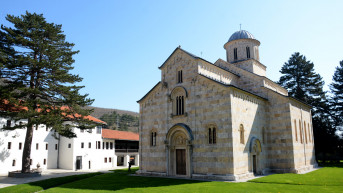
The use of the word Metohija has for years provoked disapproval among Albanian politicians in Kosovo. It is considered unacceptable in official documents, on road signs, in the names of political parties, and in public discussions. Yet, as interviewees told Kosovo Online, the term—which denotes church land—should not offend anyone. The main reason it has become “non grata” in Pristina, they explain, is that the name Metohija points unmistakably to the Serbian identity of the territory it describes.
Written by: Dusica Radeka Djordjevic
Geographically, Metohija covers the area from Pec to Prizren, between the Prokletije and Sar Mountains in the south.
“There is no ‘Kosovo and Metohija,’ that does not exist,” said Donika Gervalla-Schwarz, Kosovo’s acting Minister of Foreign Affairs, at the latest session of the United Nations Security Council dedicated to the situation in Kosovo.
On October 21, Gervalla-Schwarz stated that “Kosovo and Metohija” is an expression of Serbia’s hegemonic ambitions over Kosovo and represents the old language of Slobodan Milosevic and those who still follow him.
In his response, Serbian Foreign Minister Marko Djuric noted that records from the 11th, 12th, and 13th centuries already use the word metoh to denote the property of churches in the western part of Kosovo and Metohija, and that it is neither derogatory nor in any way attributable to Slobodan Milosevic.
Hvosno and Old Serbia
Historian Marko Markovic told Kosovo Online that there is no reason why the word Metohija should offend anyone or provoke opposition, since in its original meaning there is nothing negative about it. The term, he explains, is a medieval expression meaning church estate.
It refers to the part of Kosovo that contains the largest number of Serbian churches and monasteries.
“When we look at medieval charters, inscriptions, and other written sources of that time, we see that there was hardly a single village without a church, monastery, hermitage, or other traces of Christian, that is, Serbian culture. All of these are encompassed by the term Metohija—church land. The entire territory of Metohija literally belonged to the Church, since each medieval monastery represented a kind of feudal estate. The property of one monastery ended where another’s began, and so on endlessly,” Markovic explains.
At certain points in history, he adds, the use of the word varied.
“There was a period when the term Hvosno was used, and later, when the Turks occupied the area, it was referred to as Old Serbia. At the Berlin Congress it was also described by that term—Old Serbia. Later came other expressions—first Kosmet, and eventually just Kosovo,” the historian notes.
Claims that the phrase Kosovo and Metohija represents “the language of Slobodan Milosevic,” according to Markovic, have no connection to historiography or scholarship.
“That notion is purely linked to the day-to-day politics of the Albanian elite in Kosovo and Metohija. The expression Kosovo and Metohija began to be used after the liberation of 1912, during the Kingdom of Serbia, and later the Kingdom of Yugoslavia,” he says.
After World War II and the rise of the communist government, Markovic continues, the term Metohija was gradually sidelined in favor of the shorter form Kosmet, until later constitutional amendments and political developments further pushed Metohija out of official use.
As to why politicians in Pristina today reject the term, Markovic says it is because it reminds them that the territory of Kosovo and Metohija was unmistakably part of the Serbian kingdom and empire in the Middle Ages.
“It clearly points to the Serbian identity of that land—and that’s precisely what they want to suppress,” he concludes.
There have been many strong reactions in Pristina whenever the word Metohija is mentioned. Seven years ago, a journalist from Kosovo’s public broadcaster was suspended for a month for using the term in a Serbian-language news program.
Since 2012, political parties whose names include words deemed contrary to the Constitution of Kosovo—such as Metohija—cannot be registered. When the phrase Kosovo and Metohija appears in proceedings before the Special Court in The Hague, Albanian politicians protest, claiming it constitutes a serious insult.
“The use of the term Kosovo and Metohija by the Office of the Special Court’s Prosecutor is not a slip. It is a deliberate, politically motivated act that represents not only a grave insult to the citizens of the Republic of Kosovo but also a challenge to our institutions and our state. It is a humiliation,” Democratic Party of Kosovo MP Vjosa Çitaku wrote on Facebook in April.
The “Dukagjini Plain”
Professor Vanja Stanisic of the Faculty of Philology in Belgrade explains that the word Metohija means monastic property and belongs to the Byzantine cultural tradition.
“We were part of that civilization, and it naturally came to us as a cultural heritage. The area called Metohija contains our most precious cultural monuments, and that is why the term irritates institutions in Pristina,” Stanisic told Kosovo Online.
He emphasized that Metohija is a name with a long history and “must not be erased.”
“It’s another matter whether we can practically enforce its use now, but we will certainly continue fighting to bring it back to life,” Stanisic said regarding the ongoing opposition of Kosovo’s authorities to the word.
Albanians, he notes, have another historical name for the same territory—the Dukagjini Plain (Rrafshi i Dukagjinit).
“Dukagjin was a territory on the Albanian side—it was the domain of Duke Jovan or Gjin Dukagjin. The emergence of the name Rrafshi i Dukagjinit should not concern us unless it threatens us. If it begins to threaten us, that’s another matter,” he said.
Asked why Albanians feel threatened by the use of the word Metohija, Stanisic replies that it is because it makes clear that everything in that region is Serbian.
“When we say Metohija, everything becomes clear. Our most important monasteries are right along the border with Albania. The fact that they call it differently is their business—unless someone demands that Metohija be replaced by Rrafshi i Dukagjinit. That cannot happen,” he stresses.
Similar examples, he adds, exist elsewhere in the world.
“There’s the example of Korea and Japan—the sea between them is called the Sea of Japan by the Japanese and the East Sea by the Koreans. Every Korean would rise in protest if asked to call it the Sea of Japan,” Stanisic observes.
Attempts at Falsification
Journalist and writer Zivojin Rakocevic from Gracanica says there are three cultural heritages in Kosovo and Metohija—Serbian, Ottoman, and Albanian—but that the Pristina regime seeks to make everything “Kosovan,” with Metohija standing in the way of that ambition.
“Metohija prevents that idea from being realized. And it cannot be otherwise. As long as you have Metohija in your heart, as long as you can touch the awe-inspiring image of Christ in Decani or caress the Nemanjic Vine in the Patriarchate of Pec, it remains wholly ours in every century and every age. The administration is trying to falsify what it cannot seize—what it failed to appropriate through pogroms and various regimes,” he emphasizes.
According to Rakocevic, Metohija is Serbia’s most fertile, most sacred, most beautiful, and most sanctified land.
“It is home to three UNESCO World Heritage monuments—a treasure of humanity. There are hectares of frescoes there. It is perfectly understandable that an authoritarian regime, which now believes it controls that land, must erase the word Metohija—because it must flee from everything that is ours, everything that is beautiful, and everything that, as we can now see, lies in the very heart of what they perceive as the Kosovan identity and culture,” Rakocevic concludes.




comments