
Vienna Institute for international economic studies: Despite geopolitical challenges, the Western Balkans’ economy is growing
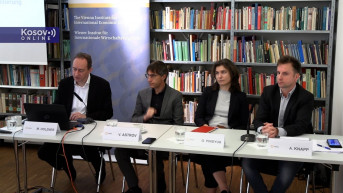
The Vienna Institute for International Economic Studies presented today its autumn forecast for the countries of Central, Eastern and Southeastern Europe, within which the Western Balkans is projected to record economic growth of 2.5 percent for this year, 3.4 percent for the next, and 3.7 percent for 2027.
Director of the Vienna Institute, Mario Holzner, emphasized that despite the difficult international environment and geopolitical risks, the economies of Central, Eastern and Southeastern Europe are demonstrating resilience.
The Institute forecasts Kosovo’s economic growth at 3.9 percent for this year. For next year, a mild decrease to 3.8 percent is expected, but for 2027 the projection rises to 4.1 percent.
As for Serbia, the Institute forecasts a growth of only 2 percent for this year, but an increase to 3.5 percent for the next. The projected growth for 2027 amounts to 4 percent.
Holzner explained that, due to recent developments in Serbia, the forecast for next year has been revised downward and added that it does not include potential risks from possible disruptions in gas and oil supply resulting from the EU’s latest measures.
He added that a decline in foreign direct investment (FDI) is expected in Serbia, and that the country’s growth forecast has already been significantly reduced, considering the pace of growth achieved so far.
Regarding other countries in the region, Albania is projected to record growth of 3.5 percent this year, Bosnia and Herzegovina – 2.2 percent, Montenegro – 3.4 percent, and North Macedonia – 3 percent.
For next year, growth is expected to increase in Albania – to 3.9 percent, and in Bosnia and Herzegovina – to 2.7 percent, while forecasts for Montenegro and North Macedonia remain unchanged.
As for the unemployment rate, Serbia leads the region, with a projected 8.5 percent for this year and 8.3 percent for next year. Kosovo’s unemployment rate is projected at 10.7 percent for this year and 10.6 percent for the next.
Holzner also pointed out that Romania, Slovakia and Hungary are facing high budget deficits, coupled with weakness in German industry, while domestic issues are also affecting the Austrian economy. He noted that the announced increase in defense spending among NATO countries is stimulating economic growth.
The Institute expects that, in the coming years, NATO member states will record an additional growth effect of 0.2 to 0.3 percent, and that countries such as Poland and those in the Baltic region could see even higher figures.
“Eastern European countries will also economically benefit from Europe’s rearmament, as they traditionally possess strong defense industries. This could help them modernize their industrial base and successfully transform toward an innovation-driven growth model,” said Richard Grieveson, Deputy Director of the Institute.



comments