
Joseph: Economic development and trade are no substitute for resolving political issues
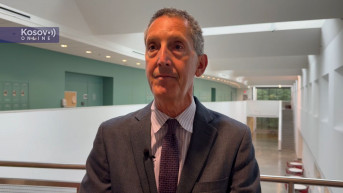
Senior fellow at the Johns Hopkins School of Advanced International Studies Edward Joseph told Kosovo Online that economic development and trade are no substitute for resolving political issues, and that political issues are the main obstacle to economic growth.
He was commenting on the recent statement by Richard Grenell, the US President’s special envoy for special missions, in which Grenell, speaking about relations between Belgrade and Pristina, placed emphasis on economic development.
Joseph said that while Grenell emphasizes economic development, and that it is indeed important for President Donald Trump, it is equally important to understand that economic growth and trade are not a replacement for resolving political questions.
As two clear examples, he cited Ukraine and Russia, and China and Taiwan. Before the February 2022 invasion, Russia was one of Ukraine’s main trading partners, and China is still Taiwan’s top trading partner, yet in both cases, there is no trust.
“We see, therefore, that you can have a high level of trade and a very low level of trust. In the Balkans, that lack of trust and those tensions are a problem for economic development and for foreign investment. So there is no simple solution where you can just say: ‘We can have economic growth and trade and then we don’t have to worry about these difficult political issues,’” Joseph said.
He added that the failure of the Open Balkan initiative, known as “Mini-Schengen” during Trump’s first term and under the Washington Agreement, and later emphasized during President Joseph Biden’s term, is further proof of this.
“What has been achieved under Open Balkan? Almost nothing. Bosniaks, Croats, Kosovo Albanians, and Montenegrins want nothing to do with trade arrangements that leave the largest country, Serbia, in a dominant position. None of them wanted anything to do with it. And the only two countries that did, North Macedonia and Albania, have withdrawn. Prime Minister Mickoski has pulled out of Open Balkan, as has Albanian Prime Minister Rama. So this whole concept that ‘we can trade our way through difficult political issues in the Balkans’ doesn’t work. It hasn’t worked. It is an important component, the EU has a Growth Plan that’s part of this, but even there, we see there is no substitute for resolving difficult political issues,” Joseph concluded.
Commenting on Grenell’s view that the idea of mutual recognition between Serbia and Kosovo is ridiculous, Joseph offered a different perspective.
“Mutual recognition between Serbia and Kosovo cannot be ridiculous. This is not just my opinion. It cannot be ridiculous because President Trump himself, during his first term, wrote to the president of Serbia and the prime minister of Kosovo stating that normalization should be based on mutual recognition. That’s in writing from President Trump himself, and we cannot say that mutual recognition is ridiculous,” Joseph said.
Speaking about whether Richard Grenell’s views reflect the current policy of the Trump administration, Joseph said that a very good indicator is the State Department’s statement on the recent meeting between Serbian Foreign Minister Marko Djuric and US Secretary of State Marco Rubio in Washington.
“In it, the first emphasis is on reducing tensions, including between Kosovo and Serbia and in Bosnia and Herzegovina, and later in that statement Secretary Rubio mentions laying the foundations for economic development and prosperity. But the first emphasis is on reducing tensions. In other words, the political focus, not the economic focus. The economic point is second in Rubio’s remarks,” Joseph stressed.
As a reminder, Grenell recently said that, in his personal opinion, the idea of mutual recognition between Serbia and Kosovo is ridiculous, because young people want jobs, and that the focus should be on economic development as the driver of problem-solving.



0 comments