
Barduani: Under my command, we have not observed any significant changes in the presence or deployment of the Serbian Armed Forces
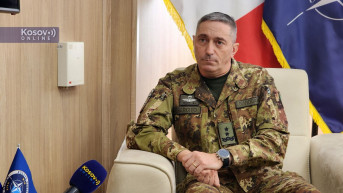
In an extensive interview for Kosovo Online, KFOR Commander Major General Enrico Barduani spoke about the current security situation in Kosovo, KFOR’s role, the EU-facilitated dialogue, the Ibar bridges, the Kosovo Security Force (KSF), and Bayraktar drones.
When asked about the security situation in Kosovo, Major General Barduani stated that it is generally calm but remains fragile:
"The security situation in Kosovo is generally calm, but it remains fragile. This means it is still susceptible to potential escalation due to several unresolved issues, the occasional use of inflammatory rhetoric, unilateral actions, and activities perceived by communities as provocative. As KFOR Commander, my priority is to ensure that KFOR remains well-positioned on the ground to continue providing a safe and secure environment for all people living in Kosovo. At all times and impartially, in accordance with our longstanding UN mandate, based on the well-known UN Security Council Resolution 1244 of 1999. Allow me to emphasize that KFOR is not alone in undertaking these substantial responsibilities. In fact, we continue to work in close coordination with the Kosovo Police and the European Union Rule of Law Mission in Kosovo (EULEX), in their respective roles as security providers," said the KFOR Commander.
How does the lack of progress in the dialogue between Belgrade and Pristina impact the security situation?
"Let me underscore that NATO and KFOR continue to fully support the EU-facilitated dialogue aimed at normalizing relations between Belgrade and Pristina. In this context, we welcomed the appointment of Mr. Peter Sørensen as the new EU Special Representative for the Dialogue, given his extensive knowledge and experience on Western Balkans issues.
I believe the EU-facilitated dialogue is the only viable framework for resolving outstanding issues and achieving outcomes that respect the rights of all communities and produce sustainable solutions. Respect for all communities is key to lasting stability.
To move forward, it is crucial that both Belgrade and Pristina implement the existing agreements and, at the same time, demonstrate flexibility and willingness to make necessary compromises in the interest of all people living in Kosovo and for a more stable Western Balkans.
In this regard, KFOR continues to play its role, maintaining a visible and flexible posture on the ground across Kosovo to prevent any possible escalation. KFOR works tirelessly every day in synergy with all actors of the broader international presence in Kosovo."
We are aware that KSF deployments in the north require KFOR Commander’s prior authorization. Does this also apply to the Bayraktar drones operated by KSF?
"Let me emphasize that, in accordance with the existing arrangements between NATO and Pristina, the Kosovo Security Force may only be deployed in northern Kosovo with the prior consent of the KFOR Commander.
I welcome Kosovo’s continued adherence to this obligation, which is essential for stability and a matter of trust between NATO and Kosovo.
Separately, pursuant to UN Security Council Resolution 1244, the KFOR Commander retains primary authority over Kosovo’s airspace. This means I am authorized to approve or deny any airspace access over Kosovo.
Specifically regarding Bayraktar drones, KFOR has approved a permanent restricted zone in the central-southern part of Kosovo, where KSF may conduct the necessary training for drone operators without interfering with either civilian or KFOR air traffic."
Is there currently a need to increase KFOR troop numbers in Kosovo?
"KFOR, with its current strength of approximately 4,600 troops from 33 countries—NATO Allies and partners—is well-prepared to manage the current situation and continue to effectively fulfill its UN-mandated mission.
Should the security situation on the ground require urgent reinforcement, NATO is fully capable of deploying additional troops from reserve forces and activating the newly established Allied Reaction Forces, which consist of a core of 1,000 troops."
How do you assess statements by Kosovo authorities claiming that their security is at risk due to 70% of Serbian military capacity being positioned near Kosovo? Also, there have been differing interpretations of former U.S. President Trump’s remarks by President Osmani and other senior officials in Pristina. Has the security situation been endangered in recent months?
"Allow me to begin by stating that KFOR maintains a presence in the area and closely monitors the situation.
In particular, as the highest authority for the administrative boundary line, KFOR continuously conducts activities along it, including patrols, observation posts, reconnaissance, and monitoring.
Under my command, we have not observed any significant changes in the presence or deployment of Serbian armed forces.
Furthermore, under existing procedures stemming from the Military-Technical Agreement signed by NATO and the Government of Serbia in 1999, Serbian forces are required to regularly inform KFOR about troop deployments and operational activities near the administrative boundary line, formerly known as the Ground Safety Zone.
As KFOR Commander, I can say that cooperation has been stable and ongoing. I maintain regular communication with all counterparts, including representatives of Kosovo’s security institutions and the Chief of the General Staff of the Serbian Armed Forces—General Milan Mojsilovic. This helps preserve and enhance mutual situational awareness."
How would you assess KFOR’s cooperation with the Serbian community in Kosovo?
"In line with our UN mandate, KFOR must regularly engage with all communities living in Kosovo, including the Serbian community—whether through our daily patrols, the activities of our Liaison and Monitoring Teams, or direct engagement with community leaders.
We value the trust placed in us by the Kosovo Serb community, which reflects recognition of our daily efforts.
As I have already mentioned, and considering the stabilizing role that KFOR continues to play in supporting regional stability, I also maintain regular contact with the Chief of the Serbian Armed Forces.
This is critically important for ensuring timely information exchange and avoiding misunderstandings—especially during times of heightened tension or crisis.
Let me share with you my personal conviction, based on my previous experiences in Kosovo—not as KFOR Commander, but personally. I believe that the deepest desire of the people living in Kosovo, regardless of their ethnicity, religious belief, or political views, is to live in peace and continue with their lives."
At present, KFOR provides security for the Visoki Decani Monastery and the main bridge over the Ibar River. Is it time for the bridge to be reopened?
"KFOR’s position on the Ibar Bridge in Mitrovica is clear and consistent. Any decision regarding the reopening of the bridge must be made at the political level, with the involvement of both parties and in timely and effective coordination with the international community.
In this respect, NATO Secretary General Mark Rutte reiterated this position during his visit here last March and in his meetings with President Osmani and Prime Minister Kurti.
That said, KFOR maintains a constant presence in the Mitrovica area—not only a permanent presence at the main Ibar Bridge, but also through extensive patrol operations throughout the city—and continues its activities to contribute to a safe and secure environment for all those living in the area, in accordance with our longstanding UN mandate.

0 comments