
Doyle on the processes in The Hague, the trial of Thaci and others: Witness protection of highest priority for the court
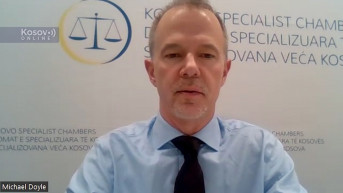
So far, over 100 witnesses have safely testified in trials before the KSC. Witness protection is of the utmost priority for the court, Michael Doyle, spokesperson for the Kosovo Specialist Chambers in The Hague, says in an interview for Kosovo Online.
Doyle, among other things, points out that it often requires immense courage and a sense of public duty for someone to come forward and agree to tell their story, thereby contributing to justice and the rule of law.
"So far, over 100 witnesses have testified safely in the trials before the KSC. Witness protection is of the highest priority to the court. A specialized unit ensures the safety and well-being of witnesses before, during, and after the trials. This includes providing psychological support to witnesses when needed. Judges can also order a variety of protective measures, such as assigning pseudonyms and using voice or face distortion. Witnesses can also testify via video link. The role of witnesses is incredibly important to fair, impartial, and independent proceedings. Often, it takes enormous courage and a sense of public duty for someone to come forward and agree to tell their story, and in so doing, contribute to justice and the rule of law. The fact that witness testimonies are so important for fair and impartial trials was one of the reasons why it was agreed in the Exchange of Letters between Kosovo and the EU to establish the KSC and why the court has a seat outside of Kosovo. This was also reflected in the law adopted by the Kosovo Assembly, which gives the court the authority to try cases against the administration of justice. As the presiding Judge put it in the Gucati and Haradinaj judgment, when speaking about witnesses: 'their protection from intimidation and harm lies at the very foundation of any system of criminal justice, be it domestic or international. Without witnesses, there can be no justice for victims or for society at large,'" Doyle says.
Was it necessary to ban the communications of Thaci and others because of the intimidation of witnesses, and how long will those measures remain in force?
It is important to recall the contents of the decision by the Trial Panel in this case in order to be clear about the facts and to correct some misunderstandings. First, the decision relates to three of the eleven detainees in The Hague, namely Hashim Thaci, Kadri Veseli, and Rexhep Selimi. Second, communications and visits are not banned, as has been reported by some media. Rather, the Trial Panel ordered that a system be put in place whereby the KSC Registrar approves all non-privileged visits and communications with Hashim Thaci, Kadri Veseli, and Rexhep Selimi, in order to identify and exclude from visits and communications those individuals who could pose a threat to the integrity of proceedings. In its decision, the Trial Panel found that the three accused appear to have disclosed confidential information to visitors received in the context of the proceedings or elicited during the testimony of protected witnesses. Without making findings about whether the conduct of such visits constitutes a criminal offence, the Judges noted a substantial risk that the three accused will disclose privileged information to unauthorised third parties unless adequate measures are put in place. The Judges also ordered changes to the conditions of visits, for example, the three accused cannot meet with more than one visitor at a time, with the exception of spouses and children, and visits and communications are more actively monitored. The Trial Panel will review these measures every six months and the Registrar will report to the Trial Panel on the implementation of the decision every two months.
When at the earliest can we expect the judgment in the case against Thaci, Veseli, Selimi, and Krasniqi, having in mind that we heard commentary claiming that the trial could last even longer than five years?
Due to the complexity of the case, it is currently not possible to estimate the overall duration of the trial. The Prosecution has indicated that it intends to finish its case around April 2025. After the closure of the Prosecution case, the Defence teams may file motions seeking the dismissal of all or some of the charges. Pending any eventual decisions on this, the Defence teams would then have the chance to make their cases and call witnesses. At this time, we do not have an estimate of how much time the Defence teams will require for their respective cases.
What do you think about the incident in Pristina during the last visit of President Trendafilova when it came to physical conflict between the Kosovo police and the demonstrators?
I would not comment on protests or other political developments. The President was visiting Kosovo in November to communicate with the public about the work of the Kosovo Specialist Chambers, to answer people’s questions, and to listen to their views. The court is located in the Netherlands and follows its own specific legal framework that differs in some ways from the legal framework of courts that hold proceedings in Kosovo. Because of these differences and because the trials deal with crimes allegedly committed or commenced in Kosovo, people naturally have questions, and sometimes concerns. One example of a difference is that the judges of the court are citizens of EU member states, as well as Switzerland, Norway, and the United States, and the trials are conducted in line with the court’s own rules of procedure and evidence. Another difference is that the Kosovo Specialist Chambers has its own dedicated witness protection and support unit and the court has its own system for victims to participate in the proceedings. While she was in Kosovo, the President had a two-hour meeting with journalists and civil society, and she gave a lecture and had a discussion with law students. Among other topics discussed, President Trendafilova explained how the KSC’s legal framework guarantees the rights of the accused, the protection of witnesses, and the dignity of victims. President Trendafilova visited Kosovo, and will continue to do so, as part of the KSC’s continuous efforts to transparently and accurately inform the public about how the court operates and about what is happening in the courtroom. While the KSC differs in some ways from other courts, it shares the same fundamental mission: to deliver justice and accountability, and to uphold the rule of law.
How do you judge the cooperation with EULEX and the Kosovo Police?
I am not in a position to assess this cooperation because I represent the court, while it is the Specialist Prosecutor’s Office that conducts investigations and carries out arrests. Under the law that was adopted by the Kosovo Assembly, the Specialist Prosecutor’s Office is a completely separate institution from the court. Police within the Specialist Prosecutor’s Office have the authority and responsibility to exercise powers given to Kosovo police under Kosovo law, and a number of arrests have been carried out by the Specialist Prosecutor’s Office with the support of the Kosovo Police and the European Union Rule of Law Mission in Kosovo.
How do you comment on the transfer of Haxhi Shala as well as on the latest actions in Kosovo? Were the actions carried out in coordination with the Kosovo Police and EULEX?
The Specialist Prosecutor’s Office said in its press release that EULEX provided operational and logistic support in line with its mandate and in accordance with the Kosovo legislation and that the Kosovo Police also provided operational support. As I said before I cannot comment further on arrests, as these are carried out by the Specialist Prosecutor’s Office, and I represent the Specialist Chambers. Speaking on behalf of the court, I can however give you an update on the status of the case. The indictment, which was confirmed by the Pre-Trial Judge, alleges that in April of this year, Mr Shala coordinated with a group of individuals, including Sabit Januzi and Ismet Bahtijari, meetings with a witness in order to induce the witness to withdraw evidence or refrain from providing evidence in official proceedings before the Kosovo Specialist Chambers, including by use of serious threat and the promise of a benefit. Mr Shala was transferred to the Detention Facilities of the Kosovo Specialist Chambers in The Hague on 12 December, and his initial appearance before the Pre-Trial Judge took place on 13 December. Another hearing to prepare the case for trial was held last Friday, 15 December, when Mr Shala pleaded not guilty to all of the charges. The Prosecution has asked to join this case with the ongoing case against Sabit Januzi and Ismet Bahtijari, who were arrested in October.


0 comments