
Bujanovac "Kontraendorfin"
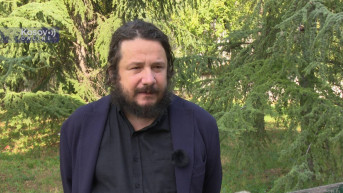
Writing for Kosovo Online: Muharem Bazdulj
A few years ago, a significant portion of the local public, mostly those who neither follow literature nor read books, was scandalized by the "treatment" of the poet Desanka Maksimovic in Basara's novel "Kontraendorfin".
Unaware of the laws of literary fiction and the fact that a novelist's variation on a very old urban anecdote does not necessarily represent the author's civic stance, they clamored about an "insult to honor". These days, Desanka's name, however, has reappeared in newspaper articles in the "current events" section. Moreover, our portal has published news that the Municipal Assembly of Bujanovac needs to decide whether to adopt the decision of the School Board from the Bujanovac village of Biljaca to change the name of the local elementary school from the current "Desanka Maksimovic" to "Ismail Kadare".
According to announcements, the majority for confirming such a decision certainly exists. However, the final word is not here in the Municipal Assembly but in the Ministry of Education of the Republic of Serbia. The competent minister, Slavica Djukic-Dejanovic, has already stated that it is "unacceptable for a school named after Desanka Maksimovic to change its name, wherever it is located. Removing the name of this great poet means forgetting her anti-fascist messages from 'Bloody Fairy Tale', which were sent for the benefit of all people and all children".
The most bizarre thing in this whole initiative is the suggestion to name the school after a living person. Truth be told, Kadare is 87 years old but still active and vital. As much as it has been said for decades that he is the most important Albanian writer – even artist – of all time, there is something inappropriate about naming schools after living individuals. Someone more morbid might say that it invokes some kind of ill fate. Some acquaintances of mine from Vrbas take pride, with some justification, in the fact that in that town, for the first time, a public institution was named after Danilo Kis. It happened only a few months after his death. Such an honor during one's lifetime is indeed unusual. (Truth be told, the prominent German writer Hans Magnus Enzensberger included "99 literary vignettes from the 20th century" in his wonderful book "Survival Artists"; 98 vignettes are dedicated to dead writers: from Gide to Andric and from Broch to Skvorecky, with only one dedicated to a living writer: Ismail Kadare; however, I doubt that the people in Bujanovac were considering this Enzensberger precedent).
This "case" can still be an occasion to point out that in Serbia, there is considerable consistency in the idea of naming schools (also) after individuals from their national and cultural history in places where a significant number of members of a national minority reside. In Bujanovac, there are already schools named "Naim Frasheri," "Ali Bektashi," or "Muarem Kadriu". In Tutin, there is the "Ibrahim Bakiq" school, and in Backa Topola, there is the "Caki Llajosh" school. Of course, there are also schools named after key figures in Serbian culture, such as in all three of the mentioned municipalities where there is an elementary school named after Vuk Karadzic. There is no controversy over school names given to the Serbs who have contributed to global science, like Nikola Tesla (and such an example exists in Backa Topola). There are also other well-chosen names. One school in Tutin is named "Mesa Selimovic". Although Selimovic considered himself a Serbian writer, Bosniaks regularly include him in their representative editions. Despite or perhaps because of this, interest in the work of this writer serves as a link between the cultures of Serbs and Bosniaks. Hence, such a name is not controversial and is actually well-accepted both in the local community and from a broader perspective.
In this sense, perhaps Minister Djukic-Dejanovic's negative reaction is hasty, and perhaps the initiative should not be completely rejected overnight. If it is a school attended by Albanian children and if the School Board and parents of the children are bothered by such a name, this should not be ignored. Desanka Maksimovic is so present in Serbian culture and memory that the name of one school practically changes nothing. However, instead of the name of a living person, perhaps a name could be found that serves as a "link" between the culture of Serbs and Albanians. Two individuals immediately come to mind: Bekim Fehmiu (1936 – 2010), the legendary actor from "I Even Met Happy Gypsies" and "Special Education", and Petrit Imami (1945 – 2019), a famous Professor at the Faculty of Dramatic Arts and the author of the seminal book "Serbs and Albanians through the Centuries".
Both of them were Albanians, both realized themselves as individuals and artists in Belgrade, both left a deep mark on Serbian culture, and both valued good relations between Albanians and Serbs. They deserve to have something named after them. The elementary school in the Bujanovac village of Biljaca would not be a bad start.
0 comments