
Damnjanovic: Kosovo has become the cheapest Serbian word
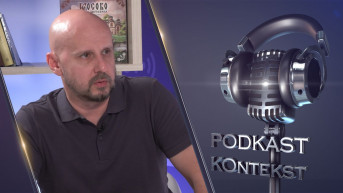
It is easy to write ‘Kosovo is Serbia’ or ‘No surrender’ in Belgrade. You need to go down there, because the perception immediately changes. There is less of those big words when you see how people live and what brings them joy. It is easiest to talk about Kosovo and pretend to know what should be done there. That is why we have had situations where some people show up before Vidovdan, create chaos with chest-thumping, then go back home, and the ordinary people in Kosovo are left to suffer, actor Igor Damnjanovic, a member of the Serbian Drama Ensemble of the National Theater in Pristina with a permanent stage in Gracanica, said in the KOntext podcast.
“Insecurity in Kosovo is an everyday reality, and we are used to it. The enclaves south of the Ibar live in a state of temporariness, and now so does the north. That sense of temporariness makes everything temporary, relationships, friendships, jobs, and that is not good for a normal life,” Damnjanovic said.
The National Theater in Pristina, of which he has been a member for decades, was expelled from its home building in June 1999. The archives and costume sets remained inside, while the actors were forced out. They regrouped six years later. In the meantime, the Albanian drama troupe was established as the National Theater of Kosovo.
“By the end of 2004, the theater was on life support. Then Nenad Todorovic, with help from the Serbian Government, managed to gather a few of us old members to start a new chapter. At first, we worked from a private apartment in Leposavic, and few of us believed it would last this long. The task then, and now, is to preserve Serbian culture in Kosovo wherever our people live,” the podcast guest said.
He and his colleagues have proven countless times that a building is not necessary for theater, performing in Serbian communities on meadows, in backyards, church courtyards, and private homes. Sometimes, there was only one person in the audience.
“In the beginning, it was frightening and intense, but that time brought us back to why theater exists. To perform a play, you only need actors doing something and an audience watching. That is true, primal theater. Everything else is just an accessory. The energy we share with the audience, and their emotional response, won’t let us quit. How can you give up on a mission when someone tells you after a show that you made their life better? That becomes a life mission,” Damnjanovic reflected.
He notes that on occasion, a few Albanian colleagues attended performances in Gracanica, but he personally has not seen any plays in the theater in Pristina, nor would he perform there.
“I have nothing to perform in Pristina, even though we were invited to. Who would I perform for and how? Just to satisfy some political formality of peace and reconciliation? I’m supposed to accept performing in the very place I was driven out of, for an audience that isn’t mine,” he emphasized.
He believes theater cannot be apolitical and that its role is to present reality to the audience and help them understand the world they live in. He says the National Theater in Pristina, now with a temporary seat in Kosovska Mitrovica and a permanent stage at the Gracanica Cultural Center, maintains a serious level of production, through its budget, choice of directors, and repertoire. Although he performs on stages in Belgrade and across Serbia, the audience in Kosovo is dearest to him.
“I feel the difference. And that reaction from our audience in Kosovo means much more to me than any reaction in the rest of Serbia. It is our duty to preserve culture and language down there,” the actor concluded.
In the video segment of the interview, you can hear about the moment when Damnjanovic realized he could understand the Albanian language through a specific film role, along with other details from his conversation with Dragana Biberovic.



0 comments