
Draskovic: Kosovo is in Serbia's hands as long as it wants to go to the West

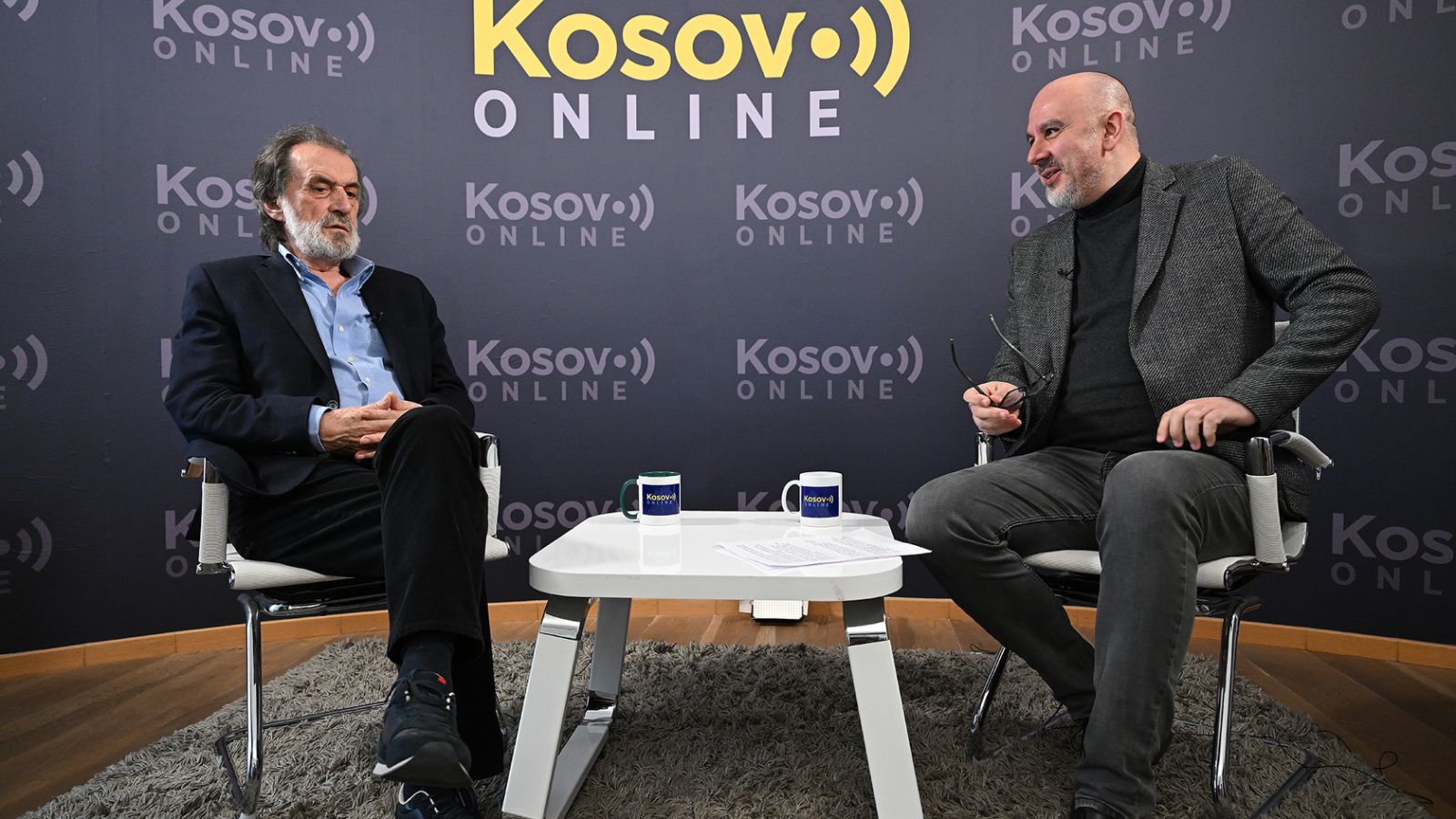
There are some things that not even a hundred people like Kurti can influence. Our goal must be for any border between Serbia and Kosovo to disappear, an administrative line, call it whatever you want, so that you can simply drive from Belgrade, as in the days of Yugoslavia, and go freely wherever you want in Kosovo. If Albanians want to join the European Union, and we also want to join the European Union, these are the rules. This was stated in a conversation for the podcast "KOntekst" by one of the most prominent Serbian writers and politicians, Vuk Draskovic, whose novel "Russian Consul" from 1988 was recently adapted into a film that is currently filling domestic cinema halls.
Draskovic reminisced about the time when he wrote "Russian Consul," which, despite 35 years having passed, bears similarities in drama to the current situation in Kosovo.
"At the time I was writing 'Russian Consul,' I was deeply involved in assisting Serbs coming to Belgrade from Kosovo, then to Pionirski Park, where they demonstrated and protested. The famous Martinovic affair was happening at that time. Overall, they came to complain about pressures and displacements, and these complaints were mostly directed at the Pristina leadership, which was then jointly ruled by Serbian Stalinists and Albanian Stalinists, Maoists. And when 'Russian Consul' appeared, I was anathematized. 'Russian Consul' was not accepted by the Serbian national elite. Why? Because in 'Russian Consul,' there is no deification of Milosevic. I don't know, maybe my characters were smarter than me," Draskovic says.
He particularly emphasizes the catastrophic consequences of the rule of Serbian communists.
"On St. Sava Day in 1949, the Zadusnica church, where several thousand Serbian children were dying of hunger and cold, when the Serbian army in the Great War, through Kosovo and Albania, retreated together with civilians and columns of the weak, was mined. The order to mine that church, with the explanation that it was to break the Greater Serbian hegemony, was issued by the Serbs who ruled Kosovo and Metohija at the time. They, those State Security Administration agents, those Serbian Stalinists in Kosovo, ordered that public toilets be built from the bricks of that church in Djakovica. In my novel 'Russian Consul,' there are scenes, that've been filmed, whether it will become a series, I hope it will, remains to be seen, where the Serbs in Djakovica in the 1970s cross themselves and light candles in front of the public toilets. Because those toilets are the remnants of their church. Those toilets are their church," Draskovic points out.
He particularly emphasized the wisdom necessary for the Serbs in Kosovo, in a situation where they had been under immense pressure for a long time.
"It seems to me that today the most important thing for the Serbs in Kosovo is to say, 'God, give us the wisdom and strength to change what we can change, to endure what we cannot change, and the intelligence to distinguish between the two. During Yugoslavia, Albanians were a national minority. In Kosovo, they were a national minority within Serbia. They are a politically very wise people. And I remember that they often emphasized a slogan that sounded good and was well-received in the ears of the democratic world. The position of a minority, of every minority, in every state, is a reflection of the majority. Now, due to unfortunate circumstances, they are the majority in Kosovo, and Serbs are the minority. And I think that Mr. Kurti and all Albanian leaders should remember that slogan and tell themselves that the position of the Serbs in Kosovo is their mirror. If Serbs are discriminated against, if they don't have the rights they must have, then the reflection in the mirror is rough, nothing, inhuman. In the history of the Albanians, much importance was attached to morality. I have studied the history of those people well. Of course, like in any nation, there were all kinds, but there were many bright moments in Serbian-Albanian relations. Both sides have somehow covered it up with their own fault," Draskovic points out.
He believes that relations between Serbs and Albanians could significantly improve.
"I talked for three hours with Shimon Peres in Jerusalem, he passed away a few years ago, and we talked extensively about Albanians, Serbs, Palestinians, Jews, and he told me - our conflict with the Palestinians will never end because we are from the same father. It's a problem of small differences and that problem is unsolvable. Just like our problem with, say, the Croats is unsolvable. But he said, be happy that you don't have that problem of small differences, familial similarities, with Albanians. And when things are brought to European standards, when everyone is in the European Union, relations between Serbs and Albanians in Kosovo will be better than between Kosovo Albanians and Albanian Albanians. Because they will be burdened by the problem of small differences, and we and the Albanians will not be burdened by that problem. You can feel this in the movie 'The Russian Consul'," Draskovic emphasized.
He believes that regarding Kosovo, concerning the Serbs, things are "not lost at all and are not hopeless."
"Kosovo is in Serbia's hands as long as the state of Serbia wants to go West, as long as the state of Serbia wants to join the European Union, and indeed, the NATO alliance. You cannot join the European Union or NATO if there is a territorial problem. Europe insists on not getting into quarrels, and on solving that problem so that both Kosovo and Serbia can enter the European Union. We have something that is guaranteed to us. What is guaranteed to the Serbs in Kosovo, we must not let it slip away. I mean everything guaranteed by the Ahtisaari document. I was present at those negotiations, and discussions, they were pressured. They had to make huge concessions; the Americans especially insisted on that during the Vienna negotiations. They were forbidden to have symbols of Albania, the coat of arms, and the flag, so they invented a flag. They had to accept that the Serbian language would be equal to the Albanian language throughout the territory of Kosovo. I think we have a great chance to fight for Ahtisaari’s plan and also Serbia is economically superior, and the Albanians have been living with us for almost a whole century. Economically, they are connected to Serbia in every aspect. With economic presence and cultural presence, in Kosovo, when there is no border, when European laws apply, the Serbs in Kosovo would soon feel at home. They wouldn't feel like foreigners in the land where they were born, where all their relatives were born," Draskovic said, who was in charge of foreign affairs in the federal government during the bombing of the Federal Republic of Yugoslavia in 1999.
To learn more about what Vuk Draskovic said about the events of that period and other current political topics in his conversation with the editor of KOntekst, Milos Garic, you can watch the entire episode in the attached video.

0 comments