
The Era of Efraim Zuroff
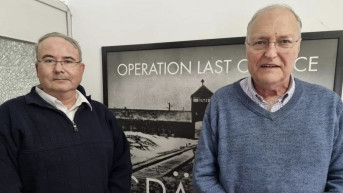
The esteemed Jerusalem-based Menahem Begin Heritage Center concluded this year’s Israeli Holocaust and Heroism Remembrance Day with a moving event dedicated to the last Nazi hunter, Dr. Efraim Zuroff. Four decades of relentless pursuit of justice, while leading the Simon Wiesenthal Center’s national branch, bring a historic era to a close.
Dr. Zuroff’s thorough religious and secular education laid the foundations for his life mission—an undertaking of a unique aspect and appearance in human history, as well as the capacity to actively address the implications of the Holocaust. Born in 1948, alongside the State of Israel and three years after the end of World War II and the Holocaust, he obtained his academic education at Yeshiva University in New York and earned his doctorate at the Hebrew University of Jerusalem after repatriating to the Jewish state in 1970. His doctoral thesis focused on the Rescue Committee of American Orthodox Rabbis, founded in the fateful year of 1939. Zuroff had the privilege of being a student of the world-renowned expert Professor Yehuda Bauer, often highlighting, alongside Bauer’s scholarly excellence, his pedagogical virtuosity.
From Nazi war criminals hiding across South America and the Middle East, through revisiting the post-Soviet period, to examining the practices of Anglo-Saxon legislative bodies regarding refugees with false identities and fabricated narratives, Zuroff faced immense challenges. He exposed himself not only to unpleasantness but also to real danger, particularly in Latin America. He never compromised his principles, even when foreign policy considerations or pressures might have suggested otherwise, even at the cost of being marginalized. However, the consequences of selectively leaving history behind and focusing solely on the future have led to the distortion and denial of the Holocaust—fueled by a lack of education and the devaluation of the humanities—resulting in the reassignment of crimes to external actors, while domestic collaborators were not only rehabilitated but even celebrated as fighters against occupation in their respective countries. Just this week, outrage and sharp condemnations followed the decision of the Latvian Prosecutor’s Office regarding Herberts Cukurs, known as the "Butcher of Riga," including reactions from Yad Vashem itself.
Dr. Zuroff’s unwavering commitment to historical truth naturally led him to reject any division of victims by national or religious affiliation. During the crucial years of his engagement, when Nazi war criminals and their collaborators were still alive and active, much of the Serbian people remained absorbed in the idea of Yugoslavism, avoiding the delicate issues from World War II that might have affected interethnic relations.
In that period, the prevailing narrative labeled victims broadly as victims of fascism and their domestic collaborators as traitors, without specifying who the victims were, on what grounds, or who persecuted them. Memorials stripped of spiritual content failed to name perpetrators or the basis of persecution. Memories remain vivid of the American Jewish organizations' efforts to revive the extradition proceedings against Andrija Artukovic to Yugoslavia.
Dr. Zuroff’s historic achievement was his contribution to locating, bringing to trial, and finally securing the extradition and prosecution of Dinko Sakic, one of the commanders of the Jasenovac concentration camp. Through this, Efraim Zuroff etched himself permanently into the collective memory of the Serbian people. It was Dr. Zuroff who proactively and authoritatively contributed to internationalizing the understanding of the manual brutality of the Jasenovac camp system, which remains insufficiently known to the global public outside of specialized academic circles.
As the decades-long avoidance—and even disinterest—of part of the Serbian national body toward the darkest chapters of its history, particularly concerning events throughout the Independent State of Croatia, gave way overnight to a field of mass interest—and sometimes opportunistic exploitation by those lacking competence, seeking personal promotion and thereby relativizing the sacredness of the new martyrs—Efraim Zuroff served as a corrector. He helped Serbs protect themselves from themselves. From a crystal-clear situation in which the Serbian people were among the greatest sufferers of World War II, the narrative slid into bargaining and polemic, eagerly awaited by those systematically working to relativize the massacres at Jadovno, Prebilovci, Stari Brod, and other tragic and unfinished pages of mass suffering under the Independent State of Croatia.
Despite his professional approach, which leaves no room for sentimentality or emotional interference in multidisciplinary, rational severity, Efraim Zuroff would speak of Ponary, Babyn Yar, or the Old Fairgrounds in Belgrade with a tear in his eye and a trembling voice. He lived entirely for the cause of bringing Nazi criminals to justice and, with the passage of time and historical shifts, for fighting Holocaust distortion. Thus, unfinished projects, such as that of Sándor Képíró, left him deeply saddened, and the renewed manipulative and malicious activity around the house of Xhafer Deva in Kosovska Mitrovica, where he had earlier acted effectively on his own initiative, caused him profound concern. Hence the perseverance of Dr. Zuroff in the "Last Chance" campaign.
Remembering Zeni Lebl, who uniquely contributed to the historiography of Jews from the former Yugoslavia and herself survived the Holocaust, standing like a granite rock against all attempts at historical revision—where nothing can compensate for or comfort the hopelessness of the Holocaust, that unique crime in human history—Efraim Zuroff also acts not just with his mind but with his heart. Following the question posed by the great Simon Wiesenthal—"What will we say to the victims of the Holocaust when we join them in the afterlife?"—Dr. Zuroff did everything, absolutely everything, and more than within his power, fully aware of his historical responsibility to future generations.
From the commemorative booklet printed for the event at the Menahem Begin Center, among the personal tributes, Efraim Zuroff highlighted two during the evening: one from the President of the Republic of Serbia, Aleksandar Vucic, and another from Professor Michael Berenbaum, Director of the Sigi Ziering Institute at the American Jewish University. In 2017, Dr. Zuroff was awarded the Gold Medal for Exceptional Merits and Selfless Dedication in Defending the Truth about the Suffering of Jews, Serbs, and Other Peoples during World War II.
After thirty-nine years of fruitful work at the Simon Wiesenthal Center, Dr. Zuroff leaves behind, among other things, precious archival material, more than five hundred thematic articles, and annual reports of the Center. An era comes to a close, but Efraim Zuroff’s fruitful work continues, along with the legacy of an uncompromising fight against Holocaust denial and distortion, as well as the genocides that unfolded in parallel during that tragic epoch.
Written by Aleksandar Nikolic, Honorary Consul of Serbia in Israel


0 comments