
FEUILLETON Henry Kissinger, America, and Kosovo (6): The unsustainability of Bosnia and the Dayton Agreement
Writing for Kosovo Online: Dragan Bisenic
Kissinger explained that he had had no intention of entering the Kosovo debate until Clinton announced that he was willing to approve the deployment of 4,000 soldiers for a peace mission in Kosovo. This deeply disturbed him at the time because he believed that this issue and the region should be left to European nations.
Kissinger believed that Europeans lacked self-confidence, but not the ability to handle the situation in the Balkans.
"This is very uncharacteristic of me because I am a strong advocate of NATO. But it seemed to me that the only reason for Americans to get involved there was not a necessity because Europeans had enough power to deal with the local opposition, but because of European self-doubt – their own determination to stay the course, and therefore, they wanted us to provide the backbone. I thought this was not a good basis to get into something that Europeans could handle with American logistical support", Kissinger reasoned. He believed that there must be a "division of responsibility within NATO, where Europeans should take more responsibility. He did not believe that US ground forces should be deployed where European ground forces could do the job, with Americans providing logistical and other support.
In the end, he raised the question, can the NATO Council be organized to reflect this reality?
Rambouillet as a tactical tool of the KLA
Kissinger argued that the intentions of the KLA were not to achieve autonomy but independence and that it would not surrender weapons to NATO forces.
"As for the KLA, its goal is independence, not autonomy. It agreed to Rambouillet as a tactical means to use NATO air power against the hated Serbs. It is even less likely that the KLA will accept autonomy under Serbian rule now that Serbia has been so weakened by the NATO air operation. The KLA will not hand over its weapons to NATO forces. And NATO forces will not have domestic support if they fight the KLA to impose disarmament. Nor will the KLA silently accept Serbian forces controlling its borders. The fulfillment of the envisaged role of Serbian police and military forces in the proposed agreement is both unclear and almost impossible to implement", Kissinger believed.
The ironic outcome of the Rambouillet Agreement, on behalf of which NATO air operations are conducted, is that NATO peace forces will replace the Serbs as obstacles to the national aspirations of the Albanians – especially if Serbia is too weak to provide resistance. Moreover, as Kosovo moves towards independence, pressures on Macedonia, which consists of a third Albanian population, will increase. Why shouldn't they be given the same self-determination as their brothers in Serbia? This will risk expanding conflict as Bulgaria claims rights over its ethnic nationals in Macedonia, constituting at least a third of the population, and Greece sees an opportunity to diminish or eliminate a state whose very name it has rejected.
Since he believed that the administration needed to redefine its goals, and given that the military operation had already begun, Kissinger argued that NATO could not survive without achieving its objectives. He did not believe in the realistic possibility of fulfilling the conditions of the Rambouillet Agreement and proposed that it be "deprived of esoteric components". The conditions for ending the air war should then be an immediate ceasefire, the withdrawal of Serbian forces as envisaged after the start of negotiations in Rambouillet, and the immediate commencement of negotiations on the autonomy of Kosovo.
After the military operation, Kissinger believed that a new situation and reality on the ground would emerge in which NATO would become the most important force in Kosovo. To fulfill this role, NATO could not resist Albanian demands for independence. "These negotiations are likely to be protracted and acrimonious. But, at their conclusion, Kosovo's independence in some form is inevitable unless NATO forces it with the kind of Serbian sovereignty the President promised – a course that neither the alliance nor the American public will support", Kissinger concluded.
If Milosevic rejects a ceasefire on these terms, there will be no alternative but to continue and intensify the war, even if it requires deploying NATO ground forces – a solution I have vehemently rejected so far but one that will have to be considered to maintain NATO's credibility. Regardless of the outcome, it will be necessary to station some NATO ground forces in Macedonia or Kosovo, not as peacekeeping forces but to prevent the spread of conflict in the Balkans. I have consistently warned of such an outcome. However, due to hesitation and confusion, NATO now has few choices if it wants to avoid a larger war.
At the Senate hearing held on April 22, 1999, Kissinger continued to elaborate on the historical background of the Balkan conflicts, stating that he had studied various Balkan conflicts from the mid-19th century through various world wars and their exceptional complexity. In response to the chairman, Senator Warner, who mentioned that they had begun in 1389 and that it had been a "historical battle", Kissinger replied that he had not gone that far but had studied everything that had happened in the last century.
"The fact is that the peoples in these areas, who have been overwhelmed by conquerors many times, are weak, conciliatory, or exterminated, converted, or gone. Those who remained emphasized their ethnic distinctiveness and rallied around religion to the extent that when we use American principles of ethnic coexistence, it is almost incomprehensible. The truth is that they sometimes lived together quite peacefully, in Sarajevo and elsewhere, as long as there was some external force on them. What they obviously cannot tolerate is the domination of one group by another", Kissinger said.
Kosovo's independence undermines Bosnia and Herzegovina
Because of this, he said he was "very concerned" or "reluctantly wants to see America adjudicate every conceivable conflict that might arise there". An additional concern was created by the future necessity of America's constant presence, as "the passions of the population will exceed our tolerance and understanding, and we will be drawn into managing all these conflicts indefinitely".
Considering all this, Kissinger wanted a "political solution on a broader basis", in which Americans do not have to "bear all the responsibility for keeping various passions under control". This solution should be "broader than NATO and broader than Kosovo". Therefore, he pointed out to the senators, "Just look at Macedonia, the Albanians. Look at the reaction to refugees. For them, this is a life-and-death issue not to increase the number of Albanians. Bulgarians - the larger part of the Slavs in Macedonia speak Bulgarian. There are the Serbs, there are the Greeks. The Greeks don't even recognize the name 'Macedonia'. So when that explodes, what are we going to do?"
He, therefore, proposed some "comprehensive solution" where Kosovo could get "something like independence, autonomy, something similar, and it would be an international matter" because that is the "only direction in which we can go, now, after the bombing".
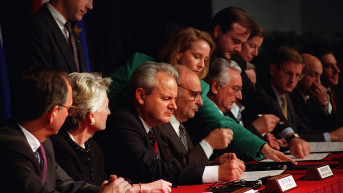
Essentially, if Kosovo's independence is accepted and recognized, the foundations of Bosnia and Herzegovina's existence are undermined. Such a solution inevitably calls into question the survival of the Dayton Agreement. "Honestly, I never thought the Dayton Agreement was a significant contribution to ending the war. I think the political attempt to bring these three ethnic groups together into a multi-ethnic state will sooner or later explode and drag us into all sorts of political maneuvers, like when we try to influence elections in the Serbian part of Bosnia. Therefore, I would prefer a Balkan solution where different ethnic groups are separated in Bosnia, not brought together. Whether you agree with me or not on this issue, I would like some international conference to address these numerous issues", Kissinger suggested.
Continuation tomorrow: A new Berlin Congress for the Balkans


0 comments