
FEUILLETON Rambouillet - ultimatum for the bombing (17): Milosevic and Holbrooke - for the last time
Writing for Kosovo Online: Dragan Bisenic
Nikola Sainovic confirms that the Serbian delegation in Rambouillet was fully aware of the risk.
"Did we refuse to surrender Kosovo in the face of that risk - yes. The only question that remains is whether I, representing the government, have the right to surrender a part of the country under threat and to accept the loss, the ultimate loss of sovereignty. And what happened with the Kumanovo Agreement, which is also an agreement related to the United Nations? It is sought In Rambouillet, meaning the agreement is with NATO, not with the UN. That's the difference," Sainovic explains.
It remains a secret how Milosevic accepted the reporting from the Rambouillet delegation. Nikola Sainovic did not have a direct answer to this question because "we were constantly in contact, we installed a desk in the Ministry of Foreign Affairs, encrypted telegraph, so Belgrade was constantly informed about what was happening. At the time of the break in negotiations, we made a strategy, since we already had a proposed document, to decide what to propose as an amendment to the document in the second phase of Rambouillet. And that was the common stance of the state leadership. When we came to continue in Paris, it was said - there were absolutely no changes at all! Milosevic knew what was coming, as soon as it was refused to even discuss any text. It was clear what was coming".
Apart from the text they offered? "Yes, because in the continuation, when we came to Paris, they said - now we are discussing the implementation of the agreement from Rambouillet. We say, wait, in Rambouillet, no agreement was adopted because even the Albanians did not adopt it. What are we talking about? The answer was - you are very uncooperative," Sainovic testifies.
Even the advisor to the Albanian side in Rambouillet, Professor Marc Weller, concluded that the conference in Rambouillet had represented a significant departure from the norm in international mediation. The presence of parties at the negotiations was secured by the threat of the use of force by NATO. Acceptance of a temporary political solution for Kosovo was to be achieved, if necessary, by threat or use of force. The implementation of the agreement was to be ensured by the presence of 28,000 strong NATO-led forces, in addition to a significant OSCE contingent.
Acceptance of this presence was also supposed to be obtained by the threat of the use of force, if necessary. At the time of the conference, there was no explicit mandate from the United Nations Security Council for the threat or use of force against the parties. Instead, NATO had to rely on the justification of violent humanitarian action in general international law to defend its position.
However, Weller assessed that the Rambouillet model could represent "a further step in the development of innovative mechanisms for conflict resolution regarding self-determination", overlooking that there was nothing new in the mechanism itself, as ultimatums have long been known, and its connection with the self-determination of peoples today would most likely be wished to be forgotten.
The head of the FR Yugoslavia delegation, Professor Ratko Markovic, assessed that the "agreement" had been a phase in the implementation of the decision made earlier to separate Kosovo from Serbia through aggression and to overthrow Slobodan Milosevic from power in Serbia. The decision was made in the center of Western political power, but since it was deemed too cruel even for some countries within the Western alliance, it was nobly called “humanitarian intervention“, Markovic wrote.
During the bombing, Milosevic, in an interview with the American TV network C-SPAN, stated that there had been "no negotiations in Rambouillet, and your public must know that". Milosevic said, "During those three long weeks, two in Rambouillet and one in Paris, there was not a single meeting between the delegations to talk. The Albanians and Serbs and others in the state delegations could not exchange a single word. There were no negotiations. Look at the delegations - on one side, you had the Serbian delegation composed of all nations living in Kosovo. Three Albanian parties had representatives in the Serbian delegation. Furthermore... The Serbs, Albanians, Muslims, Roma people, Egyptians, Gorani people... All of them had representatives in our delegation. On the other side, you had a delegation of the separatist movement. That was not an Albanian delegation," Milosevic said.
According to him, this explains the main difference in approaches.
"Our approach from the very beginning has been that the Kosovo problem can only be solved on the principles of equality of all citizens in that region. On the other hand, we have the approach of your state allied with separatists who favor Albanians. They give them the right to dominate over the rest of the population. In Kosovo, there are Serbs and Montenegrins - 250,000 of them. Their grandfathers and great-grandfathers lived there even before a single Albanian came down from the mountain. That is ancient Serbian territory. What was attempted to be imposed in Rambouillet was not autonomy at all but independence," he said. He emphasized that the authorities in Yugoslavia made a distinction between separatists in Kosovo and the Albanians who were honest, good, and somewhat patriarchal, but that was not a flaw for them.
"Even those separatists didn't use weapons until your representative came to tell them, to supply them. I was surprised to see NATO humiliate itself by allying with those killers and drug dealers".
When asked about footage on television showing a large number of Albanian refugees and whether his policy was to expel all Albanians from Kosovo, Milosevic said, "That has never been the policy of this country, nor is it my policy. During the war in Croatia, we protected all Croats in Serbia. When there was war in Bosnia, we protected all Muslims in Serbia. There are many refugees, but that is the result of the bombing. Everyone is fleeing because of the bombing. Before that cursed bombing of this country, there were no refugees".
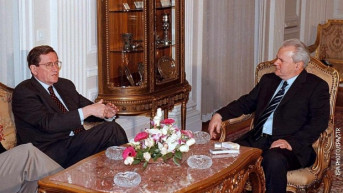
Washington wanted to try once again and asked Holbrooke to return to Belgrade and meet with Milosevic. Hill says his relationship with Milosevic deteriorated further in light of Rambouillet. The visit to Belgrade he made in February at the suggestion of Albright and Jamie Rubin went badly.
Holbrooke and Hill, along with a small delegation from Washington, met with Milosevic on the evening of March 22. The talks with the Yugoslav President were short-lived.
Richard Holbrooke, upon parting, said to Milosevic, "You understand what will happen when I leave", knowing it was the last fateful moment in which the dogs of war could still be silenced. "Yes", Milosevic replied. "You will bomb us. You are a great powerful country and you can do whatever you want, and we can't do anything about it". "The bombing", Holbrooke warned, carefully choosing his words in consultation with senior Pentagon officials, "will be swift, sharp, and continuous". "You are a superpower. If you want to say that Tuesday is Thursday, you can do it. It doesn't matter what we think," Milosevic concluded.
After this, the US diplomat informed reporters at an impromptu press conference that the response from the Yugoslav side had been negative and that his only remaining task was to travel to Brussels and inform NATO's Supreme Allied Commander Europe, General Wesley Clark, of their content. "My phone will be available, and the authorities in Belgrade know his number," Holbrooke concluded his address to the journalists.
Milosevic said that the question of NATO's involvement in the Kosovo solution would be discussed in the Serbian Parliament, the Assembly, which would meet in the morning on March 23. Holbrooke and Hill stayed that night until morning and then listened to the debate in the Assembly of Serbia. They went to the airport late in the afternoon on March 23.
Furthermore, at that time, in Western diplomatic circles, there was also an opinion that Richard Holbrooke left the last meeting with Milosevic believing that a short-lived military intervention would serve as an alibi sparing the Yugoslav President from criticism for the loss of sovereignty over a significant part of the national territory. Milan Milutinovic's statement will also be remembered, as when asked by journalists in Paris if the authorities in Belgrade were aware that rejecting the proposed agreement would lead Serbia into war with NATO and likely result in the loss of Kosovo and Metohija, he laconically replied, "Que Sera, Sera" ("Whatever will be, will be").
(The End)
comments