
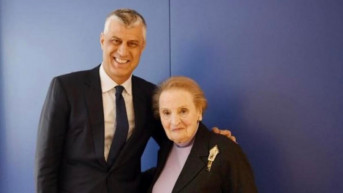
FEUILLETON Rambouillet - ultimatum for the bombing (14): Albright assures Thaci of the seriousness of the bombing
Writing for Kosovo Online: Dragan Bisenic
Hill explained why it wasn't possible to have "harsh" discussions with the Albanians.
"Harsh talks with the Albanians to push them into saying 'yes' were not at all facilitated by their use of mobile phones, a device that wasn't widespread in Dayton in 1995. A harsh talk with them would often result in someone calling one of their numerous supporters in Washington, who would then call the State Department and complain. Living in a big city, I explained to Phil and Tina," Hill stated.
Even Kosovo Albanians found it hard to believe that NATO was actually planning to bomb Serbs, so on February 22, NATO's commander in Europe, General Wesley Clark, came to Paris and met with the Albanian delegation at a nearby NATO base. Particularly worrying was the sudden disappearance of Thaci, who left Rambouillet on the 18th and returned after two days, and no one knew where he had been. There were suspicions that he had met with the ideologue of the KLA, Adem Demaci, who had refused to come to Rambouillet and who had been giving very harsh and radical statements for months.
Hil asked Thaci: "Why can't you agree to this?" I asked Thaci, truly not understanding whether he grasped the almost fatal consequences of answering "no" for the Kosovars.
"You're the one who doesn't understand," he replied. "If I agree to this, I'll go home and they will kill me," Thaci replied.
For the bombing of Serbia to be carried out, the Albanians needed to accept the agreement. But if they didn't accept it, why was the US Secretary of State persuading the Albanian delegation to accept it? She could have concluded that the Albanians didn't want it and that would have been the end of it. However, the goal was for NATO to come to Kosovo at all costs and become its decisive component. If this couldn't be secured through Serbian consent, then it was necessary to have at least some basis, and only the Albanians could provide that basis. That's why Madeleine Albright had to insist that the Albanians provide an alibi for the bombing by accepting some draft agreement, which she didn't hide.
"After the failure on Saturday, I tried various tactics. First, I told Thaci what a great potential leader he was. When that didn't work, I said we were disappointed in him, that he was mistaken if he thought we would bomb the Serbs and if the Albanians rejected the agreement. For that, we could never get NATO's support. 'On the other hand', I said, 'if you say 'yes', and the Serbs say 'no', NATO would bomb and bomb until the Serbian forces were driven out and NATO could enter Kosovo. You would have security. And you would be able to govern yourselves“.
Thaci responded that the only purpose of the KLA had been to fight for independence and that it had been very difficult to give up on that. I said, 'You don't have to, but you have to be realistic. This agreement is for three years. We know Milosevic is the problem. But the situation could look very different in three years. This is your chance. Seize it because you may never have another'. Although obviously embarrassed and almost tearful, Thaci refused to say 'yes', Albright described.
Co-chairs Hill, Mayorski, and Petritsch on the last day of the conference continuation sent the Serbian and Albanian delegations the final version of the agreement text (Russia distanced itself from the disputed second and seventh chapters) with a cover letter leaving a deadline until one o'clock in the afternoon for a response.
Hill and Petritsch visited the Albanian delegation and did not receive any satisfactory response. The Albanian delegation responded with a declaration stating that consensus had been reached that the document could be signed two weeks after 'consulting the people of Kosovo', requesting a swift deployment of NATO forces in the province and emphasizing that the Albanians expected a referendum on the status of Kosovo to be held in accordance with point 3, article I, of the eighth chapter three years after the agreement was signed".
According to Wolfgang Petritsch's testimony, the head of the Serbian delegation in Rambouillet, Ratko Markovic, responded with three letters, the first of which was sent at one o'clock in the afternoon, the second at half past two, and the third at four o'clock. Although they stated that the conference had made significant progress (the first letter listed the issues with which the Serbian side agreed), it was emphasized that there could be no independence for Kosovo and Metohija, nor could it become a third republic, and the readiness of the Serbian and Yugoslav sides to continue working was emphasized. However, what was obvious after the end of the conference in Rambouillet was that in Serbia, after its conclusion, the political forces that had been against Rambouillet from the very beginning prevailed, believing that Serbia had to risk armed conflict with NATO while Milan Milutinovic practically disappeared from public view.
Almost at the very end of the conference, Veton Surroi appeared before Hill and Petritsch. He said he was authorized by the Albanian delegation to address the foreign ministers of the Contact Group. Hill escorted him to the room where they were and told them that Surroi had a statement for them. Surroi said that the delegation had accepted the plan, but it would take time to return to Kosovo to build support among the local people because some aspects of it, namely autonomy rather than independence, would be problematic for them. The fact that the delegation had to return to Kosovo did not satisfy all the foreign ministers, but Secretary Albright made sure they understood that Veton Surroi's message was a "yes".
Hill didn't have much sympathy for him, but he approached him and said he had doubted him because of many things he had done in the past, but he would never forget what he did that day.
To be continued tomorrow: Milutinovic offers that Serbia joins NATO


0 comments