
How Wine Vision helps promote the Balkans as serious wine markets
With Wine Vision by Open Balkan beginning this weekend in Belgrade, Serbia, here is an article published by The Buyer last year about the fair’s rapid rise.
In his opening remarks, Serbia’s president, Aleksandar Vučić, spoke about ‘Wine Vision by Open Balkan’ potential global reach. With professionals and distributors coming from all the over world, including key markets such as Italy, the US, China Australia, South Africa, Lebanon, Mexico, France, the Netherlands, Tunisia, Uganda and the UK.
Having long relied upon others to tell the story of its winemaking renaissance, Wine Vision is taking the lead in showcasing what the region offers in an increasingly competitive wine world. While much light is shone on Croatia and Slovenia, the rest of the former Yugoslavia remains relatively neglected, despite its proud wine heritage, recent investments in modernisation, and specific domestic varieties. Wine Vision is beginning to redress the balance, with a clear sense of initiative and momentum.
Education for all
Wine Vision was a chance for buyers and importers from key markets around the world see what opportunities there are both supplying and sourcing wine and spirits from across the Balkans
An impressive list of masterclasses offered thematic and tangible insights. Christopher Burr MW provided valuable advice on exporting to the UK, Zsuzha Toronyi and Caroline Gilby MW presented marketing and sales strategies for wine in competitive markets, and Eniko Kiraly described innovative and sustainable solutions for wine closures.
These are domains in which many winemakers from Serbia, North Macedonia, and Albania are often learning on the job, grappling with often complicated regulations and shifting consumer preferences.
Indigenous grapes such as Prokupac and Tamjanika (or Temjenika) also featured prominently. Caroline Gilby MW and Igor Luković, a wine critic from Serbia, each spoke about rare varieties from Serbia, while Simon Woolf described the ‘Amber Revolution’ taking place from Georgia to the Balkans.
The emphasis on autochthonous grapes is part of a coherent strategy to promote the region’s uniqueness. There are many outstanding examples of international varieties and blends, but it is native sorts that provide a novel and compelling story for wine consumers, particularly in more developed markets.
The development of Prokupac, Grašac, and Vranac - to name but three - over the past decade demonstrates their potential in the hands of winemakers experimenting with different approaches. While more needs to be done to develop the specific identities of the regions from which they originate, there is a view that a lack of strict regulation allows winemakers to innovate more freely.
Two experts from North Macedonia - Zvonko Herceg and Jadranka Klarić - explored the traits of Vranec (or Vranac) and Stanušina, respectively. Croatia’s Saša Špiranec spoke about GROW, an acronym composed of the names Grašac/Graševina, Olaszrizling, and Welschriesling. For many in the audience, these were new and exciting discoveries.
Award winning
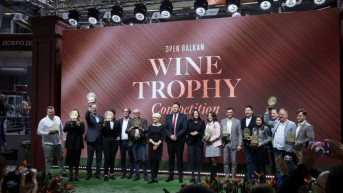
Wine Vision looks to highlight the best of the Balkans with is own WIne Trophy awards
The Open Balkan Wine Trophy has become a badge of honour for wineries in the region. Judged by six Masters of Wine, headed by Caroline Gilby MW this year’s awards featured some notable winners including: Whites Stone Merlot 2019, Temet Winery, Serbia (best red wine); Vranec ‘Terroir’ Grand Reserva 2020, Chateau Kamnik, North Macedonia (best red wine from an autochthonous variety); Signum Chardonnay 2022, Frug Winery, Serbia (best white wine); Grašac Grand Fru 2020, Vinčić Winery, Serbia (best white wine from an autochthonous variety); and Moma Traminac 2023, Bikicki, Serbia (best orange wine).
Business to business
The trade dimensions of Wine Vision offered wineries the opportunity to showcase their products to a host of wine professionals. Serbia’s Chamber of Commerce estimates that Wine Vision was attended by over 400 international buyers, with over 1,500 business meetings scheduled; a number that does not include the thousands of spontaneous interactions at individual booths.
Jordan Trajkov, founder and chief executive of Popova Kula Winery from North Macedonia, commended the fair for hosting and not merely inviting wine buyers.
“The Wine Vision B2B meetings were very successful, especially for matching wineries with international buyers and importers,” said Dr. Slobodan Vujić, owner of the award-winning Fragaria Winery from Serbia, adding: “It was possible to taste Fragaria wines and to discuss further exports to some very interesting markets, which otherwise would be hard to reach, such as Netherlands, Angola, and others.”
“By giving both sides access to the ‘B2Match’ platform, they have enabled direct communication upfront and during the trade fair,” explained Trajkov.
It meant like-minded producers and potential buyers and suppliers could set up meetings based upon specific criteria. He also commended Wine Vision for actively hosting and not merely inviting wine buyers.
These successes are such that others from the world of wine, distillation, and gastronomy descended upon Belgrade to find new markets for their products. The presence of numerous buyers from Asia, for instance, is a compelling proposition that reinforces the sense that Wine Vision is a global hub that benefits not only those from the Western Balkans.
Written by: Ian Bancroft, a writer and former diplomat based in the former Yugoslavia



0 comments