
Messages from Kazan: Multipolarity is the only solution for economic growth and World Peace
Written for Kosovo Online by Zeljko Sajn
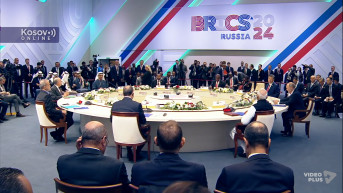
The recently concluded 16th BRICS Summit in Kazan, attended by delegations from 35 countries and six international organizations, including the presence of UN Secretary-General António Guterres, underscored the growing interest of states in joining this alliance, which is advancing towards the formation of a new international order. This order is based on international law, free from hegemonism, financial and technological colonialism, and is built on the foundations of economic cooperation and the utilization of natural resources.
Following the Cuban Missile Crisis, which lasted 13 days between the U.S. and the USSR (Kennedy and Khrushchev), where these two nations—Allies in World War II—came close to military conflict, among other reasons, for dominance in the Middle East and the so-called Global South, today we are witnessing a similar situation, now complicated by the Ukrainian crisis. At the time, Americans believed they had won the race for Kennedy's second term, but those who wanted war assassinated him and changed the course of history. Today, on the eve of the U.S. presidential elections, where Harris and Trump are the main contenders, the situation is not much different. Two assassination attempts have been made on Trump, and even if he becomes the 47th president of the U.S., it remains to be seen what awaits him from those for whom peace does not fill their pockets.
How did the modern world end up on the brink of total war?
It all began with the dissolution of Yugoslavia and the fall of socialist countries, starting with Ceaușescu's ouster in Timișoara and the end of the Cold War, followed by the NATO-led bombing of Yugoslavia. The world became divided over Kosovo's independence and Serbia's sovereignty. The conflicts in Ukraine and the Middle East, and the challenges faced by "small" countries trying to navigate the West’s hypocritical policies, which continually shift the political rules, sow discord not only among EU candidates but also within nations. The global population fears a third world war and the use of nuclear weapons. While dialogue at the negotiating table seems distant, the 16th BRICS Summit has given hope that a path toward peace and global development has been found.
“BRICS encompasses like-minded sovereign states representing different continents, development models, religions, and indigenous civilizations and cultures. All our states stand for equality, good neighborliness, mutual respect, and the affirmation of the noble ideals of friendship and unity, for universal progress and prosperity. Our states demonstrate responsibility for the future of the world through actions—not words—and have a genuinely positive impact on global stability and security, making significant contributions to solving acute regional issues,” said the host of the Summit, Russian Federation President Vladimir Putin.
UN Secretary-General António Guterres agreed with Vladimir Putin’s stance, stating that multipolarity is the key to global development and peace: “The [16th BRICS] Summit of the Future highlighted the need to strengthen multilateralism in the interest of global development and security. Now we must turn words into action, and we believe BRICS can play a crucial role in this direction.”
Guterres particularly emphasized that the world needs peace in Gaza, Lebanon, Sudan, and Ukraine—“a just peace, in accordance with the UN Charter, international law, and the resolutions of the General Assembly.”
While the West has selectively adhered to the UN Charter, undermining the authority of the organization whenever its principles did not align with their interests, the BRICS Summit brought back the focus on the importance of this organization and respect for international law.
It’s worth noting that the West expressed disapproval of the UN Secretary-General's participation in the BRICS Summit, a stance coming from countries that neither respect the UN Security Council nor the UN Charter, leading hypocritical and power-driven policies. For instance, consider the NATO-led bombing of Yugoslavia without UN Security Council approval or Kosovo’s declaration of independence, despite the clear statement in UN Resolution 1244 that Kosovo is part of Serbia’s territorial integrity and sovereignty.
The Summit highlighted the necessity of UN reform and respect for the UN Charter. “The organization rests on the principle of sovereign equality of all its members” (Article 2, Paragraph 1 of the Charter). Russian President Putin emphasized this very UN principle in his speech as a goal of BRICS.
Serbia, as the successor of Yugoslavia—a founding member of the UN—and as a friend of the Russian Federation, was a guest at the BRICS Summit in Kazan. As a country rich in natural resources, Serbia can play a significant role in the direction BRICS advocates, but it is also crucial for it to align with the world’s multipolar changes, which are highly significant for the issue of Kosovo and Metohija.
The first important step is dialogue at the round table of world powers—Russia, the U.S., the U.K., France, and China—which have diverged over the issue of Kosovo’s independence, and the UN must begin serious, not demagogic, reforms. How long this will take depends on who leads the U.S. administration. The UN Security Council will likely expand, with India, Brazil, and South Africa joining in some capacity, and possibly one of these countries—India being the closest—gaining permanent member status. In that case, nearly all continents would be represented.
In any case, UN reform is necessary, given that the U.S., U.K., and France—permanent members of the Security Council—have acted outside this global organization. Consider the example of the bombing of Yugoslavia. Such actions can be described as “opposition work operating outside institutional channels with military support.” Thus, the foundation for the peace the world longs for lies in returning all political actors to the original principles of the UN and resuming dialogue at the round table, where everyone is equal. Then, UN Resolution 1244 would have the strength to protect and defend Serbia’s constitutional territorial integrity and sovereignty, and relations between Belgrade and Pristina could truly normalize—a responsibility of Brussels, yet we are no closer to such normalization. On the contrary, Brussels seems intent on delaying any agreement on the normalization of relations between Belgrade and Pristina, which only heightens tensions in Kosovo and Metohija.
Considering the purpose of the Minsk agreements, which merely served to prepare Ukraine for war with Russia, as confirmed by Angela Merkel and Hollande, it’s understandable to question the good intentions of the Brussels Agreement. Even Henry Kissinger believed that such agreements always served dubious goals. For example, Kissinger said of Stalin’s unwavering principle: “In a philosophical sense, the ideological conflict with Nazi Germany was part of a general conflict with capitalism, in which he included France and Great Britain. Who would ultimately provoke Soviet hostility depended solely on which of these countries Moscow viewed as the greater threat at the time.”
Kissinger added that, in a moral sense, Stalin made no distinctions between capitalist countries. “His reaction to the signing of the Briand-Kellogg Pact in 1928 clearly showed what he truly thought of countries extolling the virtues of general peace,” Kissinger said, arguing that throughout European history, all agreements that aimed to rearrange the balance of power for new wars were termed peace treaties when signed, though they were signed with the intent of preparing for another conflict.
Although his words have proven true in the modern world, given the Minsk agreements and the Brussels Agreement, the message from the 16th BRICS Summit offers hope that such policies have come to an end, and that all future peace talks and multipolar relations will be based on a balance of interests, free from hegemony, and in compliance with international law. Russia emphasized this, and all BRICS members agreed, which was included in the Kazan Declaration’s 43 points.
For Serbia, it is crucial that the Kosovo and Metohija issue is moved to the UN Security Council, where impartial resolutions can be made based on international law, rather than being under the control of European leaders—primarily Germany and France—who derive their credibility from the legacies of De Gaulle, Brandt, Genscher, and Kohl. The failure of the Brussels Agreement, which Kurti refuses to accept with the backing of his mentors, suggests that the Kosovo issue will move to New York, under UN auspices, which is the only correct path for respecting international law, sovereignty, and territorial integrity, all of which are the foundation for preserving Kosovo within the Republic of Serbia.
The 16th BRICS Summit in Kazan showed that multipolarity is the only solution for both economic growth and world peace. The Summit of the Future has brought Russia back onto the political stage as a leading player in shaping global developments, as well as reaffirmed the authority of the UN, under whose roof compromise solutions based on international law and the UN Charter will be pursued—fully supported by UN Secretary-General António Guterres, which also benefits our country.


0 comments