
Summary of the Week 82
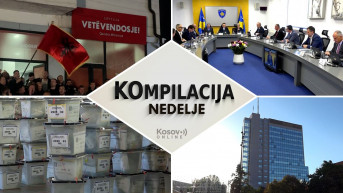
The past week was a week of answers. Who voted how, who won, who will govern the cities and municipalities, and who will run the other institutions in Kosovo? Yet every answer opened a series of new questions.
It has long been clear that a final solution—especially in Kosovo—does not necessarily resolve all dilemmas. Quite the opposite: every conclusion tends to generate new questions. Thus, even the announcement of electoral victories has not put an end to pre-election challenges.
“Here the question arises whether a new transitional government will be formed that will govern for a period of time, or whether new elections will be held that may bring some changes, though certainly not drastic ones,” Dragisa Mijacic of the National Convention for Chapter 35 told Kosovo Online.
Although sometimes necessary, drastic solutions are not always desirable. And as a rule, they are avoided until new questions and new challenges push everything else into the background. Many of these questions are being raised continuously by citizens.
“The issue of the missing, the issue of license plates, documentation, the Association of Serb-majority Municipalities,” lists Dusan Radakovic of the Center for Advocacy of Democratic Culture. He adds: “All of these could have been resolved…”
They could have—but the opportunity never came. Every suitable moment in recent months was spent on campaigning, voting, counting, and reassessing one’s own and others’ decisions.
“Not forming a government has definitely been used as a convenient excuse,” says Milos Pavkovic from the Center for European Policies. “Essentially,” he says, “it is an avoidance of obligations.”
Other obligations imposed themselves. Decisions were voted on even when there was no real reason—or no legal basis. Questions raised by such decisions will be answered later.
“All decisions that were not previously defined in the annual government plan or in the budget can be considered illegitimate,” says Aleksandar Sljuka of the NGO New Social Initiative.
Whether these decisions will be annulled will depend on those who may have the opportunity—and enough support—to do so. One such test of support awaits next week.
“Some may now think it is better to vote for a minority government, for Konjufca’s proposal, because it can be easily brought down. Better that, than having Kurti’s government again, which they can never bring down,” suggests one possible scenario, Professor Nexhmedin Spahiu.
Regardless of whose expectations will be dashed, it is certain that next week, instead of conclusions, we will be opening new questions.



0 comments