
Trial in The Hague: Truth and justice in measured doses
Written by: Zeljko Sajn for Kosovo Online
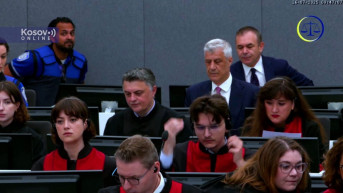
The court in The Hague conducting proceedings against former leaders of the Kosovo Liberation Army (KLA) is often presented to the public as a belated act of international justice. However, a closer examination of its origins, mandate, and political context reveals a far more complex phenomenon. The Kosovo Specialist Chambers are not the product of a universal legal consensus, but rather the result of prolonged political balancing between the need for accountability and the interests of major powers in preserving the order established after 1999.
The Court’s Origins: From Shock to Control
The process that led to the establishment of this court began with the 2011 report of the Council of Europe, which contained serious allegations of crimes committed by the KLA against Serbs, Roma, and political opponents among Albanians. That document represented not only a legal challenge but also a significant political threat, as the accusations concerned structures that had been Western allies during and after the war.
In that context, the administration of President Barack Obama and the U.S. State Department, under the leadership of Hillary Clinton, faced a clear dilemma. Ignoring the report was not an option, yet initiating an international tribunal under United Nations auspices would have meant returning the Kosovo issue to the UN Security Council, where Russia and China would assume a decisive role. That was a threshold the West was not prepared to cross.
In this respect, the policies of the administrations of Bill and Hillary Clinton, followed by Barack Obama, demonstrate clear continuity: insistence on individual criminal responsibility while simultaneously safeguarding the political and military framework of the 1999 NATO intervention, which at no point was called into question.
The solution was found in a hybrid model: a court formally linked to Kosovo’s legal system but physically located in The Hague, staffed by international judges and prosecutors, and established without a UN mandate. This model, operationalized by American and European diplomats, enabled the prosecution of allegations while maintaining political control over their scope.
American Continuity: Different Administrations, the Same Boundary
Although administrations in Washington changed, the underlying logic remained the same. During Donald Trump’s presidency, the court was pushed into the background and treated as a technical legacy of previous policy. With the arrival of Joe Biden, the emphasis returned to the rule of law, but with clear insistence on stability and continuity. The court was accepted as a mechanism for closing a chapter, not reopening it.
Across all three periods, the common denominator was identical: prosecute individuals, but do not question the broader political and military framework of NATO’s 1999 intervention. Justice was permitted — but only up to the point where it did not threaten the foundational Western narrative.
What a Conviction Can — and Cannot — Change
A conviction of senior KLA figures would have significant symbolic and political impact. It would judicially confirm that crimes against Serbs and other non-Albanians occurred and were not isolated incidents without command responsibility.
This would seriously undermine the myth of a “clean side” in the conflict.
Nevertheless, such a judgment would have no legal effect on the legality of NATO’s intervention, nor would it open the question of responsibility of Western states. The court’s mandate has been carefully circumscribed precisely to prevent such implications. In that sense, the court functions as a pressure valve: part of the truth is acknowledged, but its expansion beyond the permitted framework is prevented.
Serbia Between Law and Realpolitik
For Serbia, its relationship with this court represents a classic clash between principles and interests. Cooperation with the court allows crimes against Serbs to receive judicial confirmation carrying weight in international forums. A boycott, on the other hand, would mean voluntarily relinquishing that instrument without any influence over the process itself.
At the same time, Serbia insists on a clear boundary: the court’s work must not have status-related consequences. In this regard, the key reference point remains United Nations Security Council Resolution 1244, which defines Kosovo as a territory under temporary international administration and leaves the question of its final status open. That is the legal framework the West does not challenge in relation to this court — precisely because it is not a United Nations mechanism.
Conclusion: Truth in Measured Doses
The Kosovo Specialist Chambers are not an expression of ideal justice, but of calibrated justice. They exist because the West had to respond to serious allegations, yet they were shaped so as not to endanger political decisions made at the end of the last century. In that sense, the court represents a compromise between the West and its own past.
For Serbia, the key question is not whether this justice is complete, but whether it is usable. In international politics, even limited truth can be a significant asset — provided it is employed thoughtfully, consistently, and without illusions about its boundaries.
comments