
Who Is Who – Dirk Schuebel: German diplomat focused on Eastern Europe, advocate of sanctions against Russia
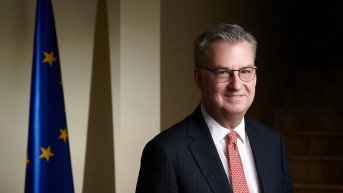
Career German diplomat Dirk Schuebel will arrive in Pristina on September 1 to replace Aivo Orav, the former Head of the EU Office in Kosovo. He takes up the post from his current position as Head of the Russia Division at the European External Action Service (EEAS).
Schuebel’s professional biography shows that his diplomatic career has been focused primarily on Eastern Europe, while the Western Balkans has not been among his principal areas of engagement.
Unlike his predecessor, Aivo Orav, who had previously served in Skopje and Podgorica before his appointment in Pristina, Schuebel’s new assignment will mark his first posting in the Western Balkans.
From September 2022 to July 2024, he served as the European Union’s Special Envoy for the Eastern Partnership.
Prior to that appointment, he was Head of the EU Delegation to Belarus from September 2019 until 2022.
Before serving in Minsk, he headed the Russia Division at the European External Action Service during his first term in that role, following five years, from 2013 to 2018, as Head of the Bilateral Eastern Partnership Division, responsible for the EU’s bilateral relations with Ukraine, Belarus, Moldova, Georgia, Azerbaijan and Armenia.
His career also includes serving as Head of the EU Delegation to Moldova from 2009 to 2013. That posting followed three years as Head of the Political, Press and Information Section at the European Commission Delegation to Ukraine and Belarus in Kyiv, where he served from early 2006 until 2009.
Schuebel began his diplomatic career more than three decades ago, holding various positions at the German Federal Foreign Office and later at the European Commission.
Diplomatic Career Began in 1993
Dirk Schuebel began his diplomatic career at the German Federal Foreign Office in 1993, shortly after German reunification. He specialized in international economic relations, foreign trade and trade promotion.
He later moved from the German Foreign Office to the European Commission in the late 1990s, marking the beginning of his work within the EU’s supranational institutions.
At the Commission, he served in the Directorate-General for Transport and Energy before taking up positions in the Directorate-General for Enlargement and the Directorate-General for Trade, where he focused on developing and implementing EU policies rather than conducting traditional bilateral diplomacy.
Within the Directorate-General for Enlargement, Schuebel contributed to the EU’s strategic work with neighboring and potential candidate countries in Eastern Europe, including preparatory work on association agreements and technical assistance programs aimed at encouraging market-oriented reforms in post-Soviet economies.
In 2013, Schuebel became Head of the Bilateral Eastern Partnership Division at the EEAS, a position he held until 2018. During that period, he oversaw EU relations with Armenia amid instability in the South Caucasus, including escalating tensions over Nagorno-Karabakh. He contributed to negotiations on the Comprehensive and Enhanced Partnership Agreement (CEPA) between the EU and Armenia, which was initialled in March 2017.
Mission in Belarus
Schuebel assumed the post of Head of the EU Delegation to Belarus in the summer of 2019. His appointment was welcomed at the time by then Belarusian Foreign Minister Vladimir Makei, who described it as timely for strengthening dialogue between Minsk and Brussels.
However, following the presidential election of August 9, 2020, which sparked protests in Minsk, Schuebel stated that the European Union stood with peaceful demonstrators and called for respect for fundamental rights, reflecting the EU’s position in support of democratic aspirations against authoritarian consolidation. Belarusian authorities, meanwhile, accused him and other EU diplomats of interfering in the country's internal affairs by financing and encouraging unrest.
In response, the European Union imposed targeted sanctions beginning in August 2020, expanding them by 2021 to include asset freezes and travel bans against more than 100 officials and entities.
Tensions culminated in threats by the Belarusian authorities against EU diplomats, eventually leading to a request in the summer of 2021 for Schuebel to leave the country.
Head of the EEAS Russia Division
Schuebel first headed the Russia Division at the European External Action Service from 2018 to 2019. In that internal role, he oversaw analysis of Russian foreign policy and contributed to shaping the EU’s strategic response.
In March 2023, following Russia’s full-scale invasion of Ukraine in February 2022, Schuebel was actively engaged as the EU’s Special Envoy for the Eastern Partnership, focusing on strengthening relations with partner countries, including Ukraine, Moldova and Georgia.
His work emphasized targeted diplomacy aimed at enhancing local resilience. Schuebel stated that the Eastern Partnership framework would remain the EU’s principal instrument despite the disruption caused by the war.
Views on EU–Russia Relations
Schuebel has consistently supported the European Union’s policy of imposing and maintaining sanctions against Russia in response to the 2014 annexation of Crimea and the February 2022 invasion of Ukraine, arguing that such measures are necessary both to deter aggression and to promote accountability.
In public statements following the invasion, including remarks made during discussions in the European Parliament, Schuebel described the war as “a turning point” requiring intensified sanctions to isolate Moscow and strengthen Ukraine’s defense, in line with the EU’s shift from selective engagement toward comprehensive disengagement from Russia.
Born in East Germany
Schuebel was born in 1965 in East Germany. He has spoken publicly about growing up in the former German Democratic Republic, where his parents lived under communist rule and, like many others, expressed concerns about the uncertainty surrounding potential reunification with West Germany.
He holds a degree in foreign trade and international trade relations.
Schuebel is married and has one daughter.
0 comments