
Who is Who – Edita Hrda: Czech Ambassador from the UN, advocated for visa liberalization and Kosovo's EU membership
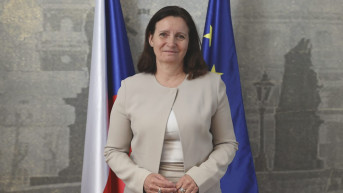
She is far more familiar with South America than Europe, yet as a career diplomat, she served as the Permanent Representative of the Czech Republic to the United Nations and as Ambassador to the EU. During the Czech presidency of the EU, Kosovo was granted visa liberalization, and she openly expressed her full support for Kosovo's EU membership.
At a regular session held on Wednesday, the Government of the Czech Republic decided to appoint former EU Ambassador Edita Hrda as its Special Envoy for the Western Balkans.
“The region requires intensive diplomatic attention. The government’s envoy will work within the Ministry of Foreign Affairs. I am pleased that the importance of the Balkans is growing. We assessed that a tool for better coordination was needed,” said Minister of Agriculture Marek Viborni after the session, explaining that Hrda’s mandate will begin in April.
Hrda became familiar with the Western Balkans during her tenure as the Czech Ambassador to the EU.
Czech media criticized the fact that the Czech Mission to the EU consists of 250 people, but Hrda dismissed this claim, stating that it is "the largest Czech embassy in the world."
“Since taking office, I have often been asked whether we are spending too much or too little on the presidency. My answer has always been the same: I categorically reject this approach. In the past, there were presidencies that, despite large budgets, achieved little. Likewise, some smaller countries’ presidencies are remembered with great respect,” Hrda said, explaining that France’s EU mission employs twice as many people.
During the Czech presidency of the EU, on November 30, 2022, the ambassadors of EU member states approved visa liberalization for Kosovo citizens, effective January 1, 2024.
In an interview with Nacionale, Hrda stated that she was "very happy" that this decision was made during the Czech presidency.
“Kosovo has made significant progress in all blocks of the visa roadmap, including document security, border and migration management, asylum policies, public order and security, and fundamental rights related to freedom of movement. We have also emphasized that Kosovo should strive for further alignment of its visa policy with that of the EU. This is very important for maintaining good cooperation in the future,” Hrda said.
She also explained that the Czech Republic worked with other EU member states to make the Western Balkans "one of the main priorities in foreign relations."
“We did our best to bring the EU and the Western Balkans closer together because we have always seen the future of the Western Balkans in the EU,” Hrda said.
Just a year earlier, in April 2021, she met in Brussels with Kosovo's ambassador responsible for NATO relations, Astrit Zemaj.
"During the meeting, discussions focused on enhancing bilateral relations between Kosovo and the Czech Republic. On that occasion, Ambassador Hrda reaffirmed the Czech Republic’s full support for Kosovo on its path to the European Union," Zemaj wrote on his Facebook profile.
The Czech Republic was the 40th country to recognize Kosovo, doing so on May 21, 2008.
After then-President Milos Zeman announced in 2019 the possibility of the Czech Republic revoking its recognition of Kosovo, the Ministry of Foreign Affairs quickly responded, stating that this recognition was "legally complete and final."
Biography
Born in 1963 in Prague, Hrda completed two degrees in her hometown: Economics and Management, as well as Information Studies. She later attended diplomatic academies in Madrid and Vienna.
She completed her education in 1995 in the United States through the German Marshall Fund (GMF) program.
Hrda's career initially had little to do with diplomacy. From 1986, she worked as a freelancer—an interpreter and translator from German and Spanish—before joining the Institute for Advanced Management in Prague.
She joined the Czech Ministry of Foreign Affairs in 1992, initially serving in embassies in Germany, Austria, and Switzerland.
It took her only two years to advance in the diplomatic service. In 1994, she became the Director of the Latin America Department, and later, the Director of the Central Europe Department.
During this period, she was also the chief negotiator in Czech-German discussions on establishing the Future Fund and the Czech-German Discussion Forum.
She was appointed as ambassador to Argentina and Paraguay in 1999, followed by a role as Director of the U.S. Department in 2004.
In 2011, she became the Permanent Representative of the Czech Republic to the United Nations and also served as Ambassador to the Caribbean region.
At the same time, she chaired several UN institutions, including UNDP, UNFPA, and UNOPS.
Hrda was the first Czech diplomat to hold the position of Director-General for the Americas within the European External Action Service (EEAS).
She was appointed to this role in 2015.
“Ambassador Hrda has succeeded in a highly competitive environment and has been placed in a senior position within the European diplomatic service. This is a great achievement for Czech diplomacy, which continues to promote Czech nationals in European institutions,” said Czech Foreign Minister Lubomír Zaorálek.
From 2020, she served as the Czech Ambassador to the EU.
Hrda has received numerous honors, including the Grand Cross of the Order of General Liberator San Martín in Argentina, the Order of the Sun in Peru, and the Silver Medal "Pro Merito Melitensi" from the Sovereign Order of Malta.
Her biography states that she speaks five languages: German, Spanish, English, Russian, and French.
She is married to former Slovak and Czechoslovak politician Jozef Šepeťka, one of the leaders of the Velvet Revolution, who later transitioned into banking. They have a daughter, Debora.

0 comments