
Simic: Belgrade is the capital for Serbs in Kosovo and Metohija; it always has been and always will be
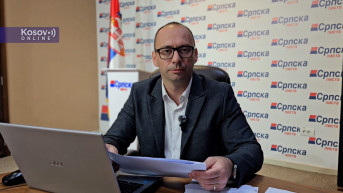
Igor Simic, a member of the Presidency of the Serb List, said today that Belgrade is the capital for Serbs in Kosovo and that this would not change. Regarding the results of the snap parliamentary elections, he reiterated that Nenad Rasic had won one seat thanks to Albanian votes, adding that international representatives were aware of this. Commenting on the institutional deadlock in Pristina, he said that foreign officials had stepped back somewhat and did not want to “play babysitter” to Albanian political leaders, who were demonstrating an inability to perform the duties entrusted to them.
“For all Serbs in Kosovo and Metohija, Belgrade is the capital. That is how it was, how it is and how it will remain,” Simic said in an interview with Radio Belgrade, adding that there were some who had “strayed from the path” in that respect, but that they were a minority.
“We know who we are, what we are and where we belong. The fact is that without Belgrade and Serbia, there would be no Serbs in Kosovo and Metohija, and every Serb living in Kosovo and Metohija is aware of that,” Simic said.
He added that the expression “Kosovo Serbs” was unacceptable, because Serbs were Serbs wherever they lived, adding that it was particularly insulting that foreigners had also adopted such a narrative.
“We told them that we are simply Serbs. I asked international representatives why their colleagues, the ambassadors in Serbia, do not refer to ‘Serbian Albanians’ from Presevo, Bujanovac and Medvedja, or ‘Serbian Croats’ from Vojvodina. Why do they forget those adjectives then? I received no answer, but I did not expect one either,” Simic said.
Regarding the results of the elections held on 7 June, Simic reiterated that Nenad Rasic’s party had won one seat thanks to votes from Albanians rather than Serbs, something of which, he said, international representatives were also aware.
“They are aware of what was done. Rasic received votes in areas where Serbs have not lived for decades—and not a small number of votes,” Simic stressed. As just one example, he cited the fact that Rasic won as many as 448 votes in Prizren, where only a few dozen Serbs live.
Simic noted that Nenad Rasic had never been a member of the Serb List and that, as he put it, “people of that kind will have no place in the party.”
Asked who Nenad Rasic actually was, Simic replied that he had always been “a trump card up the Albanians’ sleeve.”
“When the Serb List was formed, he had his own political party and a certain number of votes, but even then he was supported by Albanians. As minister of labour and social welfare, he was always something of a trump card up the Albanians’ sleeve, to be used when necessary and to play a role in presenting the Pristina regime as multiethnic,” Simic said.
He pointed out that, over three election cycles, fewer Serbs but more Albanians had voted for Rasic.
“He was a minister in the government when a decision was made not on expropriation, but on the outright seizure of property in Zubin Potok and Leposavic for the construction of quasi-police bases for special units in exclusively Serb communities. This is even contrary to Kosovo’s Law on Police, which stipulates that the ethnic composition of the police must reflect the ethnic composition of the population. Yet he did not even voice opposition at the government meeting, so that he could at least say that he had been outvoted. Nor did he vote against the decision concerning what Pristina calls the Museum of Serbia’s Genocide in Kosovo and Metohija. On the website of the Ministry for Communities and Return, he called on young Serbs to join the Kosovo Security Force. This is a man who publicly said that Serbs did not need the Community of Serb Municipalities, and who never spoke out when the dinar was abolished, when institutions were raided or when social welfare centres were closed. He did not condemn incidents in which shots were fired at Serb children, as happened to the Stojanovic brothers in Gotovusa on Christmas Eve. He did not condemn the unjustified arrests of Serbs,” Simic said.
Noting that the Serb List had often been accused of being made up of “traitors and criminals,” he recalled that municipalities in the north had been run by Albanian mayors for four years. Those mayors had access to all the relevant documentation and could have initiated any proceedings had there been grounds to do so.
“Not a single mayor, councillor or director from the Serb List has been either charged with or convicted of corruption. The leaders of the Serb List, starting with its president, Zlatan Elek, as well as myself, have been accused of attacking Kosovo’s constitutional order and face punishment. On the other hand, no complaint has been filed against Rasic, who often supports the student protests in Belgrade, for attacking Kosovo’s constitutional order. We are not all the same. I do not consider myself more of a Serb than anyone else, nor less of one. But compared with Nenad Rasic, every honourable Serb on the face of the Earth is more of a Serb than he is. He has never raised his voice against what is happening to the Serbian people,” Simic said.
Asked what outcome he expected from the situation in Pristina, he said that the formation of the central institutions had reached a “stalemate.” Albin Kurti had enough MPs to form a government, having won 53 seats and counting on Rasic’s support and that of the non-Serb minorities, but electing the president remained a problem.
“The fact is that the Albanian political elite has become accustomed to foreigners resolving domestic problems for them. This is not the first dispute over the election of senior officials, but until now such matters were resolved with an envelope containing a message from an embassy. This time, the foreigners have stepped back somewhat. They no longer want to play babysitter, while Albanian political leaders are showing that they are incapable of performing the duties entrusted to them. Kurti, in particular, wants to be an absolutist. He wants power without delivering results,” Simic said.
He also noted that more than 13 per cent of Albanians had left Kosovo. He explained that, while Serbs were leaving for security reasons, Albanians were leaving because of economic difficulties, as Kosovo lacked roads, railways, factories and economic development.
Simic recalled that, since Albin Kurti came to power, there had been more than 1,000 ethnically motivated acts of violence against Serbs.
He said that the arrests at Gazimestan were an example of such violence against Serbs.
“This year, 36 Serbs were arrested at Gazimestan. People were given penalties with no right of appeal. This shows that we have an overt system of apartheid in Kosovo and that simply being a Serb is enough to get you arrested,” Simic stressed.
He said that the Serb List had insisted that the international community take a clear position and state that it opposed such conduct.
“Last year, on Vidovdan, 12 Serbs were arrested over Serbian flags, which are permitted under minority rights and Pristina’s own laws and regulations. The international community remained silent then. This year, 36 Serbs were arrested. But next year, even more of us will attend the commemoration honouring the fallen Serbian heroes at Kosovo Field. Let them prepare more vehicles for arrests, because it is obvious that they will not stop, since they face no sanctions from the international representatives who are supposed to monitor respect for everyone’s rights in Kosovo and Metohija,” Simic said critically.
He pointed out that Kurti had nothing to offer citizens except raw nationalism and hatred of Serbs.
He recalled that pensions and salaries were far lower than in central Serbia.
“When you add the cost of food and electricity, everything is more expensive in Kosovo than in central Serbia, so you can imagine how satisfied the citizens are. That is why Kurti suffered a drastic decline in his number of votes, which he partly offset with votes from the diaspora, which continues to fall for his nationalism,” Simic said.
He also pointed out that goods from North Macedonia and Albania could not replace the goods from Serbia that Kurti had banned, as they could not match them in either quality or quantity.
He also recalled that Pristina had decided that every product must display the flag of its country of origin on its packaging, thereby exerting additional pressure on consumers. He said that this violated numerous European regulations, as well as the CEFTA agreement.


0 comments