
Vucic: Paunovic’s statement does not reflect the will or policy of the President or the Government of Serbia
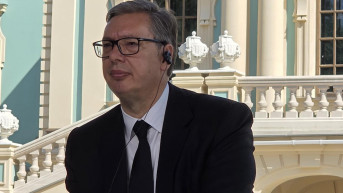
Serbian President Aleksandar Vucic said that the statement made by Serbia’s Minister of Public Administration and Local Self-Government, Snežana Paunovic, reflects neither the will nor the policy of the President or the Government of Serbia. He also reminded that it was more than 250,000 Serbs—not Albanians—who were ethnically cleansed from Kosovo.
“We must act responsibly. Our policy must be one of dialogue, compromise and talks, never ethnic cleansing. Snežana Paunovic herself is a victim of ethnic cleansing. Our policy is peace and stability—there is no place for ethnic cleansing,” Vucic told reporters in Kyiv.
He stressed that the minister’s statement, in which she said she would have “ethnically cleansed Kosovo in 1998,” was careless and that it is irresponsible to make such remarks in public.
“As for those who are lecturing us, they would do better not to say anything,” Vucic underlined.
He also responded to a statement by Kosovo’s Interior Minister Xhelal Sveçla, who declared Paunovic persona non grata in Kosovo, pointing out that Pristina has so far declared virtually every Serbian government official unwelcome.
“They barred Ana Brnabic from entering Kosovo when she wanted to attend a private christening at the Gracanica Monastery. What Pristina says is of no relevance. And wasn't the very person who made that statement the one who spoke about my so-called ‘Sarajevo safari,’ who blatantly lied about the Serbs and who is engaged in the ethnic cleansing of Serbs?” Vucic asked.
He reiterated that it was more than 250,000 Serbs, not Albanians, who had been ethnically cleansed from Kosovo.
Reality Regarding Kosovo Is Not Quite So Rosy
Commenting on Albanian Prime Minister Edi Rama’s statement that Vucic was unwilling to accept reality and that “Kosovo and Metohija no longer exists,” Vucic said that reality concerning Kosovo is not quite as rosy as Rama portrays it.
“The reality is not easy for our side, but I am not convinced that it is as rosy as Rama sees it with regard to the future of Serbia’s southern province. Time will tell what lies ahead. I only hope that we will always resolve everything peacefully, through dialogue and compromise,” Vucic said.
Regarding Rama’s assessment that the Open Balkan initiative failed because the two of them stood behind it, the Serbian president said Rama was largely right—not only about Open Balkan, but also about the initiative for gradual EU accession outlined in the joint article they co-authored for Frankfurter Allgemeine Zeitung (FAZ).
“No one wants to lose influence or allow someone else to take the lead,” Vucic remarked.
Mutual Appreciation for Support of Territorial Integrity
Vucic said that during his meeting in Kyiv with Ukrainian President Volodymyr Zelenskyy, the two leaders expressed mutual appreciation for each other’s support for territorial integrity.
He thanked Zelenskyy in particular for once again demonstrating respect for Serbia’s territorial integrity.
“Serbia, for its part, always respects Ukraine’s territorial integrity and adheres to the UN Charter and all resolutions of the United Nations,” Vucic stressed.
He also expressed hope that President Zelenskyy would visit Serbia in the foreseeable future.
“During my stay in Kyiv, I held three important bilateral meetings, as well as a separate, brief but very important conversation with European Commission President Ursula von der Leyen. I met with the President of Romania, the Prime Minister of Slovenia and the President of Ukraine,” Vucic said.
He added that his talks with the Romanian president focused on the steadily strengthening cooperation between the two countries.
“We have good relations not only because of our shared respect for territorial integrity. Romania has never recognized Kosovo’s independence,” the Serbian president added.
Vucic said they had also discussed the Đerdap 3 hydropower project, noting that Serbia’s Minister of Energy would sign a memorandum of cooperation on the matter the following day.
“This is an investment that will provide the capacity and opportunity to meet the growing demand for massive amounts of electricity. We have finally managed to accelerate the project with the assistance of the United States,” Vucic stressed.
He added that they had also discussed road infrastructure, noting that Serbia expects Romania in the coming days to decide which route it wants to use to connect Timișoara with Serbia, after which Serbia will build a high-speed road to that point.
According to Vucic, the two sides also discussed further energy interconnection, including the construction of gas and oil interconnectors.
With Slovenian Prime Minister Robert Golob, Vucic said he discussed the continuation of Corridor V, the development of the railway from Belgrade to Trieste, and eventually from Belgrade to Ukraine.
He noted that EU funding would be necessary for these projects and said he had asked Ursula von der Leyen for her support.
Vucic emphasized that he was the only participant who did not sign the declaration adopted at the summit, adding that the wording of the document clearly explains why he chose not to do so. He noted that Serbia’s position on sanctions against Russia is well known to all participants.
He added that the summit focused exclusively on military issues.
“That was the only topic of discussion. We are a militarily neutral country, but people are enthusiastic about Ukrainian drones and military capabilities. We must take care of ourselves and protect our own country,” Vucic said.
0 comments