
Who is Who - Tonino Picula: EP Rapporteur, critic of Serbia and "participant in the Homeland War"
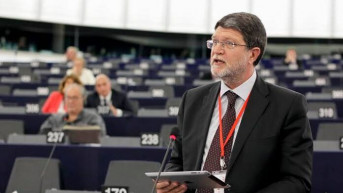
Croatian MEP Tonino Picula has become the European Parliament's rapporteur for Serbia.
Picula was elected to the new European Parliament as a representative of the Social Democratic Party of Croatia.
He has been known in the region for some time, as in the previous term he was responsible for Montenegro on behalf of the EP, but also, it could be said from his heated communication, for strong rhetoric toward Western Balkan countries, especially in the case of Serbia.
Resolving open issues between Serbia and Kosovo
Speaking two years ago about the recommendation for a new EU enlargement strategy, he emphasized as an imperative that the EU must strengthen its constructive engagement with the authorities of both Serbia and Kosovo to achieve a comprehensive and legally binding agreement on normalization based on mutual recognition "between the two countries."
"This is crucial for both countries to advance on their European paths and contribute to regional stability, prosperity, and the normalization of relations. We must resolve all outstanding issues through the Belgrade-Pristina dialogue quickly, transparently, and in good faith," Picula stated in an opinion piece for Parliament Magazine at the end of 2022.
He was particularly harsh in his criticism of Serbia after the events in Banjska and was among the EP members who demanded that Serbia be condemned, that measures be imposed against it, or that infrastructure projects be halted.
At the end of October 2023, he stated that the European Parliament's Resolution on the Kosovo-Serbia dialogue has the capacity to influence the European Commission and the European Council to consider sanctions against Serbia.
He also demanded that Serbia extradite Milan Radoicic to Pristina.
SNS Presidency member Goran Vesic commented that Picula is "a failed politician whose opinion is irrelevant even in Croatia."
"Picula is asked about nothing in Croatia, nor is he important for any decision-making. And since he's not important in his own country, he clearly thinks he should be important when it comes to Kosovo and Metohija. That's his intention, but it's just an attempt at self-promotion by a failed and unsuccessful politician," said Vesic.
"He has no other job but to hate Serbia"
Serbian President Aleksandar Vucic also spoke about him when commenting on accusations of fascism directed at Serbia from Croatia.
As Vucic pointed out at the time, it was Tonino Picula from Croatia who was speaking about this – "a country that has dozens of murals of convicted war criminals across the country, as well as streets named after Mile Budak, a Nazi war criminal, which only the state can decide."
"They are such liars, everything is based on lies. And they think someone will be scared. I'd rather not exist than be a servile lackey to Picula, Viola von Cramon, who have no other job but to hate Serbia and lie every day," Vucic said.
"Putin has done more for the EU and NATO than all their advocates"
Picula was the author of an EP resolution that conditioned progress in the accession negotiations between Belgrade and Brussels on Serbia aligning with the sanctions policy against Russia.
Commenting on the conflict in Ukraine, Picula stated that Russian President Vladimir Putin has done more to expand the EU and NATO than "all the advocates within the Union and the Alliance."
What tensions?
During his previous mandate, he was responsible for Montenegro on behalf of the European Parliament, and he recently publicly warned the administration in Brussels that the agreement between Montenegro and Serbia on dual citizenship could contribute to "electoral engineering," meaning that Belgrade could directly interfere in the electoral processes.
Sparks have flown before between Abazovic and Picula.
He criticized the signing of the Fundamental Agreement with the Serbian Orthodox Church, but the then Montenegrin Prime Minister in a technical mandate, Dritan Abazovic, did not remain silent, emphasizing that it was the best decision, which eliminated tensions.
"Imagine what Picula says, that the decision caused tensions. What tensions? I, as a friend, am just reminding you to check, because it's easy, as a journalist... So, before the Fundamental Agreement, we had protests in Montenegro, car-liturgies, blockades, various things..." Abazovic responded.
At the beginning of 2023, the MEP said that through contradictory actions and inconsistent policies, the authorities had managed to shake the goodwill, support, and conscientious work of all those who continuously root for the success and European prosperity of Montenegro.
He assessed that the then ruling coalition persistently tried to bring Montenegro closer to "those who are deliberately destabilizing the Western Balkans region during Putin's adventure in Ukraine."
Sociologist and MEP
Born in Mali Losinj in 1961, he graduated in sociology in Zagreb. From 2000 to 2003, he was the Minister of Foreign Affairs of Croatia.
In the early nineties, he was a "participant in the Homeland War," as stated on his website.
He was a member of the Croatian Parliament, head of the Croatian delegation to the OSCE Parliamentary Assembly, mayor of Velika Gorica, and in 2013, he was elected as a member of the European Parliament, where he has held various functions to this day.
He lives with his wife Marijana and daughter Petra.


0 comments