
Political conditions in the region are slowing down the Open Balkans; the participating countries are already reaping the benefits
The Open Balkans initiative, at a time of global upheavals and crises, offers various opportunities for easier cooperation and economic progress to the member countries, Serbia, North Macedonia, and Albania. However, the others from the region have remained on the sidelines for now, according to experts, mainly for political reasons.
The President of Serbia, Aleksandar Vucic, and the Prime Ministers of Albania and North Macedonia, Edi Rama, and Zoran Zaev, launched the initiative with the goal of free movement of goods, services, people, and capital according to the EU model, but the Open Balkans was also conceived as a support for existing regional initiatives, their concretization, and response to requirements of the economy, companies, and real life.
The rest of the Western Balkan “six” have remained outside the Open Balkans for the time being, although Bosnia and Herzegovina and Montenegro have shown interest with their presence as observers at the Initiative's summits.
Last year, two summits were held in Belgrade and Ohrid, where the former chairman of the Council of Ministers of Bosnia and Herzegovina, Zoran Tegeltija, and the Prime Minister in the technical mandate of Montenegro, Dritan Abazovic, were observers. Kosovo has shown no interest in the initiative, and Prime Minister Albin Kurti is even decidedly against the Open Balkans.
Economist Ljubomir Savic believes that the Open Balkans would give the greatest results and be realized at full capacity if economic interests were put before political disagreements and diversity.
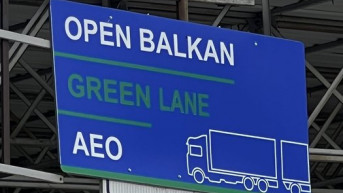
"Unfortunately, for now, of everything that has been signed, only what concerns transport is producing full results, so trucks are no longer waiting at the borders, and it is also possible, he adds, that some seasonal workers have moved to Serbia from North Macedonia and Albania, " Savic told Kosovo Online.
He believes that the Open Balkans initiative offers great opportunities, such as open borders without delays, the possibility of duty-free import and export, and a unique phytosanitary certificate, which does not have to be checked at every border.
Also, as an advantage, Savic states that hospitality workers from Serbia now have open opportunities to work on the Albanian coast, as well as that construction workers from Albania and North Macedonia can work in Serbia.
According to him, all three countries are facing a labor shortage, primarily those people who perform craft activities.
"Labour exchange between the three countries is not realized, not because it bothers someone or because there is no interest, but because the number of people available is decreasing. Just look at Serbia, we lack drivers, tilers, plumbers, and construction workers who come, not from countries of the Open Balkans, but from Asia," Savic said.
He points out that a large number of workers from the entire region moved to Germany and European countries, which offer higher wages and better benefits.
Savic also assessed that the Berlin process was not in conflict with the Open Balkans, but that there were political disagreements in the Western Balkans, which hindered economic growth and cooperation.
"No one from the region, except for Kosovo, questions the Open Balkans, however, the members of the Open Balkans have a partially bad pre-history and all those who influence the development of the initiative are now declaratively on one side, but in practice, it does not show that way, because the economic criteria are exceeded by some other things," Savic said.
Savic emphasized that the "problem of Kosovo" had a big impact on the development of economic cooperation among the member countries of the Initiative.
"The benefit of this agreement is that people, who had a negative pre-history like Serbia and Albania, started to talk and open business opportunities, but then there were fears and misunderstandings about political issues in Kosovo. It is much easier that, for example, the railway or the highway go through Kosovo, but that will be bypassed, because we have a problem with Kosovo," Savic says.
People who deal with the economy and make profits says Savic, are people who will easily "put aside" all other issues.
"When it comes to money and big earnings that are offered to both, I think that people who deal with that kind of business are pragmatic, and when they negotiate they don't ask what you did to us; what you are giving us, and when you will recognize Kosovo and how you will solve this issue," Savic said.
In addition to the economic benefit, Savic estimates, the biggest benefit of the Open Balkans is that the three countries are slowly starting to "melt the ice" in relations and some problems are slowly being overcome.
"God grant that the economy in the countries of the Initiative becomes a priority, but we live in such an area where the economy cannot be in the foreground. The Open Balkans Initiative offers fantastic agreements, but it is not only implemented by these countries, it is also influenced by other countries that sometimes hinder or they encourage the development of the Initiative depending on what they want, primarily from Serbia. So we are in some 'dark region' where most people are clear that the Open Balkans offers benefits to all people, but there is, unfortunately, a vocal majority that solves the issue of borders, recognition, and other things," Savic concluded.
Savić also referred to CEFTA, which he assessed as an exceptional opportunity for the advancement of countries in the region, stressing that the entire process of exchange and economic progress was "disrupted by the behavior of Albanians".
During 2019, 2020, and 2021, a series of meetings, forums, and summits were held (Novi Sad, Tirana, Ohrid, Skopje, Belgrade, Nis) within the framework of the Open Balkans and several declarations and agreements were signed, which created the legal framework for specific activities and benefits.
Agreements were signed on cooperation in the fields of agriculture, energy, culture, and civil protection, as well as agreements on work permits, electronic services, and veterinary and phytosanitary inspections.
The director of the Business Association "Srbija Transport" Goran Aleksic spoke about the example of good practice and the implementation of signed agreements within the initiative for Kosovo online, he pointed out that the "green corridors" on the borders between Serbia, North Macedonia, and Albania had been formed as part of the Open Balkans initiative, had had a significant impact on speeding up the transportation of goods and passengers, and thus on reducing the costs of carriers.
"On the border between Macedonia and Serbia, since last year we have really had an accelerated flow of passengers, and especially goods, which has significantly improved transport and reduced the costs of carriers. The cost of transportation can be measured in several ways, such as financially due to the retention of goods at the border, but also through the hiring of drivers. Faster procedures mean a reduction in the number of hired workers and lower costs, which is important considering the lack of drivers in Serbia," Aleksic said.
Aleksic announced that next week the representatives of "Srbija transport" would hold a meeting with the Association of Transporters of North Macedonia, with whom he was in constant communication, where ideas for improving transport between the Open Balkan countries would be discussed.
"We are now working on harmonizing tolls in these three countries, in order to make it easier for transporters and improve the business environment," Aleksic said.
He added that the preparation of the Strategy for the development of traffic in Serbia until 2030, which would take into account the Open Balkans initiative, was in progress for the further improvement of transport and trade, and should be completed this year.
"Transport and customs are the main connections between countries, and the Strategy should harmonize transportation procedures, after which additional improvement of business relations and flows of goods and passengers is expected," Aleksic believes.
"Srbija Transport" is an association that gathers around 500 companies engaged in road transport of goods, more than 100 bus carriers, and almost all private carriers of goods by rail.
Aleksic expects that the Traffic Strategy in Serbia will focus to railway transport, especially due to investments in railway infrastructure that are ongoing or planned.

0 comments