
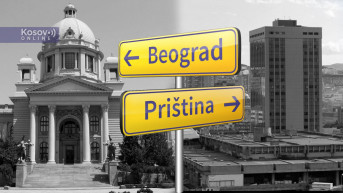
It is not ruled out that the US and Russia will agree on interest spheres and put an end to Belgrade-Pristina relations
Writing for Kosovo online: Zeljko Sajn, special correspondent of "Politika"
For the first time in history, the United States and the Russian Federation are meeting on the battlefield directly, as opposing sides in the Russian-Ukrainian conflict. Through subtle politics through NATO, militarily and politically, as well as through the direct supply of weapons, the US is helping the Ukrainian state in the fight against Russia, which is protecting its Russian people with a special military operation. These two largest military powers started negotiations in Geneva. However, there is still no progress.
At the same table, American and Russian diplomats in the capacity of the ministries of foreign affairs, at the level of deputy ministers of this department, are discussing the end of the war in Ukraine. The ultimate goal, of course, is peace, but let's not forget that at this moment the foundation of a new world order is taking place, one in which India and China play important roles and is based on economic principles, with war spears on European soil. Simultaneously, intensive negotiations on the normalization of relations between Belgrade and Pristina are taking place.
Europe is trying to bring Ukraine and the Balkans under its patronage of obedience while excluding Russia's influence. Macron and Scholz, the leaders of France and Germany, emphasize that Ukraine must defeat Russia, and by using such an imperative tone, they are actually encouraging war rather than peace. At the same time, Serbia is under pressure to accept non-paper as an EU document in oral form, without a clear goal.
While the Brussels agreement specifically talks about the normalization of relations between Belgrade and Pristina, the new European document seems to have only added fuel to the fire, so neither side has satisfied Miroslav Lajcak, the EU's special representative for the dialogue between Belgrade and Pristina and the special issues of the Western Balkans, who advocates for a compromise solution in which neither side can get 100% of everything they want, but both sides have to make a compromise, which will be stimulated by political and economic benefits.
As a result, dissatisfaction with the negotiations in Brussels began to spread among Albanians living outside of Kosovo and Metohija. Alternative for Albanians, the Albanian party in North Macedonia, has requested the formation of the Community of Albanian Municipalities (CAM) in North Macedonia, in the territorial part where the majority of the population is of Albanian nationality. It is a territory bordering Albania in the west and Kosovo and Metohija in the north.
The proposal of the Alternative's General Secretary, Zeqirja Ibrahimi, for the formation of CAM was analyzed as a result of anger over the party's expulsion from power, which gave the Albanian Alliance, in coalition with SDSM and DUI, the opportunity. However, the simultaneous initiative of Albanians from the Presevo Valley, in the south of Serbia, who are seeking the formation of the Community of Albanians in the Presevo Valley, showed that it was not just an ill-advised angry move. According to Shaip Kamberi, a member of Serbia's Parliament, a delegation of Albanians from Medvedja, Bujanovac, and Presevo will speak before the US Senate about "discrimination of ethnic Albanians in the south of Serbia by Belgrade." As it turned out, these initiatives warned Albanians not to lose sight of themselves as a political entity.
As Bishop Velimirovic told Professor Pupin, Borrell and Lajcak are expected to send a message to everyone on March 18 in Ohrid, the center of Christianity in the Balkans, that political delusions are over and that major political changes on economic grounds are on the table, in which important place decisions from the West are made by the US, and from the East by China, India, and Russia, while on European soil the EU is fighting for its leadership positions, with the German and French leaders in charge. The Balkans are led by Serbia, as the leader of the "Open Balkan" initiative. Therefore, it is very important that petty ethnic interests are annulled as soon as possible and Walker's wishes for the creation of "Greater Albania" are forgotten, because they are not part of any negotiation argument at the table, and according to Kissinger, the most respected diplomat alive, wishes do not work in negotiations, but only what is on the table.
It is not ruled out that it will soon be announced in Geneva that the US and Russia have agreed on the spheres of interest that are the cause of the conflict in Ukraine and that an end will also be put to the relations between Belgrade and Pristina in a compromise between Kurti's insistence on mutual recognition and Vucic's "no" to Kosovo's UN membership.
The US and Germany will not withdraw their recognition of Kosovo, nor, on the other hand, will Russia and Spain recognize Kosovo. America will allow Serbia, as a political benefit, partial sovereignty and non-recognition of Kosovo, but will insist on economic benefits in which the American economy will be included.


0 comments