
Analysts: Gervalla's latest statements are the height of the scandal; her philosophy is apocalyptic
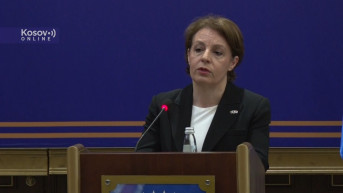
Analysts and former diplomats have assessed that the latest statements of Kosovo's Minister of Foreign Affairs, Donika Gervalla, in an interview with Vienna's "Der Standard" are the peak of the scandal, the Albanian Post writes.
"The peak of the scandal", "it is better not to give statements", "another mistake", "her statements resemble the editorial of the editor-in-chief of the newspaper 'Zeri i Popullit'", "tragi-comedy", "political nonsense", are some of the words used by political analysts, former diplomats, and university professors to describe Gervalla's statements, according to the Albanian media.
According to them, Gervalla, who should be the head of Kosovo's foreign policy and the person who creates, develops, deepens, and expands relations with other countries, marked her performance with a new diplomatic scandal.
She fiercely criticized Western diplomacy, assessing that they "don't want to see and hear" and explaining how Western countries have made "serious strategic mistakes" that could push the region into war.
For the sociologist and political analyst Artan Muhaxhiri, it is already predictable, taking into account Gervalla's other diplomatic scandals in the international arena, that the Minister's statements in Austrian newspapers caused ridicule in American and European offices.
"After the initial sarcasm with this naivety of hers, it is easy to assume that sympathy for such a self-destructive level of foreign policy conception followed," Muhaxhiri says.
According to the former Ambassador to the United Arab Emirates, Avni Arifi, the statements of the head of the diplomacy of Kosovo, that is, the "lesson" to the West, are not only considered scandalous but also completely useless.
"Foreign policy was much more advanced in the 90s, when we did not have recognition and were not a state, than today. The Minister's interview is more of an editorial by the editor-in-chief of the newspaper 'Zeri i Popullit' from the 80s, which insulted Soviet revisionism and American imperialism and all other democratic states," Arifi said.
Gervalla's statements, on the other hand, for international relations professor Arben Fetoshi, are a continuation of the narrative of the Government of Kosovo in relation to the international community.
"Unfortunately, this 'courage' of Kosovo's Minister of Foreign Affairs, to put it mildly, represents another mistake that reflects a potentially harmful approach to our relations with the West," Fetoshi says.
Gervalla's statement that "Kosovo cannot commit political suicide even for its closest friends", responding to the request of the EU and the US that the mayors of municipalities in the north did not work from municipal buildings, for the former Consul of Kosovo in Germany, Blerim Canaj, is proof that "there the Minister cannot make a proper analysis of simpler politics, let alone politics of a wider context".
Therefore, according to his words, the statements of the head of the diplomacy of Kosovo, who criticizes the diplomacy of friendly countries in the world's media, are "the pinnacle of scandal".
"This is not the first time that the government has insulted the politicians of powerful countries. This is rhetoric that perhaps even the most communistic countries did not use during the Cold War. So, it is Gervalla's scandal. According to the logic of her actions, there will certainly be new scandals," Canaj claims.
According to Muhaxhiri, the statements of Gervalla, who in her last interview described some Western diplomats as "problematic", Western alliances as those who "don't listen", and the mediator in the dialogue, Miroslav Lajcak, as biased, are "political nonsense, because, in reality, diplomats and emissaries do not decide on their own the strategic orientations of the main procedures".
"They are not there as private persons, but as institutional representatives and conveying the views of the parties involved - that is, as a bridge between them to facilitate communication. What is the logic that Miroslav Lajcak, a politician from Slovakia, a country that contributes to the total GDP of the EU with 0.6 percent, dictates their opinions and personal interests to powers like Germany, France, Italy," Muhaxhiri asks.
Analysts estimate that such vocabulary of the Minister of Foreign Affairs additionally affects the tense relations between Kosovo and Serbia.
"The tragicomic continuation of this arrogance, which is not based on any real fact, will in any case result in the suspension of the dialogue, the most important geostrategic and geopolitical project in the Balkans and beyond, and therefore in the further deepening of the crisis, as well as the isolation of Kosovo, including the postponement of the definitive phase of completion of the process of statehood. This approach is an indicator of our mediocre political style on the global stage. If we have gotten into the habit of doing almost all important state projects with improvisations and without a minimum of long-term planning, dominated by the spontaneous ways of acting of powerful individuals who rise above institution - in a politically normal world, it is not like that," Muhaxhiri says.
On the other hand, for Arban Fetoshi, such an approach leads Kosovo nowhere, on the contrary, as he says, "the continuation of the rebellion can cause serious political consequences".
"Asking the allies to change diplomats, and they speak with the voice of their centers, for them is not only nonsense but also insulting. I think that the head of diplomacy should not be a part of the spins in relation to relevant international factors, because she is responsible for foreign policy and she knows best the degree of deterioration of relations," Fetoshi says.
Canaj says that it is necessary to take into account the position in which Kosovo is, which has cooled relations with most countries, and that the rhetoric of the head of the diplomacy should have an orientation to regulate those relations, and not further collapse them.
"Her philosophy seems to be apocalyptic. It seems that the current political caste has conceived the treatment of the problem they created as the last battle between 'good' and 'evil' that they imagined and defined. Such rhetoric will, of course, further deepen the situation, which is already serious," Canaj concludes.

0 comments