
Barduani: Opening of the Ibar Bridge is a political issue, the solution lies in Dialogue
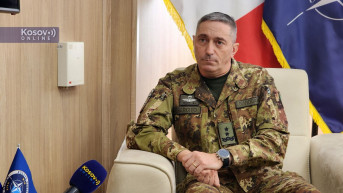
KFOR Commander Major General Enrico Barduani stated in an interview for RTV 21 that the opening of the Ibar Bridge in Mitrovica is a political issue and that the decision on it should be made through dialogue in Brussels. Until a political solution is found, he noted, KFOR will continue to maintain a permanent presence at the bridge and conduct regular patrols in the surrounding areas. Barduani stated that the security situation in Kosovo is calm, but that there is a risk of escalation because, among other things, inflammatory rhetoric is often used, and there are, he said, numerous unilateral actions, recalling the Banjska case and the explosion in the Ibar–Lepenac canal.
Speaking about the bridge on the Ibar, Barduani recalled that during his previous service in Kosovo in 2001 and 2015, the bridge was closed to traffic and stated that, for him, this means that the closure of that bridge is not only a security issue, but is primarily political in nature.
“To clarify NATO’s position on this topic, I can say that it has been clear, continuous, consistent, and transparent the entire time: the decision on the Ibar Bridge in Mitrovica should be made through dialogue and in proper and effective coordination with local communities as well as with the international community. In the meantime, KFOR maintains and will continue to maintain, until further notice, its permanent presence at the bridge and conduct regular patrols in the surrounding areas until a political solution is found,” Barduani emphasized.
Asked what made KFOR’s role more difficult during his one-year mandate, which is drawing to a close, Barduani said that Kosovo has undoubtedly long been characterized by complex and interconnected challenges, the consequences of which are felt throughout the Western Balkans region.
Among these unresolved challenges, he noted, political issues are undoubtedly the most urgent, because they hinder the normalization process between Belgrade and Pristina and affect the security of all communities in Kosovo.
Therefore, he added, KFOR maintains a vigilant and flexible presence throughout Kosovo, ready to react quickly to any events that could threaten regional stability and local security.
“We do this in accordance with our longstanding United Nations mandate, contributing to the maintenance of a safe and secure environment for all people and communities living in Kosovo, at all times, in an impartial manner, and especially in close cooperation with the Kosovo Police and the European Union Rule of Law Mission, in their respective roles as guarantors of security. Through our presence and daily activities we also aim to maintain the security framework in support of ongoing and important diplomatic efforts,” Barduani told RTV 21.
Asked about the security situation in Kosovo, Barduani stated that the situation is calm, but that there is a risk of escalation because, among other things, inflammatory rhetoric is often used, there are numerous unilateral actions, and there was also the incident in Banjska in 2023, as well as the explosion that hit the Ibar–Lepenac canal in November last year.
KFOR’s presence was even more important in these challenging circumstances, Barduani emphasized, adding that they helped maintain stability, prevent escalation by preventing and calming situations that could have led to incidents.
Asked whether further escalation could occur due to Serbia’s aspirations to destabilize Kosovo, Barduani stated that, as a military professional, he prefers to rely on facts.
“My role does not allow me to make any personal speculations. What I can say is that Serbia is a relevant factor in the region and we, as NATO, expect Belgrade to continue to fully respect its obligations under the mandate of UN Security Council Resolution 1244 of 1999 and the accompanying Military-Technical Agreement. And in that way we expect Belgrade to play a constructive role in the region. From our perspective, we continue to carefully monitor the situation, maintain a visible and flexible presence throughout Kosovo, and cooperate with the Kosovo Security Organization and the Serbian Armed Forces,” Barduani said.
As for Serbia, he said, cooperation between KFOR and the Serbian Armed Forces is highly professional and at an excellent level, as are his regular contacts with the Chief of the General Staff of Serbia, General Milan Mojsilović.
“Once again, I believe these efforts are key to maintaining regional stability,” he emphasized.
He pointed out that Belgrade respects the “red lines” established in the UN Security Council Resolution and with particular reference to the relationship between KFOR and the Serbian military authorities.
“They are written in the Military-Technical Agreement that NATO and Serbia signed in 1999. The Serbian Armed Forces and all actors with whom we cooperate are aware of our responsibility, as well as our unwavering commitment. Just to provide you with complete information on this issue, based on existing procedures arising from the Military-Technical Agreement, Serbia has a clear obligation to always inform KFOR of all its developments and operational activities near the administrative boundary line within the five-kilometer buffer zone that we call the former Ground Safety Zone. This helps prevent misunderstandings that could affect the security situation. In general, this mechanism continues to function effectively, and I am satisfied with the high level of professional cooperation that KFOR has developed in this regard,” the KFOR Commander stated.
Asked about KFOR’s level of readiness to prevent “any potential conflict from Serbia,” Barduani reiterated that, first, the Serbian Armed Forces “are obligated to report in advance their presence and activities at NATO’s administrative boundary” and that they have always respected that obligation.
“In that sense, I can confirm that during my mandate we did not notice any significant changes in their presence and posture. Second, KFOR maintains a strong and visible presence in that area. We constantly monitor this situation through a wide range of activities, including regular patrols, observations, as well as ground and air reconnaissance and contacts with civilians. These measures allow us to maintain accurate knowledge of the situation and to immediately identify any abnormal situation or development that could threaten stability. At the same time, as I mentioned, we maintain regular contacts with the Serbian Armed Forces, because communication always helps prevent misunderstandings and maintain stability,” Barduani emphasized.
Answering a question about the presence of the Kosovo Security Forces in the north, Barduani said that, in accordance with the existing obligations that the authorities and institutions in Kosovo accepted with NATO in 2013, the KSF can be deployed in northern Kosovo only with the prior approval of the KFOR Commander.
Barduani stated that, as KFOR Commander, he welcomes the continued respect of that obligation by the KSF, which was recently confirmed in writing by Kosovo’s institutions on this issue.
“As for the possibility of increasing security in the north, I can assure you that KFOR is well equipped and positioned to act independently. However, the relationship between KFOR and the KSF is of exceptional importance, which was recently demonstrated when the KSF sent a search and rescue team to Lake Gazivode under KFOR’s authorization and control. At the same time, cooperation between KFOR and the KSF continues regularly in full accordance with the regional mandate, and also with the participation of NATO’s advisory and liaison team, which is another important element present in Kosovo,” he said.
In connection with the incident in Banjska, Barduani emphasized that that incident, as well as the attack on KFOR troops in 2023, is unacceptable and that the perpetrators must be clearly identified and brought to justice.
He also stated that NATO has made it clear that this must not be repeated.
Speaking about the need to resolve issues through dialogue between Belgrade and Pristina, Barduani stated that, unfortunately, significant progress in the normalization of relations has not been achieved for a long time.
“Even during my mandate, I also know that the direct security impact of the current stalemate in the dialogue comes at the expense of security; we cannot rule out that the lack of meaningful dialogue risks turning political issues into security issues,” he said.
He emphasized that the solution is ultimately political, not military, and added that, in that context, KFOR remains fully committed to supporting the dialogue in close coordination with other actors of the international community present in Kosovo.
Asked how much the fact that institutions in Kosovo have not yet been formed after the elections held on February 9 affects matters, Barduani said that the political situation can affect local security and that they therefore closely follow political developments after the parliamentary elections.
“In that sense, KFOR will continue to monitor any possible developments, and at the same time we join the international community in encouraging the parties to move forward seriously,” he said.
Answering the question of whether Kosovo is ready to become part of NATO, Barduani said that this issue is outside his mandate.
“You will address NATO’s political leadership, since all decisions, including those relating to membership, are made unanimously by the Allies,” Barduani added.
He conveyed that he believes all people and communities in Kosovo share a unique and strong desire to live in peace, to enjoy stability, and to build prosperity, and added that the path to achieving that desire is not military but political.
“KFOR’s role is to define the framework for real and sincere political engagement,” he added.
Speaking about the presence of U.S. forces within KFOR in Kosovo, Barduani stated that the United States has clearly confirmed its commitment to the Alliance, as well as to KFOR through its long-term contribution, which currently amounts to about 600 U.S. soldiers.
“Therefore, I do not see any signs of a U.S. withdrawal. Second, I recently shared my assessment of the security situation and the latest information on KFOR’s activities within the North Atlantic Council and NATO’s Military Committee in Brussels, and a few days ago also with the ambassadors of all 33 countries that contribute troops to KFOR here in Pristina. And it is up to our political leaders to determine KFOR’s future trajectory. What I can say is that NATO’s commitment to stability in Kosovo and throughout the region is lasting, and KFOR remains a key pillar of NATO’s engagement in the Western Balkans. A successful pillar,” Barduani concluded.


0 comments