
Dacic: The meeting in Brussels confirmed our fears and statements that Pristina does not want the CSM
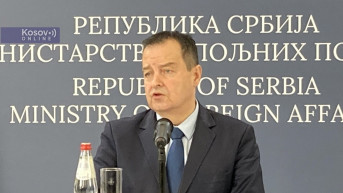
Minister of Foreign Affairs, Ivica Dacic, said that the meeting in Brussels had only confirmed Belgrade's fears that Kosovo Prime Minister, Albin Kurti, did not want to form the Community of Serb-majority Municipalities, adding that Serbia had to preserve its majority in the UN and the support of countries that had veto rights and were ready to use it, while at the same time trying to preserve the European road as much as possible, RTS reports.
Dacic said as a guest on the show "Takovska 10" that yesterday's meeting had been dedicated to two items that had been defined as priorities according to the implementation plan, the formation of the CSM and the Declaration on Missing Persons.
"That declaration was somehow agreed upon. It is in our interest that it be passed as soon as possible, without abusing the terms, because Pristina does everything calculated. More than 1,500 people are listed as missing and it is in our interest for Pristina to be cooperative because they do not allow certain locations to be searched. I think that this declaration should be the first step towards unconditionally meeting such demands, to find out the full truth," Dacic stressed.
He mentioned that he hoped that it would be a completely logical sequence, that the Commission for Missing Persons of Serbia would have free access to the territory of Kosovo.
"The second topic, the CSM, I think that we will spend these days listening to the same stories that we have been listening to for ten years. I participated in the Security Council session after the signing of the Brussels Agreement in 2013 when all members spoke enthusiastically about that act and that the plan was to form the CSM. Ten years have passed and nothing. Borrell said that the CSM had to be formed immediately. What does that mean “right now”, is that a month or ten years," Dacic asked.
For Serbia, says Dacic that is the number one condition.
"Even in the implementation plan, it is one of two issues. We believe that the CSM must be formed first, and then talk about further steps. They challenge the management team, and there will now be a relativization of importance, from names, and powers, to the statute, who writes the statute, who makes up the management team. Pristina does not want the CSM, that is, Kurti. We said that he was a “mine” for the entire peace process and we will see how it will unfold," Dacic emphasized.
Foreign policy in line with domestic policy
He points out that the foreign policy of a country cannot be a strategy by itself.
"It is also in line with the internal policy of a country. If we set as the first goal the protection of our sovereignty, then it is completely normal that all steps are in line with that, implying the rights of our people in Kosovo and Metohija, including the formation of the CSM, protection of sovereignty and integrity as much as possible in various international organizations. Our defense cannot be taking the word of some Western countries, but only the number, what is the number of countries that recognize and how many do not recognize, and how they vote", Dacic notes.
He states that a procedure has been initiated for the Council of Europe, and legal rapporteurs have been appointed, who have a deadline of two years to prepare it, so that, he adds, will certainly not be on the agenda at the summit in Reykjavík.
"In the act of voting, only votes for and against are counted. When you have 46 countries, two-thirds count there too. Those who abstain and those who are not present are not included in that number. This lowers the number that Kosovo needs to have to become a member. Only those who voted for and against are counted. That's why we fought for those who are against the independence of Kosovo to vote against it, and those who wanted to help them forced those countries to abstain. Those who were restrained do not help us. Then Kosovo in the UN does not need 70, but 65. In the first years, we had Iran and Iraq, they all abstained and then they tell you that it is good that they abstained. Azerbaijan was absent one year or was not in the hall. For the last seven or eight years, Azerbaijan has been firm and voted against," Dacic explains.
The vote of Greece, he says, was a surprise.
"If Mitsotakis as Prime Minister has ties to the Serbs, and I will remind you that his grandfather has a street in Belgrade if he says that Greece will not change its position if the President of Greece says that he will not change his position, I think that if there is a change, someone should inform us about to that. That's why we're asking for information. Is that the policy of Mitsotakis now? Tsipras declared that he was against it, whether it was Mitsotakis's decision or it was an independent decision of the Ministry of Foreign Affairs and Dendias," Dacic said.
Solidarity is important, he notes.
"We respect the territorial integrity of Greece on land, sea, and air. What does that mean, that it is a direct confrontation with Turkey," Dacic said.
"Pristina does not want the CSM"
The meeting in Brussels, he says, is only a confirmation of all our fears that Pristina absolutely “does not want to implement the Brussels Agreement, but also the agreements from Brussels and Ohrid, which is the CSM".
"We have reached the moment when it will have to be clearly visible. Germany insisted that they now vote on this in the Council of Europe, the procedures because it was Kurti's condition to be flexible about the CSM. What will be the further treatment of Kurti now, whether is cooperative or not? What are you rewarding him for, for saying he will be cooperative," Dacic asked.
He points out that there is a political struggle in Pristina over the formation of the CSM.
"The American Embassy organized the talks and that's why Escobar said that the CSM would be formed with or without Kurti. All this happened was supposed to be one more step in the normalization of relations. If every day you have some complication that Kurti advocates, what kind of normalization it is. Now they have tried to make a decision to open the bridge over the Ibar, and they will probably try to get to the premises, to try to take down the Serbian flag. Why is that, is it part of normalization, it is part only of the tightening of relations. I think that many who started to attack Serbia, now their focus is again on whether Kurti will implement something that they probably thought he would implement," Dacic said.
Dacic notes that he participated in the talks twice, when President Vucic spoke with Macron and Scholz and with Blinken and Borrell, he clearly told them what the red lines were.
"His approach is such that, without signing, he entered into a verbal acceptance that if the CSM is formed, then we can discuss the implementation of what we have committed to. He clearly said that we did not agree with the items with de facto or de jure independence and the admission of Kosovo to the membership of organizations from the UN family. If there is no CSM, the entire implementation plan is called into question. All those issues on major topics cannot be considered adequately without the formation of the CSM," Dacic emphasized.
He reminds that in the development of the situation after 1999 and after 2008, it was not known how everything would function when it comes to the institutions of Serbia in Kosovo.
"How the post office, the court in Gracanica, the education and health system will function. We wanted the institutions of Serbia; it was an opportunity for them to be replaced by the institutions of the Serbs from the Republic of Kosovo. No one could have any objections to that, because we are talking about people who live there. There was no violation of our territorial integrity," Dacic says.
Serbia will not give up on the CSM, without that, there is no progress
According to Dacic, from the beginning, there was a tendency to slow down the formation of the CSM.
"Thaci accepted it, we talked about it at the UN Security Council. The current leadership is not interested in the CSM and now they are slowly changing that expression, but as you can see, they will try everything to challenge the very idea of the CSM. Serbia will not give up on that, without it there is no further progress in the implementation of what was agreed," Dacic notes.
Foreign policy, he says, is not a love-hate relationship, but one of reciprocity.
"If we are correct regarding the issue of the integrity of Bosnia and Herzegovina, and we are, then why the question about it, is raised. There is no problem with that at all, but let's be correct to the end. Serbia also votes on some issues. When I say we respect the territorial integrity of Bosnia and Herzegovina, did Konakovic ever call to say congratulations? I hope we will have good cooperation," Dacic points out.
He indicates that President Vucic was not talking about changing foreign policy in terms of key commitments, but how the state will treat those countries that vote one way or another.
He says that Ukraine never voted for Serbia.
"Since 2015, they have never voted for us, sometimes they were outside the hall, sometimes they abstained. We don't want to be hostages of the relationship between Ukraine and Russia," Dacic said.
He states that Ukraine was against it until the vote in the Council of Europe, and then they asked for a break and received instructions.
"Moldova voted against it on the agenda, and then they abstained. This will backfire on them because Transnistria is not in Serbia, but in Moldova," Dacic says.
He notes that the foreign policy of the EU in some segments is not in accordance with the state or national interests of Serbia.
"The Embassy of Serbia remains in Tel Aviv. Israel has recognized Kosovo; I think that it has clearly stated its position. Maybe someone really thinks we are naive, but we are not that naive," Dacic adds.
He believes that during the voting in the Council of Europe, Montenegro could have at least abstained.
"I don't believe that those countries that abstained know more about Serbia and the Patriarchate of Pec than Montenegro does. There are no permanent friends and enemies in foreign policy, only permanent Serbian interests. Some of their issues will also be on the agenda. We as people sometimes try harder to befriend our enemies than to respect our friends. Friendship must be nurtured. We think that the relationship with other countries should be the way they have towards us and nothing more," Dacic said.
He notes that the fact that someone is bigger does not mean that he is more right.
"I have said several times that if a minister from Sweden should come and say that we have to introduce sanctions against Russia. What did the vote in the Council of Europe teach us? They say they love us, but they are stealing a piece of our country. I ask the one from Sweden if Sweden will vote for our territorial integrity if we lose the voice of Russia, nothing, then they are silent," the Minister of Foreign Affairs points out.
He states that those who say we don't look at the past, usually don't have it.
"And we have something to look at. The priorities of our foreign policy are known - the protection of sovereignty and integrity, the European path, friends, and relations in the region. Alignment with foreign and security policy with the EU is an obligation that Serbia has until the moment of joining the EU. If that moment was tomorrow, then we would probably do it. They don't just talk about sanctions against Russia. When we talk about the International Criminal Court, America doesn't recognize it. It's like us saying we don't recognize the Hague Court for our people. Here we are talking about the process. No one can tell us what time we can expect until joining the EU. If someone thinks that the Serbs will give up Kosovo, for the sake of the European path, it is such a delusion that it is simply insulting. Iceland withdrew from the European route because of fishing. Where do they get the right to pressure us to recognize Kosovo, because of its entry into the EU? Is that official foreign policy, but it is not. As important as it is for Serbia to enter the EU, I think it is for the EU as well it is important for this region to be a member of the EU," Dacic said.
He states that foreign policy as a strategic document does not exist.
"There is no turning back, we cannot say will not join the EU that we will not have relations with America, Russia, China, and so on. I think that in the coming days, most likely on May 12 and 13, we will discuss the visit of the Chinese Minister of Foreign Affairs. One of the messages for us and the lesson is how to behave in the UN, according to Strasbourg. We must not lose the majority in the UN and the support of countries that have the right of veto and are ready to use it, while at the same time trying to preserve our European path as much as possible," Dacic points out.
Dacic asked what they would do with the procedure in the Council of Europe if Kurti said that he would not form the CSM.
"They will have to stop it, there is no constant there. It is the only territory that was voted for admission to the Council of Europe," Dacic said.
0 comments