
Dacic: Pristina threatens the survival of the Serbs in Kosovo; the seriousness of the situation must be understood
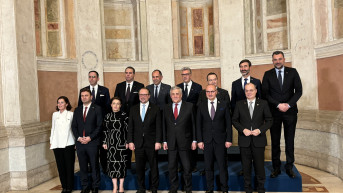
Pristina persistently and continuously, through unilateral actions, seriously destabilizes the situation and jeopardizes the basic rights, security, and survival of the Serbs in Kosovo, as evidenced by the latest move to abolish the dinar, which not only worries but also calls into question the survival of the Serbs and the dialogue process itself, Serbian Minister of Foreign Affairs Ivica Dacic stated tonight in Rome.
Therefore, Dacic pointed out, it was completely incomprehensible that the only reaction from the international community was an appeal to postpone such decisions, without considering whether they were in line with all previously reached agreements and what consequences they would have on people's lives.
"Serbs are subjected to unbearable living conditions. Therefore, it is not clear how it is possible to appeal only for postponing a decision whose goal is the expulsion of one nation from its centuries-old hearths. I hope that the entire international community will truly understand the seriousness of the current situation. We will do everything to protect our people in Kosovo and Metohija, and I hope also with your support," Dacic addressed the participants of the Ministerial Meeting on the Western Balkans.
He said that Serbia was aware that the EU expected constructive engagement from Belgrade in the dialogue with Pristina, but also emphasized that it would be normal to expect the same from Pristina.
"And it is more than clear that Belgrade is the one being constructive, but unfortunately, that is not enough for the success of this process. The other side must act in the same way. How can anyone in the EU expect success in a dialogue where Pristina persistently refuses to fulfill its long-standing obligations? How is it even possible to tolerate Pristina's complete disregard for the Agreement of which the European Union itself is the guarantor? We have no answer to these questions - for over a decade now," the head of Serbian diplomacy stated.
Dacic also pointed out that Serbia's commitment and readiness to resolve the Kosovo issue peacefully reflected the strength of the state, not weakness, as some tried to portray.
He emphasized that Serbia was committed to peace.
"I want to believe that commitment to peace, resolving all issues through dialogue, and finding ways for a more stable and prosperous future for all European citizens - are exactly the goals we all aspire to sitting at this table today. Only a united Europe can achieve this goal. We have no time to waste," Dacic said.
He especially thanked Italy and Foreign Minister Antonio Tajani for organizing the meeting, adding that the support of the Western Balkans Friends Group was of great importance and highly appreciated.
Dacic also stated that although we often heard that the EU enlargement policy was a priority, there were not many who, like the countries in this Group, were truly sincere and dedicated in their intention to support the Western Balkans on that path.
"It has been thirty-one years since the adoption of the so-called Copenhagen criteria, twenty-one years since the presentation of the Thessaloniki Agenda, and more than ten years since the last enlargement of the European Union. Unfortunately, it took a conflict in Ukraine for the EU enlargement policy to gain new momentum," the Serbian Minister noted.
He underscored that the enlargement policy was in the interest of Serbia, the Western Balkans, as well as the EU, and all its current and future members.
"I believe that the Growth Plan for the Western Balkans was adopted by the European Commission precisely in this spirit, with announced financial assistance of six billion euros for its implementation. We are ready to work seriously and responsibly on its realization, believing that this initiative will further strengthen and bring our economies and societies closer, and, hopefully, accelerate the European integration process of our region. On the other hand, what we seek is fair and equal treatment for all partners from the Western Balkans in this initiative, and we are against any politicization or political conditioning of participation," Dacic emphasized.
Stating that nothing is perfect, not even the European Union, Dacic pointed out that the EU, with all its virtues and flaws, crises, and successes, was still the most successful policy for peace, stability, and economic development in the world.
"Therefore, the reconciliation of partners in the Balkans, as well as the speed of economic development in our region, will depend, among other things, on the readiness of the European Union to accept future members," Dacic added.
According to him, Serbia sees itself as a future EU member, which is the priority goal of its foreign policy, to which the country is fully committed, aware that reforms are the key to the success of European integration.
"We are not asking for someone else to do our 'homework' for us. Neither are internal reforms the end goal, nor do we implement them for someone else, but to make our country a better place to live. What we expect is for the EU, with more trust and fewer prejudices, to more decisively implement the enlargement policy towards the Western Balkans and the Republic of Serbia," Dacic stated.
He expressed dissatisfaction with the prolonged process of Serbia's European integration, stating that there was no objective reason for its delay. He remarked that the procrastination and slowdown of the process negatively affected political and economic flows in the region, which, like the EU, needed stability and predictability.
"To be honest, Serbia is currently stagnating in its European integration process due to issues regarding the alignment of its foreign policy with the EU, largely because of our stance on the war in Ukraine. I must reiterate that in this conflict, Serbia is not neutral. We support the efforts of the EU, as well as all other international actors, to find a peaceful solution to the conflict in Ukraine," Dacic indicated.
He added that Serbia is often criticized for not being fully aligned with EU declarations.
"Let me repeat once again - European integration is our strategic goal and interest, but it is not the only one. In politics, as in life, it is most difficult to reconcile different goals, and we cannot afford to jeopardize all others for the sake of one goal. Furthermore, our obligation is to gradually align our foreign and security policy with EU policies, and judging by the current alignment rate of around 65 percent, I would say that we are doing just that," Minister Dacic stated.

0 comments