
Dacic: Solution only through dialogue; Serbia has three red lines
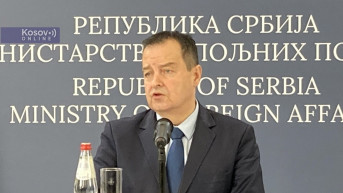
Any attempt to resolve the Kosovo issue was possible only through the establishment of a dialogue mechanism between Belgrade and Pristina, stated today the Minister of Foreign Affairs of Serbia, Ivica Dacic, at the traditional reception for members of the Government of Serbia and the diplomatic corps on the occasion of the celebration of the New Year according to the Julian calendar, adding that Serbia had three red lines.
Dacic emphasized that everything that had been signed so far had to be implemented, including the valid UN Security Council Resolution 1244, the Brussels Agreement, especially the part concerning the formation of the Community of Serb-majority Municipalities, the Washington Agreement, and everything else.
He pointed out that Serbia could not recognize Kosovo's independence and agree to Pristina's membership in the United Nations, as well as that the third red line was to ensure the rights and complete security of the Serbs in Kosovo.
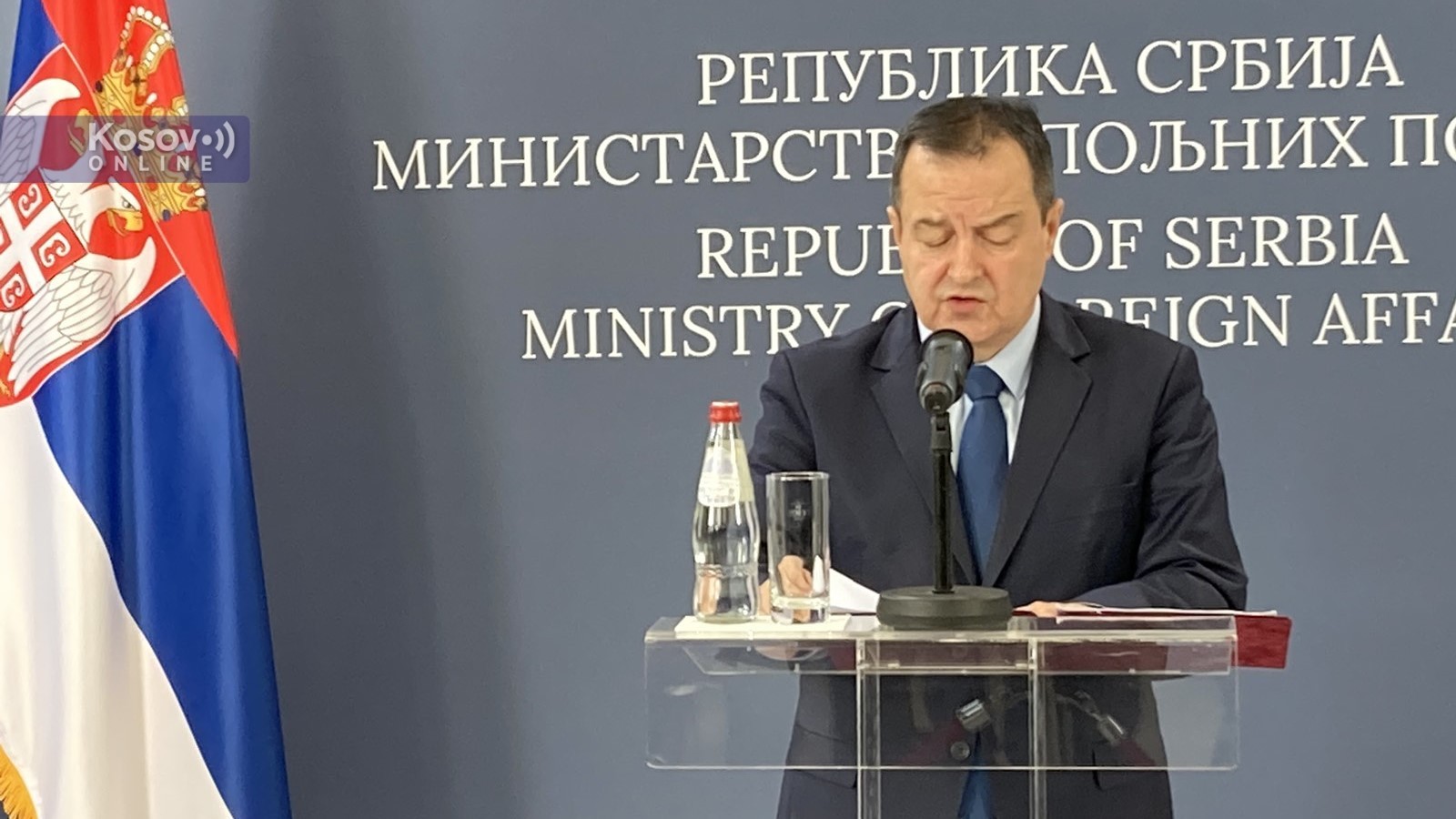
Dacic said that Serbia had been surprised by the selective interpretation of international public law and thanked the countries that did not recognize the unilaterally declared independence of Kosovo, as well as those that had changed their positions or would correct them.
He emphasized that the solution had to be based on a compromise with full respect for the positions and interests of Serbia.
Dacic pointed out that the leadership in Pristina continued to consciously cause tensions and thus created an atmosphere of mistrust.
"Even in the past year, you saw our full commitment to the dialogue in Brussels, which testifies to our sincere determination to find solutions to the existing problems. At the same time, we represent a clear, firm, and consistent position that any solution must be based on compromise, with full respect for our positions and interests. Unfortunately, we are witnessing that the current leadership in Pristina continues to deliberately and systematically provoke tensions, creating an atmosphere of mistrust through unilateral moves. The last in a series of consequences of Pristina's destructive behavior is the attempt to kill Serbian children near Strpce on Christmas Day, on the eve of the most joyous Christian holiday - Christmas, and also the arrests. We believe that a wider condemnation of such actions and incidents by the international community is needed, with proper observation of the causes that led us to the current situation," Dacic said.
The international missions of KFOR, UNMIK, and EULEX, as he pointed out, had special importance for the Serbian community in Kosovo.
"The security situation in the Province requires, unfortunately, if not a greater, at least an undiminished presence of these missions. In addition, our multilateral activities are also subordinated to the protection of our vital interests in international forums, and I primarily mean the prevention of the so-called membership of Kosovo in international organizations. Our position is that at this stage of the dialogue, we must be fully focused on finding a compromise solution and that the much-needed attention in the dialogue should not be wasted. That is why it is also unacceptable to tolerate Pristina's efforts to use the current international situation to fulfill its political agenda," the head of Serbian diplomacy said.
As he added, Serbia would continue its strong engagement in order to preserve peace and stability; would continue to defend international law, especially the part that related to the territorial integrity and sovereignty of the UN member states.
Dacic, in his speech, announced that Serbia's diplomatic activities in the coming period would also be directed towards foreign policy priorities, namely the preservation of sovereignty and territorial integrity and full membership in the EU. He also listed the development of good-neighborly relations and regional cooperation; the improvement of bilateral relations with all countries, and the special nurturing of traditional friendships as priorities.
The head of Serbian diplomacy said that peace in the world was threatened today and that the war in Ukraine had taken on the character of a world conflict with enormous consequences for the world. He underlined that Serbia stood for peace and respect for the universal principles of international law.
"The preservation of sovereignty and territorial integrity is a priority of our state order, and the state directs our foreign policy activities accordingly," Dacic emphasized.
He said that Serbia still believed that full membership in the EU was achievable and that the promise from Thessaloniki was a realistic and achievable goal. Fulfilling the criteria, in this regard, remained, he announced, one of the key foreign policy priorities, which was also the strategic goal of all governments in the previous 20 years.
Dacic assessed that it was necessary to keep the European perspective alive because it was a catalyst for reforms and prosperity, but he added that tangible progress in the negotiations was necessary while at the same time increasing the readiness of individual EU members to accept new members.
Dacic sees a chance for a breakthrough during Sweden's current presidency of the EU Council.
"Only with the full integration of the Western Balkans can the EU project be successfully completed, which will start the possibility of uniting the European continent," he said.
He also reminded that Serbia, since it had not yet became a member state and did not participate in the creation of the EU's foreign policy, had the obligation to gradually harmonize its foreign and security policy with the EU, and it was incorrect to expect progress in moments when there was no concrete progress and when the readiness for the admission of new members was questionable, especially when the territorial integrity and sovereignty were threatened at the same time.
Dacic emphasized that Serbia was ready to redefine relations with its neighbors by overcoming open issues from the past.
This, he underlined, had also been demonstrated by his recent trip to Zagreb.
The New Year's reception at the Ministry of Foreign Affairs was attended by, among others, ministers Tanja Miscevic, Tomislav Zigmanov, Djordje Milicevic, Novica Toncev, Tomislav Momirovic, as well as ambassadors of world powers (US) Christopher Hill, (Russia) Aleksandr Botsan-Kharchenko, the head of the EU delegation Emanuele Giaufret, and others.

0 comments