
Diocese: Pristina obstructs restoration of church in Gorazdevac through pressure and threats
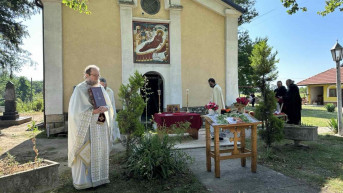
The Raska-Prizren Diocese has stated that Kosovo institutions have halted the restoration work on the Church of the Nativity of the Most Holy Theotokos in Gorazdevac by exerting pressure and threats on the workers. Following the Divine Liturgy in front of the church, the abbot of the Visoki Decani Monastery emphasized that it is clearly stipulated that the Serbian Orthodox Church (SOC) has the full right to manage its property and restore its heritage. He called on international institutions to do everything possible to end the practice of selective law enforcement and pressure from Kosovo institutions in Pristina.
The Diocese noted that on the Feast of All Serbian Saints, the second Sunday after Pentecost, a Holy Liturgy was served in the village of Gorazdevac near Pec, in front of the Church of the Nativity of the Most Holy Theotokos.
The Liturgy was served by Archimandrite Sava, Abbot of Visoki Decani Monastery, with the concelebration of Archpriest Nenad Naspalic and Protosyncellus Petar Decanac, and in the presence of the faithful from the surrounding areas, including many children.
The service was held with the blessing of Metropolitan Teodosije of Raska and Prizren. According to the Diocese, the main reason for the gathering was to encourage the faithful who are currently facing serious obstacles from Kosovo institutions in Pristina in completing the restoration of their church and securing the respect of basic religious rights.
In his pastoral sermon, Archimandrite Sava emphasized the deep historical and spiritual significance of Gorazdevac and its shrines, such as the ancient wooden chapel of the Holy Prophet Jeremiah, and reminded that the Serbian people in these areas have testified to their faith for centuries, remaining loyal to the Church and to God.
He stated that Christian shrines are not merely cultural heritage, but living witnesses and signs of God’s presence and of the encounter between man and God in the Holy Eucharist. Any attempt to obstruct liturgical life, he said, is experienced as a deep wound on the body of the Church and an act of religious persecution.
The abbot of Decani particularly highlighted the current problem of the halted restoration of the Church of the Nativity of the Most Holy Theotokos in Gorazdevac by Kosovo institutions from Pristina.
“The works, which began last year with the knowledge of the Pec municipality, have recently been stopped under pressure from the police authorities in Pristina and threats directed at the workers, including local Albanian craftsmen hired by the church parish,” the Diocese stated.
Archimandrite Sava emphasized that the works were stopped without any legal basis, even though, as he said, it is clearly stipulated that the SOC has full rights to care for its property and to restore its heritage.
“In accordance with this principle, Kosovo institutions themselves had committed years ago to assist in the realization of these rights—not to act as a force violating religious rights and freedoms. The restoration of religious buildings, especially a church built in 1925, is not a provocation but rather an expression of the desire of the parish in Gorazdevac to continue regular church life and enjoy its legally guaranteed religious rights,” said Father Sava.
Continuing his sermon, Abbot Sava conveyed a strong and resolute appeal from the Raska-Prizren Diocese to international representatives.
“Our Diocese once again calls on all people of goodwill, representatives of international institutions, and the civilized world to do everything to end the practice of selective law enforcement and pressure from Kosovo institutions in Pristina, which prevent the Church from carrying out its pastoral mission guaranteed by law. Our people are not asking for anything more than what is customary and recognized around the world—the right to pray, gather, build, repair, and preserve their holy sites, without infringing on the rights of any other community,” the abbot said.
Expressing support for the local parish priest, Archpriest Nenad Naspalic, and the faithful, Archimandrite Sava also conveyed the blessing and support of Metropolitan Teodosije, stating that the Raska-Prizren Diocese has always supported dialogue and cooperation. Though the political circumstances are difficult, the Church’s message remains clear.
“We will not stop witnessing the truth of Christ, always remaining ready to live together with full respect for all people of goodwill. If this right is taken away from us, we will serve the Holy Liturgy wherever necessary… in the fields, in the forests. Just as Christians endured persecution in the catacombs, we too testify today that the Church lives, and that the Kingdom of God is not of this world but is present wherever people gather in love and in God’s truth, offering gratitude to God,” said Abbot Sava.
Archimandrite Sava told the media present that the Raska-Prizren Diocese and its faithful have in recent months been facing systematic violations of basic rights.
“In light of the increasingly frequent denial of basic human rights to a peaceful and dignified life, arbitrary arrests and persecution based on ethnic and religious grounds, unfounded accusations, intimidation of citizens, tolerance of break-ins and desecration of Serbian Orthodox churches, and the obstruction of normal access to all SOC holy sites, the Serbian people rightly perceive such behavior by Kosovo institutions as open persecution. This is contrary to both Kosovo laws and international standards, particularly to the messages of foreign representatives that the destabilization of security in Kosovo and Metohija is against international interests and those of all peace-loving citizens in this region,” the statement said.
The Raska-Prizren Diocese once again emphasizes that it remains firmly committed to peace, dialogue, and respect for the law, but equally expects that Kosovo institutions and the international missions present on the ground will guarantee the right of the Serbian Orthodox Church and its faithful to freedom of religion, unhindered use of their property, and the protection of the cultural and spiritual heritage the Church has cared for over the centuries.
0 comments