
Diocese of Raska-Prizren: Vidovdan must not become a cause for fear, arrests, and humiliation
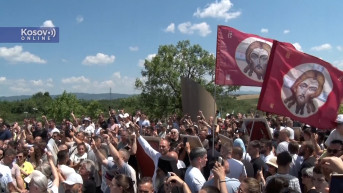
The Diocese of Raska-Prizren has expressed deep concern and its strongest protest over the conduct of the Kosovo Police during and after the Vidovdan commemoration at Gazimestan, stating that the detention of worshippers following the religious service cast a shadow over the dignified and prayerful observance of one of the most significant holidays of the Serbian people in Kosovo.
In a statement, the Diocese noted that this year's Vidovdan was marked by a Divine Liturgy at the Gracanica Monastery and a memorial service (parastos) for the Kosovo heroes at Gazimestan, in a peaceful atmosphere and without incidents.
"The faithful, clergy, and bishops gathered peacefully, with no intention of provoking or threatening anyone, but rather to pray to God, remember those who perished, and affirm the spiritual meaning of Vidovdan, which has lived for centuries in the memory of the Serbian Orthodox Church and its people," the Diocese of Raska-Prizren stated.
The Diocese emphasized that it is particularly troubling that, according to official Kosovo Police data, 37 ethnic Serbs were detained, while misdemeanor proceedings were initiated against 36 of them, despite the police's own statement that no incidents occurred during the commemoration.
"If the gathering was peaceful, then the public has every right to know on what specific, clear, and verifiable grounds the mass detention of worshippers was carried out after the conclusion of the religious service. Particularly unacceptable were the deeply degrading access-control measures at the Gazimestan memorial, which, according to published footage and testimony from numerous individuals and media outlets, went far beyond legitimate security concerns and constituted a form of harassment based on ethnic and religious grounds," the Diocese stressed.
The Diocese further stated that the Church neither condones nor will ever condone any incitement to hatred, violence, or the disruption of public order, but that religious and national identity must not be treated as a threat.
"Prayer, traditional folk songs, remembrance of one's ancestors, wearing traditional clothing, and the peaceful expression of religious and national identity cannot, in themselves, be regarded as a threat to public order. Moreover, numerous Albanian national gatherings take place with a far greater display of national symbols and staging, without being subjected to even remotely comparable policing methods," the statement reads.
The Diocese pointed out that, this year, the faithful came to Gazimestan without displaying national symbols precisely because of the previously announced restrictions.
"If even such conduct was not sufficient to allow Vidovdan to be celebrated peacefully and without degrading measures, then it is legitimate to ask whether the Serbian people in Kosovo and Metohija are gradually being deprived not only of the right to display their symbols, but also of the right to sing, to remember, to gather with dignity, and ultimately, to celebrate Vidovdan itself," the statement emphasized.
The Diocese also expressed particular concern over allegations of physical and psychological abuse of those detained.
"The Diocese has received, with profound concern, testimony alleging that some detainees were subjected to physical and psychological abuse, slapping, beatings, insults, threats, humiliation, as well as allegations that they were forced to chant 'Kosovo Republic' under threat of being beaten. These allegations must be thoroughly investigated and verified," the statement said.
It added that reports indicating that one of the detainees was a minor are particularly alarming, as are reports that journalists were obstructed in their work and subjected to degrading security checks.
The Diocese welcomed the decision of the Kosovo Ombudsman to launch a preliminary investigation into allegations of abuse and humiliation of detained Serbs, while simultaneously calling on the Ombudsman, the Kosovo Police Inspectorate, judicial and prosecutorial authorities, as well as international missions—particularly the OSCE and EULEX—to conduct an independent investigation.
"It is essential to establish the legal basis for each individual detention, determine whether the measures taken were necessary and proportionate, whether there was any abuse of authority or degrading treatment, whether minors and journalists were protected in accordance with the law, and whether the police acted impartially and without ethnic or religious bias," the statement noted.
The Diocese stressed that while ensuring the security of public gatherings is a legitimate responsibility of the competent authorities, it must never become a pretext for violating fundamental rights.
"The presence of police at a religious and memorial gathering should serve to protect the faithful and enable the event to proceed peacefully, rather than instill fear, uncertainty, and the feeling that those present are automatically viewed with suspicion simply because of their identity," the statement emphasized.
The Diocese of Raska-Prizren called on the international community to ensure the consistent implementation of standards for the protection of human rights and religious freedoms, while urging the faithful to remain calm and dignified.
"We are not asking for any privileges, but only for the minimum rights that every authority wishing to present itself as democratic must guarantee to every individual and every community. These include the right of people to pray, to remember their deceased, to sing their songs, to preserve their traditions, and, after prayer, to return home without fear that someone will be detained, humiliated, or punished simply for being part of their people and their Church," the Diocese of Raska-Prizren concluded.



0 comments