
Djuric in Przno: I highlight the position of Serbs in Kosovo and Metohija at every opportunity; we are witnessing the erosion of all their rights
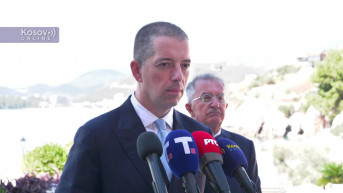
Serbian Foreign Minister in the caretaker government Marko Djuric said today, following a meeting of foreign ministers within the Berlin Process in Przno, that he always and at every opportunity emphasized the importance of the position of the Serbian people in Kosovo, where, he said, there had been a regression in both the collective and all other rights of Serbs. Djuric also stressed that there could be no European future for the Balkans without a European future for Serbia.
Djuric told reporters that representatives of Pristina had also attempted at this gathering to sideline the issue of the position of the Serbian people in Kosovo.
“What was interesting from the perspective of the Belgrade-Pristina dialogue was that representatives of Pristina attempted to sideline the issue of the position of the Serbian people in Kosovo and Metohija by raising the position of our fellow citizens and neighbors, the Albanians in Presevo, Bujanovac and Medvedja, even though no parallels can be drawn,” Djuric said in response to a question from Kosovo Online.
He said this amounted to a politically motivated attempt to divert attention.
“Of course, this is a politically motivated attempt to divert attention from the fact that, in Kosovo and Metohija, we have for a long time been witnessing a regression in the collective and all other rights of Serbs, as well as the unconstructive conduct of Kurti’s government,” the Minister said.
In that regard, he said that the latest action taken by the Pristina authorities had effectively been to invalidate the mandates of Serbian judges and prosecutors who, in agreement and coordination with Belgrade and the EU, had sought to return to their positions and had withdrawn their resignations. Pristina, however, had unlawfully annulled their appointments by accepting resignations that had already been withdrawn.
“Of course, Serbia will not fall into the trap of failing to emphasize, at every opportunity and in every forum, the importance of the position of our people in Kosovo and Metohija. We are about to continue this meeting in a luncheon format, where there will certainly be discussion of the problems and rights of our people. I will certainly raise this issue,” Djuric announced.
No European future for the Balkans without a European future for Serbia
The Minister said that the Serbian delegation had conveyed important messages, emphasizing that the two key words for the future of Serbia and the region were stability and a forward-looking approach.
“That was also the spirit of my address at this summit, where I spoke about Serbia as a country that has, on the one hand, embraced regional cooperation, while also being a driver of economic development in our region, given that Serbia’s economic growth last year was 3.8 percent, compared with 0.3 percent in the eurozone. This demonstrates that our country can make a substantial contribution to Europe’s development,” Djuric explained.
He stressed that Serbia was centrally located in the Western Balkans and that there could be no European future for the Balkans without a European future for Serbia.
“My remarks were conciliatory and forward-looking. Unfortunately, not everyone adopted an equally benevolent and progressive approach. There were attempts, particularly by my colleague Konakovic, to misuse this summit during the final days of his election campaign by directing a series of insults at Serbia and its elected representatives and attempting to portray our country in the worst possible light—as some kind of heir to war crimes, an oasis of intolerance, fixated on the past. All of that is the exact opposite of what Serbia actually is,” Djuric stressed.
He said that he had found a dignified and civilized way to point out to his colleague from Bosnia and Herzegovina—who, Djuric said he was convinced did not enjoy the support of either citizens or political actors in his country for such a position—that this was the wrong approach.
Djuric expressed optimism that, once all electoral processes in the region were completed, positive momentum for cooperation would be restored.
“In Serbia, we certainly will [contribute to that]. I am convinced that Serbia, as the region’s economic leader in terms of growth and a centrally located country, will play a key role in the period ahead,” he stressed.
Djuric noted that Serbia had demonstrated within the Berlin Process in the past that European integration, stability and the region’s economic development were at the heart of its policy.
We need more Europe, but in practical terms
Asked about the initiative to expand gradual integration into the EU, which is due to be discussed in Brussels on October 6, Djuric said that more Europe was needed, but in practical rather than ideological or bureaucratic terms.
“We need our people not to spend hours waiting at borders. We need our goods—not least because Serbia accounts for 57 percent of the regional economy—not to be held up at borders. We need to eliminate roaming charges in the countries of the region. Serbia supports all of that,” the Minister said.
He recalled that former Serbian President Aleksandar Vucic had several months earlier supported a vision under which the entire region would be included in the Schengen Area and the Single Market, adding that there was no need to wait because this did not depend on funding from Brussels or on the complicated decision-making mechanisms of the Member States.
“If we all support a European Balkans, this is something that should be relatively easy to achieve,” Djuric said, adding that several countries and officials present at today’s meeting shared a similar approach.
He also said that it was important for countries such as France and Germany to be represented at gatherings of this kind, noting that the presence of German Foreign Minister Johann Wadephul was one of the notable features of today’s summit.
Today’s meeting in Montenegro brought together foreign ministers from the Western Balkans, senior representatives of countries participating in the Berlin Process, the European Union and regional organizations.
comments