
Djuric: By transferring the dialogue to the so-called Ministry of Foreign Affairs of Kosovo, Pristina sought to emphasize its position on independence
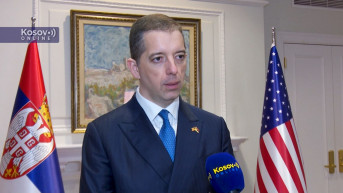
Serbian Minister of Foreign Affairs Marko Djuric stated in Washington, in an interview with Kosovo Online, that by deciding to “transfer the dialogue to the so-called Ministry of Foreign Affairs of Kosovo,” Pristina likely intended to once again “signal its position on the independence of Kosovo and Metohija.” However, he stressed that the situation is far more complex than that and that Serbia maintains its position that the issue of Kosovo and Metohija is an internal matter.
After Kosovo’s new foreign minister Glauk Konjufca informed EU Special Representative for the Dialogue Peter Sørensen that the dialogue would henceforth be led by Kosovo’s Ministry of Foreign Affairs, Djuric pointed out that he does not forget the fact that Konjufca’s political party, Self-Determination, once called its program and slogan “No to negotiations.”
“Even if that may appear to have changed superficially, I would be surprised if there were a more constructive position in substance, and that has nothing to do with who personally serves as chief negotiator. On our side, of course, the Ministry of Foreign Affairs of the Republic of Serbia supports our negotiating team led by the Director of the Office for Kosovo and Metohija, Petar Petković, but the Ministry itself is not directly at the table because for us the issue of Kosovo and Metohija is an internal matter. By transferring the dialogue to the so-called Ministry of Foreign Affairs of Kosovo, they likely wanted to signal their stance on the independence of Kosovo and Metohija in yet another way,” Djuric said.
He emphasized, however, that matters are much more complicated.
“What we need is dialogue, not unilateral, uncoordinated action and the imposition of solutions that one of the constituent ethnic communities—the Serbian people—does not accept. We need compromises, serious long-term solutions, friendship rather than conflict. Over the past three and a half years, I have not seen goodwill for that on the part of Kurti’s government. I would be positively surprised if there were signals in that direction, but I deeply doubt it,” Djuric stated.
Asked whether the United States under Donald Trump could be more favorable toward Pristina, given the high hopes it places in the Peace Committee, Djuric said that political elites in Pristina and among Albanians in the region are undoubtedly making strong efforts to retain the support they have traditionally enjoyed within U.S. political circles, but much, he stressed, is in Serbia’s hands.
“Much depends on us. We have a historic opportunity to reshape the narrative about events in our region, and here in the United States we truly have partners willing to hear the Serbian side of the story. Let us not forget that the strategic dialogue with Pristina has been frozen, among other reasons, due to concerns about the position of the Serbian people in Kosovo and Metohija,” Djuric emphasized.
He added that he is in the United States precisely to ensure that Serbia’s voice is better heard—to speak about the position of the Serbian people in Kosovo, about the concrete problems affecting people’s lives, obstacles in daily life, political prisoners, and the challenges faced at every turn.
“Our goal is to preserve peace, to be future-oriented, and to build excellent relations with the United States, which we see as a partner in protecting Christian heritage and the Serbian Orthodox population in Kosovo and Metohija,” he underlined.
Djuric reiterated that he is also participating in an important conference related to U.S.–Israeli relations organized by AIPAC, where there will be opportunities on the sidelines to advocate for Serbian interests.
“I am always satisfied when we can work effectively, with a strong team, to realize the potential of U.S.–Serbian relations and to strengthen Serbia’s position in Washington. It is not always the easiest task—politically in terms of perception at home, nor on the ground—but I know it is in the highest state and national interest,” Djuric said.
When asked whether AIPAC could help improve understanding of the situation in Kosovo, the minister noted that it is important that the existing friendship between Serbia and Israel is beginning to extend into U.S.–Serbian relations, as Serbia can gain much within that “triangle” and strengthen its position in Washington.
“Serbs have traditionally been friends of the Jewish people, whom they have always sought to protect when others tried to kill, exterminate, and eliminate them. That may not be sufficiently known within political circles here. But beyond our honorable past, which sets us apart from some others, we are also connected by the future, because Serbia is a country with great potential—more than others who present themselves as friends but, neither in numbers nor in genuine sentiment, are natural partners. We are not here to lobby against anyone, but to lobby for Serbia, for Serbian interests, and to ensure that the truth about our people—both in Kosovo and Metohija and elsewhere—is heard as clearly as possible,” Minister Djuric concluded.

0 comments