
Djuric: We demand for those who carried out the attack on the canal and who the political instigators are to be found
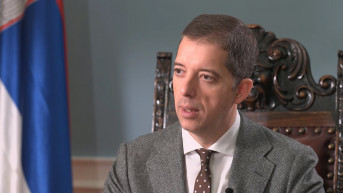
In relation to the attack on the Ibar-Lepenac canal, Pristina has demonstrated "malign intentions" but has achieved none of its goals, stated Serbian Minister of Foreign Affairs Marko Djuric. In an interview with Newsmax Balkan, Djuric emphasized that Serbia seeks a thorough investigation to determine not only who carried out the attack but also who the political instigators are, stressing that the attack undoubtedly had a political background.
"We are not rushing to make accusations, but it is telling that Albin Kurti seems to be trying to extract the most political benefit from this," Djuric observed.
He pointed out that Kurti's aim was to immediately deploy "illegal armed forces" in northern Kosovo, a goal he failed to achieve, just as he failed to create an international atmosphere similar to the one following the events in Banjska.
Djuric also noted that Kurti intended to burden the Serb List ahead of the elections in Kosovo, potentially ban its activities, and weaken and break the political capacities of the Serbian community.
"They have not succeeded in any of their goals," Djuric emphasized, adding that another objective was to boost Kurti's standing among extremist circles. How successful they were in that regard, he said, remains to be seen.
He pointed out the peculiarity of Kurti accusing not only Belgrade but also Hashim Thaçi, who is currently in The Hague, of the attack, which has been negatively received among Albanians in Kosovo.
Djuric stated that Kurti’s regime's manipulations failed to achieve their aim of slowing down Serbia's European integration, as a significant part of the international community did not take seriously what he described as unsubstantiated accusations against Serbia.
According to him, the unserious manner in which the accusations against Serbia were made, immediately after the attack, clearly shows that they were politically motivated.
Djuric stressed that Belgrade insists on establishing both who carried out the attack and the political responsibility behind it.
"We must establish who the political instigator of the attack was, as it undoubtedly had a political background," Djuric said.
He also mentioned that part of Kurti's frustration stems from the fact that he no longer enjoys the "blank check" support from major powers as he did in the past.
However, Djuric noted, this does not indicate a dramatic or drastic shift in the stance of major powers, including the U.S., toward Kosovo. He expressed a well-founded hope and expectations in Serbia that an excellent dialogue with the new U.S. administration could be developed on this sensitive topic of Kosovo.
He added that Serbia's longstanding efforts and relationship-building with the U.S., in which he himself participated as the former ambassador in Washington, provide a basis for such optimism.
"This process does not happen overnight but is part of long-term strategic efforts. I was involved in building a Serbian lobby in the U.S. Serbia has opened itself up to cooperation with the U.S. Starting with the economy, where we’ve had excellent results, this cooperation has expanded into other areas," Djuric said.
He highlighted the importance of KFOR’s commander confirming Serbian President Aleksandar Vucic’s statement that Kurti requested, within minutes of the incident, that the Kosovo Security Forces (KSF) enter the north, a request KFOR rejected.
This, Djuric stressed, was a result of Serbia's proactive approach, as Serbian Armed Forces Chief of Staff General Milan Mojsilovic established contact with Admiral Stuart Munsch, commander of NATO’s Joint Forces Command in Naples, presenting Serbia's arguments.
Djuric also conveyed that the Serbian Armed Forces received high professional marks for their conduct in this situation, demonstrating seriousness and responsibility despite challenging circumstances.
"We demand a full investigation to determine who carried out the attack and who the political instigators were, as they attempted to undermine Serbia's international position and that of the Serbs in Kosovo, achieve military occupation of the north, and aid Kurti in the elections," Djuric reiterated.


0 comments