
Andric Rakic: Diocese's appeal primarily calls on the EU to protect the rights of the Serbian Orthodox Church
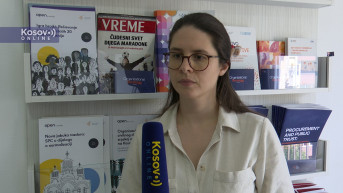
The Executive Director of the New Social Initiative, Milica Andric Rakic, assessed that, through its recent statement on the increasingly difficult position of Serbs and the Serbian Orthodox Church (SOC) in Kosovo, the Diocese of Raska and Prizren was primarily calling on the international community to use its influence to ensure that the Kosovo authorities respect the key mechanisms established for the protection of the SOC.
"In essence, through its statement, the Diocese was urging the international community to exert its influence on the Kosovo authorities to ensure compliance with the key protection mechanisms, above all the Implementation and Monitoring Council responsible for overseeing the implementation of the Law on Special Protective Zones. I assume they expect the greatest support from the European Union, which, after all, also has obligations under Kosovo's Reform Agenda, as well as within Kosovo's EU accession process, which Pristina itself describes as one of its key foreign policy objectives. There are numerous mechanisms through which the EU can insist on the consistent implementation of all protection measures," Andric Rakic told Kosovo Online.
She believes that the European Union is the primary addressee of the Diocese's appeal, followed by the United States.
"There is also the fact that the status of the Serbian Orthodox Church has repeatedly been mentioned during the dialogue as an issue requiring further work and resolution. I believe the EU is their primary point of reference. After that, I assume, come the United States, namely the U.S. Embassy, as it has previously been heavily engaged in resolving issues concerning the Serbian Orthodox Church in Kosovo, particularly the ownership dispute involving the Visoki Decani Monastery. That is why I believe these are the primary addresses to which the Diocese is appealing," Andric Rakic said.
Speaking about the experience of civil society organizations in communicating with Kosovo institutions, she noted that their experience has been very similar to that described by the Diocese and that the problems they raised generally failed to receive an adequate response.
"Our experience with Kosovo institutions has been very similar. With assistance—sometimes directly, but more often through embassies or international organizations engaged in mediation—we sought to address some of the community's problems in cooperation with Kosovo institutions, particularly with EU support. However, our experience has been much the same. Most often, we encountered either outright denial of the problems we highlighted or, even when the Government acknowledged that those problems existed, they ultimately remained unresolved. All of that engagement with the Government produced no tangible results and brought no improvement in the position of the community," Andric Rakic stressed.
According to Andric Rakic, the Diocese's statement also suggests concern over the possible withdrawal of KFOR from its role as the security provider for the Visoki Decani Monastery.
"The statement suggested that the Serbian Orthodox Church harbors a certain degree of concern that KFOR might withdraw from its role in protecting the Decani Monastery. Consequently, there is also a lack of confidence in the Kosovo Police, which would be the only institution capable of assuming that responsibility. I assume this is precisely why the Church has launched this appeal—to try to prevent any transfer of responsibility because, unfortunately, it does not have confidence in the Kosovo Police as a security force capable of preventing a potential escalation of interethnic tensions. That is precisely the scenario for which KFOR has been tasked with securing the Decani Monastery," she said.
Commenting on possible reactions from the international community, she assessed that the EU, the United States, and the leading European countries should respond to the Diocese's appeal, although she does not expect them to do so publicly.
"In this case, I do not expect anyone to publicly state that they accept the arguments put forward by the Serbian Orthodox Church or openly advocate its positions. In general, the approach of the international community has changed over the past two or three years. Although they remain engaged on certain issues, they now do so in a much more subtle manner. In other words, they no longer speak publicly or apply public pressure on the Government of Kosovo, as used to be the case, when you could see an embassy openly criticizing a particular policy and stating that it had to stop. Such public statements have become increasingly rare. Pressure still exists, but it is conveyed primarily through private messages to the Government of Kosovo rather than through public channels," Andric Rakic pointed out.
One of the few recent public reactions, she noted, was the U.S. Department of State's statement that a strategic dialogue with Kosovo would not be launched until Pristina fulfilled its obligations toward the Serbian community.
"Statements of that kind, which were once much more frequent, have now become quite rare. Therefore, even if any of these actors considers the issues raised by the Diocese and begins acting upon them, I do not expect them to speak about it publicly," Andric Rakic concluded.
0 comments