
Rakocevic: The Diocese's report comes as no surprise; Thousands of cases of discrimination against Serbs go unnoticed
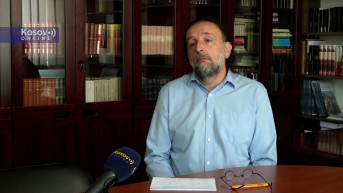
Writer Zivojin Rakocevic from Gracanica has said that the recent statement issued by the Diocese of Raska and Prizren on the increasingly difficult situation of the Serbian people and the Serbian Orthodox Church in Kosovo comes as no surprise, arguing that thousands of instances of discrimination against Serbs occur every day but remain largely unseen.
Speaking to Kosovo Online, Rakocevic said that, in his view, the events at Gazimestan during the Vidovdan commemoration revealed the true nature of the institutions' attitude toward Serbs in Kosovo.
“The corridor of hatred through which hundreds and thousands of people were forced to pass on Vidovdan is the clearest indication of what has happened after 27 years of attempts to establish at least a minimum of democratic and normal institutional values in Kosovo. There was one narrative about the institutions prior to Gazimestan; since Gazimestan, there has been another narrative, one that clearly shows that every police officer who forced people through that corridor—which was deliberately created and had all the characteristics of a prison camp—is a source of institutional hatred projected through the uniform and the institution itself, with the intention of sending a message to those who are different that they do not belong there,” Rakocevic said.
He stressed that the root of the problem lies in the thousands of daily incidents that remain invisible to the broader public.
“That hatred manifests itself through hostile looks, the closing of service counters, people turning their backs on you, doors being shut, and unmistakable messages about who does not belong. There are thousands of cases of linguistic discrimination, violations of property rights, hundreds of innocent people in prisons, and the complete absence of any prospect of living in the cities. All of this is happening today, it will continue tomorrow, and it is something that the Serbs of Kosovo and Metohija endure every single day,” he said.
Commenting on the Diocese of Raska and Prizren's report, Rakocevic stated that the Serbian Orthodox Church experiences the consequences of such an environment on a daily basis.
“The Serbian Orthodox Church's report is not surprising in the slightest. Every day, the Church feels the impact of this constant stream of incidents, pressure, hatred, an atmosphere of fear, and the persistent message that someone, somewhere, does not belong,” he said.
As an example, he referred to a group of pilgrims who, according to him, were detained for approximately one hour at a crossing point last year.
“One woman asked the head of the crossing what the problem was, and he replied that everything was fine. When she asked whether there was anything she should change on her list, he answered: 'You should change your head.'” Rakocevic recounted.
He believes that the essence of this discrimination lies in the expectation that, within what he described as an undemocratic society, Serbian culture, Serbian statehood, and Serbian spirituality should submit to Albanian ethnic dominance.
“We are being asked to accept someone else's freedom. How do you explain to a police officer who treats you with hatred that, even if you wanted to, you cannot live according to the freedom of someone who hates you? How can a person adapt to hatred that says: 'You must become like me'?” Rakocevic concluded.

0 comments