
Dostanic: Regardless of internal crisis, Germany's stance toward Kosovo will not change
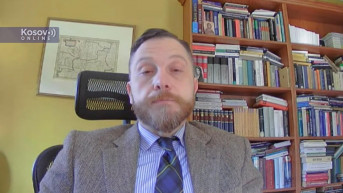
Dusan Dostanic from the Institute for Political Studies states that despite political, economic, and identity crises, the government in Germany remains on an Atlanticist course and committed to its foreign policy, and that no changes should be expected regarding Kosovo. He adds that Germany will insist on fulfilling the Franco-German plan as one of the sponsors of Kosovo's independence.
Dostanic explains to Kosovo Online that the current German government remains committed to its previous foreign policy, as evidenced by the example of Ukraine.
"This issue with Ukraine can also be seen in the context of the protests by farmers, because farmers who complain about subsidies being withdrawn rightly ask, 'How is it that there is no money for subsidies to farmers, but there is money, for example, to help Ukraine, a country at war?' Then the question arises again, what is the purpose or goal, what is the function of government – is it to care for its citizens and their well-being or to resolve conflicts around the world and assist countries where things are not as they should be? In any case, in Ukraine, it is evident that this government remains committed to its previous foreign policy, and in that sense, it seems that there should be no expectations for changes regarding Kosovo with this current government," our interlocutor states.
According to him, the Greens, who are currently leading German foreign policy with Annalena Baerbock, are firmly and much more radically on an Atlanticist course than was the case with Angela Merkel, but he reiterates that it is difficult to speak in broad terms about a policy change.
"The changes compared to Angela Merkel's policy are not quite so drastic. During Angela Merkel's rule, all those things happened regarding Kosovo, which from our perspective are not so positive: recognition of Kosovo's independence and Germany's engagement in that regard. And with this new government from two years ago, things have not changed, the course has not changed, so German patronage over that entity in our southern province has not taken on any other form. The only thing that can be rightly said is further exacerbation of relations with Serbia, meaning that if there were still some barriers during Angela Merkel's time, there are no longer any barriers under the leadership of the Greens," Dostanic assesses.
He reminds that Germans have been quite engaged on the Kosovo issue before, and there are books in which various authors claimed that US policy towards Kosovo in the 1990s was conditioned by German policy, "meaning that Germans from the beginning showed quite an understanding for the KLA and the terrorist activities that took place there in the late 1990s."
"We now see that the Germans were active in giving that Franco-German plan, which certainly binds them, and they will insist that the plan be fulfilled, but it is conditioned by the fact that they recognized Kosovo's independence long ago, and Germany's official policy as it is today represents one of the sponsors of Kosovo's independence, and there should be no illusions about that," Dostanic says.
However, he adds that different voices are coming from the opposition at the moment.
"Understanding for the Serbian position cannot be found among the Greens, among the Social Democrats, or among the liberals, while different tones are heard from the Alternative for Germany. In the Bundestag, there were talks about the real situation in Kosovo, or it was pointed out that a government that is so engaged in the case of Ukraine and protects the sovereignty of Ukraine at all costs, to the extent of supplying weapons to that country at war, on the other hand, supports the secession of the Serbian province, and there is no hope that it will engage in protecting the sovereignty and territorial integrity of Serbia," Dostanic concludes.


0 comments