
Drecun: Arming of Pristina is the greatest security threat to Serbia
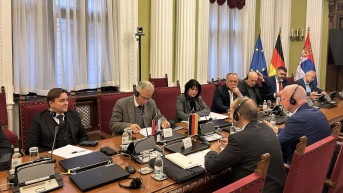
The Chair of the Serbian Parliament’s Committee on Defence and Internal Affairs, Milovan Drecun, met with Bundestag MP and Chair of the Defence Committee, Thomas Röwekamp, to discuss the security situation in the Western Balkans, with particular focus on Kosovo. Drecun emphasized that the primary security threat to Serbia is the process of the violent secession of Kosovo, noting that the complexity of the situation is further compounded by the “unlawful arming of Pristina” and the creation of regional military alliances.
Drecun criticized the failure to implement the Brussels Agreement in the part concerning the establishment of the Association of Serb-majority Municipalities, reiterating the unlawful arming of Pristina and the formation of regional military alliances.
“Serbia’s specific position in the EU integration process has been further complicated by the requirement to align its foreign policy with that of the European Union, as well as the so-called normalization of relations with Pristina, while the Brussels Agreement—signed more than ten years ago—has yet to be implemented in the section obliging Pristina to establish the Association of Serb-majority Municipalities. The complexity of the situation is additionally heightened by the unlawful arming of Pristina and the creation of regional military alliances,” Drecun stated, according to the Serbian Parliament’s press release.
He added that the German KFOR contingent is actively involved in the joint activities with the Kosovo Security Force and that it is, in practice, assisting in the creation of the illegal military formation known as the “Kosovo Army”.
Referring to cooperation between Serbia and NATO, Drecun stressed that relations are at their lowest point since Serbia joined the Partnership for Peace programme in 2006, which he attributed to the instrumentalization of the 2023 events in Zvecan and Banjska by certain NATO member states. He underlined that this is also reflected in the challenges related to the arming of the KSF, as well as the support for its transformation into the Kosovo Army provided by some NATO member states.
Drecun warned that if the current legal and institutional vacuum continues, Serbia risks losing the opportunity to participate in activities of practical cooperation with NATO.
Speaking about Serbia’s full membership in the European Union, Drecun reiterated that this remains Serbia’s key strategic goal, adding that improvements in national security and defence are inseparable from the EU integration process. In line with these objectives, he said, the priority of the Ministry of Defence and the Serbian Armed Forces is engagement within the EU’s Common Security and Defence Policy.
“Serbia makes a concrete contribution to the preservation of international peace and security through its participation in UN and EU peacekeeping missions,” Drecun stated.
Thomas Röwekamp highlighted that bilateral relations between Serbia and Germany are excellent.
He assessed that, in recent years, there has not been sufficient progress in preserving peace in the region.
“Germany does not engage in any hybrid warfare, nor does it supply weapons to parties involved in conflicts in the Western Balkans,” Röwekamp stated.
Speaking about Germany’s presence within the KFOR mandate, he emphasized that a decision had been made to increase its contingent, as Germany is interested in contributing more as a partner within that framework. Röwekamp welcomed Serbia’s commitment to the EU accession process but stressed that significant efforts are needed to achieve progress in the areas negatively assessed in Serbia’s 2025 Progress Report.
“We are disappointed that the normalization process with Pristina has reached an impasse. We have criticized violations and overstepping of agreements on both the Kosovan and Serbian sides,” Röwekamp said, noting that he does not agree with claims that Germany or the EU are taking sides, as it is not in their interest to see escalation.
He called for intensified efforts to ensure full implementation of existing agreements and to use the EU integration process to create conditions that would prevent further security or military escalation on the European continent.
“We want to see the conditions fulfilled for peaceful coexistence,” Röwekamp concluded.


0 comments