
Dzihic: Trump has no intention of returning to the old United Nations framework
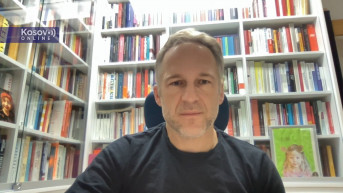
Although many uncertainties still surround Donald Trump’s Board of Peace—given that it remains unclear how it will function or what it will specifically do—one thing is certain: there will be no return to the old order, as the U.S. president has no intention of returning to the framework of international law, assessed political scientist Vedran Dzihic of the Austrian Institute for International Affairs. Dzihic added that global developments will have significant repercussions for the Western Balkans, whose fate, he is convinced, will largely depend on relations between the United States and Europe.
“We have many unknowns. We have the idea of the Board, we have had the first meeting—the founding session in Davos—and we have limited membership, which certainly does not represent the entire global order. Key countries have not joined at this moment. It is unclear how many states will ultimately accede to the Board of Peace, and it is unclear what this body will concretely do and how,” Dzihic noted.
Given, as he put it, Trump’s arbitrary foreign policy—where things can change within 24 hours—Dzihic said he is not convinced that there are guarantees of stability or sustained, serious work.
At the same time, he observed that the old “world order,” which had been in place since 1945 and became dominant after the fall of the Berlin Wall, has in a sense disappeared.
“With the fracture of the transatlantic alliance and Trump’s now very clear policy toward the United Nations, everything we have had so far—including the UN Security Council—no longer has the same influence. Trump’s move to withdraw the United States from 66 international organizations is also indicative, including organizations within the UN system,” Dzihic told Kosovo Online.
“What we know is that a new order is emerging, but we do not know what it will look like,” he added.
“We have the Board of Peace and we do not know how it will function. At this point, it is too early for an assessment. What we do know is that there is no return to the old. Trump has no intention of returning to the old framework of the United Nations, international rules, and international law,” Dzihic said.
Asked about the consequences for the Western Balkans, he replied that repercussions are inevitable and that the region’s fate will largely depend on relations between Washington and Europe.
He recalled that among the 66 organizations from which the United States withdrew are two of regional significance—the Regional Cooperation Council and the Residual Mechanism of the Hague Tribunal—as well as the Venice Commission, which was relevant for Bosnia and Herzegovina and, to some extent, for Kosovo.
“We have clear indications that continuity in U.S. foreign policy toward the Western Balkans—previously based on clear principles, a clear policy, and democratic norms—is coming to an end. From the American side, we are entering a phase of transactionalism and deal-making, where there is no certainty and no guarantees for any leader or country that they will enjoy Trump’s favor,” Dzihic warned.
He also noted that Serbia was not invited to the Board of Peace, which he sees as a clear message to Belgrade. At the same time, he pointed to the U.S. decision regarding migrant visas, which applies to all Western Balkan countries—except Serbia. He therefore considers the messages to be often ambiguous, even multi-layered.
“It is quite clear that the linearity, certainty, and stability coming from Washington that we were accustomed to no longer exist. This raises the question of how the EU will position itself in such circumstances, how it will proceed, and whether it will be able to continue the enlargement process. A central question is how and in what way NATO will position itself in a region where there are still troops in Kosovo and European forces in Bosnia and Herzegovina. These are open questions, and much will depend on developments at the global level,” Dzihic explained.
He added that the Western Balkans is a “semi-periphery” of Europe, where “when someone sneezes at the center, the region comes down with a severe flu and suffers for weeks with serious symptoms.”
“Our fate will largely depend on how relations between Washington and Europe evolve, whether Europe will manage to emancipate itself and develop its own sufficiently strong and dominant security and defense policy, and whether it can become a geopolitical actor—which it is not at this moment. Our region is of crucial importance in this regard, because here Europe has the potential and the leverage to change something,” Dzihic emphasized.
In the meantime, he said, all countries will seek to establish the best possible bilateral relations with Washington—some will “fall out of favor,” while others will “feel Trump’s favor.”
“We are already seeing certain shifts. Many factors could affect relations between Kosovo and Serbia, but what ultimately remains is the fact that the volatility and unpredictability of the new global order do not bring greater stability or clearer ideas,” Dzihic underlined.
Asked whether Trump and the Board of Peace could resolve the Kosovo issue—something the EU has long attempted without success—Dzihic said that Kosovo and Serbia are still not on the U.S. president’s agenda.
He noted that Trump likes to claim he has ended eight major wars, although it is unclear how and which conflicts these were; while he has mediated and had some positive impulses—for example between Israelis and Palestinians—he did not deliver on his pre-inauguration promise to find a peace solution in Ukraine.
“Kosovo and Serbia are not yet on Trump’s agenda. I have the sense that the Western Balkans is still not a priority for him, which does not mean that at some later point—given how frequently he changes positions and policies—he will not ‘discover’ our region, and Kosovo and Serbia, as a new arena in which to demonstrate how long-standing conflicts can be resolved,” Dzihic said.
He stressed that the role of the European Union will be decisive, noting that the EU has so far proven ineffective because the dialogue was conducted from the outset on uncertain premises.
“Especially in recent years, we have seen the EU’s full impotence in resolving this issue. In the meantime, realities on the ground have changed. We must not forget that Kosovo is seeking to establish the most stable and favorable possible relations with Trump. On the other hand, we do not see substantive support from Trump for Serbian President Aleksandar Vucic. On the contrary, we can expect more critical steps regarding allegations of election manipulation. For now, everything remains at the status quo,” Dzihic assessed.
He nevertheless expects the EU to “wake up” at some point and become more active, particularly given the Union’s fear that the Americans could “bulldoze over the EU in its own neighborhood,” which includes Kosovo and Serbia.
“I expect new initiatives, although how potent, strong, and effective they will be is hard to say. So far, they have not been. I expect that at some point, when the Balkans appear on Trump’s map, he too will become more engaged and that new initiatives will emerge. For now, we remain where we have been for several years,” Dzihic concluded.



0 comments