
Board of Peace is not a substitute for the UN, but Trump’s attempt to create “his own world”
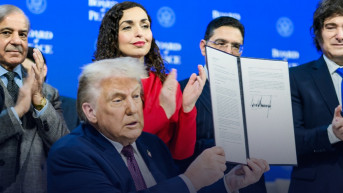
The Board of Peace—a new body established at the initiative of U.S. President Donald Trump as part of the second phase of the U.S. plan for the Gaza Strip—sparked numerous controversies as soon as the idea was announced, with the American leader effectively “throwing down the gauntlet” to the United Nations. However, interlocutors speaking to Kosovo Online assess that the Board of Peace will not be able to replace the United Nations, but rather represents Trump’s attempt to “create his own world,” as he has no intention of returning to the framework of international law.
Written by: Zoran Mirkovic
Not much time elapsed between Trump’s idea and its initial implementation, with the World Economic Forum in Davos chosen as the stage for the first act.
What is known so far is that the first group of signatories to the Statute of the Board of Peace in Davos included 19 officials from Kosovo, Pakistan, Argentina, Yemen, Azerbaijan, Bulgaria, Bahrain, Morocco, Hungary, Indonesia, Jordan, Kazakhstan, Paraguay, Qatar, Saudi Arabia, Turkey, the United Arab Emirates, Uzbekistan, and Mongolia.
It is also known that France and Spain declined the invitation, that the United Kingdom remains reserved, while German Chancellor Friedrich Merz stated that he “would be ready to join the initiative, but cannot accept the plan in its current form.” Italy, for its part, is constrained by its Constitution from joining the initiative.
It is further known that China also received an invitation but has yet to respond, while Russian leader Vladimir Putin said he had received the invitation and that the documents would be reviewed, adding ironically that Russia was prepared to contribute one billion dollars to the Board of Peace from funds frozen in the United States.
It is likewise clear who will lead the Board of Peace—Trump himself—who holds all authority in his hands, including the power to expel members and withdraw invitations to join, as he did in the case of Canada.
The cost of “membership” in this “club” is also known: one billion dollars for a three-year term. This is no small sum for smaller countries, but securing Trump’s favor requires finding the funds.
Everything else remains unknown—how many countries will ultimately join, what the Board will do and how it will operate.
For Trump, the Board could become one of the greatest international bodies ever established and achieve much once fully formed. Although he initially suggested it could replace the United Nations, he said in Davos:
“A combination of the Board of Peace and the UN could be something unique for the world.”
But will it be?
The Board of Peace Will Be Short-Lived
Daniel Kochis, a senior fellow at the Center for Europe and Eurasia at the Hudson Institute in Washington, believes it is somewhat unclear where the Board of Peace would fit within the global architecture of multilateral institutions.
He told Kosovo Online that concerns among many Western European powers about duplicating the UN have made them less inclined to participate, viewing it as a Trump initiative that may not outlast his term.
“So this will likely be an area that Western European powers largely will not engage in. And I think it will probably be something short-lived,” Kochis said.
An Imperial U.S. Approach, Like Rome’s Relationship with Its Provinces
Heinz Gärtner, professor of political science at the University of Vienna, believes the Board of Peace is essentially Donald Trump’s attempt to create his own world as a counterweight to China and to secure allies. For that reason, he does not believe it can replace the United Nations, nor help resolve the Kosovo–Serbia issue.
He notes that the United Nations are founded on a completely different concept—sovereign equality of member states—whereas in the Board of Peace, states have effectively bought their seats.
“In a bipolar world, this appears to be Trump’s attempt to create his own world as a counterweight to China. There is an imperial relationship, akin to that of the Roman Empire toward its provinces. Of course, there is indirect voluntariness in joining, although it is costly. The Board of Peace is an attempt to create one’s own world, but it cannot replace the UN Security Council. The only real veto power in the Board of Peace belongs to the United States,” Gärtner told Kosovo Online.
He is convinced that the U.S. will seek to weaken the United Nations, while still “keeping one foot in the UN.”
He also notes that states can mediate in resolving any dispute even without the Board of Peace.
Kosovo Knows How Peace Is Achieved
Neither the many unknowns nor the considerations weighing on major European countries caused much concern in Kosovo, which immediately accepted the invitation.
The document in Davos was signed by Kosovo President Vjosa Osmani, who said there were multiple reasons for Kosovo’s accession and that Kosovo knows how peace is achieved. Notably, the leaders of the three largest opposition parties welcomed participation in the Board of Peace, while the leader of the strongest party and caretaker Prime Minister Albin Kurti has yet to comment.
Nevertheless, it appears that in Pristina there is no doubt that participation in this initiative strengthens Kosovo’s international standing, even if not everything is clear.
“It is good that Kosovo is present, but of course it remains to be seen what this initiative will bring and how. Will it remain merely an initiative that produces nothing concrete, or will it directly engage in the reconstruction of Gaza? At the moment, nothing is particularly clear,” notes analyst Alma Lama.
She therefore points out that the main value for Kosovo in joining the Board lies in the opportunity for direct contact with leaders of states that have not yet recognized its independence.
Former diplomat Albert Prenkaj also emphasizes that Kosovo’s participation in the Board of Peace is important, particularly due to its closeness to the United States.
He stresses that Kosovo’s long-term goal remains increasing the number of international recognitions in order to reach a “critical mass” of states that would open the path to applying for UN membership.
Albania in a “Game Larger Than Its Real Capacities”
Albanian Prime Minister Edi Rama also responded swiftly to Trump’s invitation. In a letter to the U.S. leader, he thanked him for the invitation, stating that as a new international organization, the Board of Peace is envisioned as a focused and purposeful instrument of global leadership and responsibility. Parliament subsequently approved Albania’s accession.
However, Albanian analyst Endri Tafani warned that there was no detailed analysis of the benefits and costs the country might incur from the new organization, raising questions about the Board’s relationship with the UN and the EU, Albania’s concrete role within it, and the political and financial implications of engagement in an initiative that could draw the country into a geopolitical game “larger than its real capacities.”
“Can we be part of an organization that is against the EU? Albania, which is joining this Board while simultaneously aspiring to EU membership, is entering a game larger than it has the capacity to sustain. The financial aspect was not mentioned at all in parliament. There was also no discussion of whether Albania will be a permanent or temporary member of the Board of Peace for Gaza,” Tafani said, adding that it benefits Albania to align with the U.S., as the EU has its own internal problems.
Trump Has No Intention of Returning to the Old UN Framework
Despite the many unknowns surrounding the Board of Peace, one thing is certain: there will be no return to the old order, as the U.S. president has no intention of returning to the framework of international law, assessed political scientist Vedran Dzihic of the Austrian Institute for International Affairs.
“We have the idea of the Board, we had the first meeting—essentially the founding session—in Davos, and we have limited membership that certainly does not represent the entire global order. Key countries have not joined at this moment. It is unclear how many countries will join the Board of Peace and what it will concretely do and how,” Dzihic observed.
Given, as he says, Trump’s arbitrary foreign policy, in which things can change within 24 hours, Dzihic noted that he is not sure there is any guarantee of stability or serious work.
“What we do know is that a new order is emerging, but we do not know what it will look like,” Dzihic concluded.
“What we do know is that there is no return to the old. Trump has no intention of returning to the old framework of the United Nations, international rules, and international law,” Dzihic is convinced.
He adds that this will certainly have consequences for the Western Balkans, whose fate will largely depend on relations between Washington and Europe.
The Board of Peace as the Backbone of Trump’s World
Petar Donic, associate at the organization New Third Way, says the Board of Peace is the backbone of the new world Trump has introduced, but that it will be difficult for it to replace the United Nations, as it is tied to specific leaders and specific solutions.
“The United Nations are conceived in a completely different way. States are involved regardless of individual solutions; it is a longer-term and slower process. I do not see the Board as a replacement, but it is definitely a form of competition for addressing shock-driven and difficult issues,” Donic said.
He notes that the United Nations have shown in recent years that they play a drastically reduced role and cannot respond quickly in a time that demands rapid decisions, which is why Trump, by initiating the Board of Peace, has shown that he wants to gather states with which he can react swiftly.
“The first project through this Board is Gaza. He wants to demonstrate what he can do, and in that context the invited states were selected—a mix of those that can exert influence, traditional allies, supplemented by those with an Islamic background who can help with the narrative. Or those who proved themselves in Trump’s first and second terms as good allies and good negotiators. Many were invited based on certain criteria, but not everything follows a strict logic. That creates division, as some were invited and others were not—but only Trump knows the full reasoning,” Donic said.
He therefore believes that in the coming period there will be a kind of “hybrid solution.”
“Both will exist. Some issues will be placed before the United Nations, and others before the Board of Peace,” Donic concluded.


0 comments