
Frankfurtske Vesti: Protest of Serbs in Kosovo – a cry for freedom
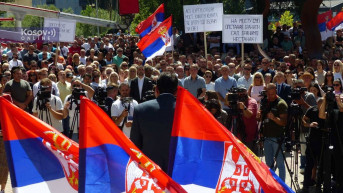
Describing last week's protests by Serbs in southern and northern Kosovo, Describing last week's protests by Serbs in southern and northern Kosovo, Frankfurtske Vesti writes that they were compelled to take this step out of sheer necessity. The interviewees in the article state that both events, the protest of Serbs in Pasjane and in North Mitrovica, are indicators of the lack of freedom and discrimination faced by the Serbian community.
Dusko Celic, an associate professor at the Faculty of Law at the University of North Mitrovica, says that the last two protests reflect a disheartening image of the spread of apartheid against the Serbian community in the southern province.
"I don't think it's too strong to say that this is a continuation of the increasingly overt policy of apartheid towards the Serbs when it comes to human rights. Serbs in Kosovo not only do not enjoy these rights, but they are systematically endangered by Pristina and the self-proclaimed authorities. Practically, these two events are a disheartening image of that apartheid being implemented by Pristina against Serbs in Kosovo and Metohija," Celic emphasizes.
He points out that it is no coincidence that the new provocations from the provisional institutions in Pristina targeted northern Kosovo and Kosovo Pomoravlje.
"It is evident that these two areas, Kosovo Pomoravlje and northern Kosovo, are still the strongest Serbian areas where the Serbian population has not yet been strategically shaken to the point of leaving. It is likely that these are now the two main targets of Pristina and Kurti. Therefore, it is no coincidence that random arrests in Kosovo Pomoravlje and the pressure to open the bridge on the Ibar coincided in time. If we try to look at the bigger picture, this is part of a constant pressure from Pristina, a systematic pressure on the remaining Serbian population in Kosovo and Metohija," Celic emphasizes.
Journalist and writer from Gracanica, Zivojin Rakocevic, says that the protests by Serbs in Pasjane and in North Mitrovica are a reaction to two levels of attacks and processes that are continuously taking place in Kosovo.
"The first level is institutional repression, which culminates in the police occupation of northern Kosovo. The second level is the arrest of innocent people, and the protest in Pasjane was held because of the terrible consequences that this kind of persecution of innocent people, who are actually political prisoners, leaves behind," Rakocevic emphasizes.
According to him, representatives of the international community in Kosovo are well aware of all the problems of the Serbian community, but they do nothing because they have "sacrificed the freedom of the Serbs."
"The international community, whatever that may be, does not want any scratches on the ground; it has sacrificed our freedom, and Belgrade has surrendered our rights. The Albanians perceive all of this as a weakness, and they will not stop until the final confrontation. However, the endurance of the Serbs and their heritage will outlive and overcome all these bad and undemocratic processes," Rakocevic says.
He highlights that there is also a third "main direction of repression."
"It is related to the Serbian Orthodox Church and cultural heritage. The protests in Kosovska Mitrovica and Pasjane near Gnjilane, on a broader scale, actually indicate that the lack of freedom and discrimination from southern Kosovo has spread to the north and that, unfortunately, we are becoming united in our lack of freedom," Rakocevic emphasizes.
Luka Jovanovic, a history professor at the Faculty of Philosophy at the University of Pristina with temporary headquarters in North Mitrovica, stresses that the latest protests by Serbs in Kosovo are "one of the last cries of the people directed at the international community, the regime in Pristina, and the government in Belgrade."
"The latest protests by Serbs in Kosovo are one of the last cries of the people directed at the international community, the regime in Pristina, and the government in Belgrade. The decades-long difficult situation of the Serbian people in Kosovo and Metohija has become even more complicated in recent years. Insecurity and fear for mere existence have become normal," Jovanovic emphasizes.
Luka adds that Serbs, both from the south and the north of Kosovo, have tried to draw the attention of the international public in a democratic way.
"At the same time, Serbs have tried to warn Pristina that there are still many Serbs in Kosovo and Metohija, that they are united, and that they will not be broken by the insane actions of the Pristina regime. The latest protests carried exactly these messages: national unity, faith in ultimate justice, and peace for all citizens," Jovanovic stresses.


0 comments