
The Bridge on the Ibar - a "Breaking Point" or Reconciliation Between Serbs and Albanians?
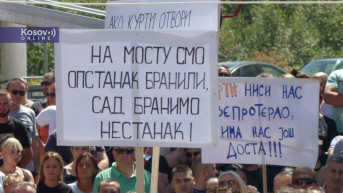
The Serbs were clear. At yesterday's protest, they loudly expressed their opposition. Representatives of the Quint states and the European Union also made it clear on Friday. However, the authorities in Pristina are not giving up on their intention to open the main bridge on the Ibar between North and South Mitrovica for traffic. Is it for traffic, security, or just an election reason? The answer depends on whether you ask Serbs, Albanians, or Western officials. For the interlocutors of Kosovo Online, the opening of the Ibar bridge is a "mix" - with many symbols.
Written by: Arsenije Vuckovic
"This is not a call for war. This is a call for peace, dialogue, coexistence, and agreement. We are not the ones who have ever called for war. Kurti and Sveçla call for war because they fear peace with the Serbian people. In that peace, Kosovska Mitrovica is a city with the most children, with the most students. In that peace, Kosovska Mitrovica is a city for everyone, and we are fighting for such Mitrovica," said Luka Jovanovic, a history professor at the Faculty of Philosophy of the University of North Mitrovica, yesterday.
He was just one of the speakers at the protest in North Mitrovica where Serbs clearly stated their opposition to the opening of the bridge.
In an interview with Kosovo Online, citizens explained that by gathering, they sent a message of peace, which they hope will reach all Quint countries and the UN.
Kurti also sent messages. On Friday, he tried to explain to the ambassadors of the Quint countries why the opening of the bridge is important to him. The Quint members heard him, but the response was not to his liking.
American Ambassador Jeffrey Hovenier was more than clear after that meeting.
"Following instructions from the capitals, representatives of France, Germany, Italy, the United Kingdom, and the USA met today with Prime Minister Kurti to inform him that our governments, in agreement with NATO, cannot support any change to the current status of the bridge in Mitrovica at this time," said Hovenier.
Everyone was convinced that Hovenier had put an end to the opening of the Ibar bridge.
"It is not about dialogue at all. It is about the right to open and about a decision that is already public," tried to counter Interior Minister Xhelal Sveçla.
The Minister of Police enjoys the coffee at the main bridge on the Ibar so much that he almost never leaves the local cafes. He was there yesterday, after the Serbian protest. Later, he walked to the bridge to see how workers were painting the foundations. A few artistic graffiti and several messages in Albanian were painted over.
Kurti also seems to like North Mitrovica very much. Especially the Serbs.
"For too long, the Mitrovica bridge over the Ibar has kept us at a distance. It has unfairly gained the epithet of separation and abnormal relations. Bridges connect us, and together let's make it a symbol of normalization," Kurti said yesterday, inviting Mitrovica residents to participate in today's public discussion and learn about the benefits of opening the bridge.
Unilateral Moves and Consequences
Senior associate at the Center for International and Security Affairs (ISAC Fund), Igor Novakovic, does not rule out the possibility of unilateral actions by the Pristina administration when it comes to opening the main bridge on the Ibar. He states that this bridge is a powerful symbol for both the Albanian and Serbian communities.
In an interview with Kosovo Online, Novakovic says that for Prime Minister Albin Kurti, opening this bridge would be a key pre-election argument that the main symbol of Serbian resistance has been overcome.
"I believe that unilateral moves are possible. We have seen a whole series of such moves over the past year and a half or more. However, the question arises as to how KFOR, which has the primary responsibility for security in Kosovo, will react. So, if it is assessed that such a move would lead to increased tensions both in northern Kosovo and between Belgrade and Pristina, I assume that they would not allow it. But again, this is just my personal speculation. We should see what would actually happen if such an action were to be undertaken," Novakovic concludes.
He mentions that several factors are crucial for Prime Minister Albin Kurti in his intention to open the main bridge on the Ibar between South and North Mitrovica to traffic.
"It seems to me that the upcoming parliamentary elections are the primary reason for this, which are regularly scheduled to take place early next year, although there is increasing talk that they might be held early, in October. Therefore, the bridge on the Ibar is a powerful symbol for both the Albanian and Serbian communities, and opening it would send a clear signal to voters, especially in Kosovo, that the north is integrated, meaning that the main symbol of Serbian resistance in the north has been overcome. It seems to me that this is the policy of the entire ruling elite," Novakovic emphasized.
According to him, the ruling elites in Pristina claim that the bridge on the Ibar is no longer a security issue and that the opening for traffic is supported by the local community.
"However, my impression is that KFOR is responsible for this matter, and the question is how they will react. We know that two vehicles are parked next to the bridge, so it primarily depends on them what will happen," says Novakovic.
When asked why the Kosovan Prime Minister Kurti, despite clear warnings from the representatives of the Quint and the EU, as well as the clear message from the American ambassador in Pristina, Jeffrey Hovenier, does not abandon the opening of the bridge, our interlocutor says that it is about the perception that unilateral moves can pass without significant reaction from Western allies.
"It should be borne in mind that Pristina, or Mr. Kurti, sees themselves as a sovereign state, that they consider it their internal matter, and that they have the absolute right to do so. This narrative has been present for a decade regarding the Self-Determination movement, and continuously for the past two years. This is their core theme, as they have seen that, in principle, if there is no significant security risk, unilateral moves can pass without major reaction," concludes Novakovic.
Cards and Diplomacy
Political analyst Nexhmedin Spahiu says that the representatives of the Quint and the EU countries did not tell Prime Minister Albin Kurti on Friday that they oppose the intention to open the main bridge on the Ibar, but that they do not support that intention, thereby distancing themselves from possible consequences.
"They did not say they are against it, they said they do not support it. Not supporting and being against are still two different things. Not supporting means that we do not take responsibility for what may happen subsequently, after that move. Being against means that we will oppose that political move. They actually just said they do not support it. This is a signal for Kurti that he can still go ahead and do it," Spahiu told Kosovo Online.
He has no doubt that for Kurti, the opening of the main bridge on the Ibar is the main pre-election trump card.
"It's also a matter of symbolism. The bridge used to be a place where conflicts occurred, and opening the bridge means that those conflicts have ended and that he (Albin Kurti) has managed to calm the situation. So, it's in his interest to show this to, of course, gain votes and to claim that he achieved something during his term because, in many other areas, he has not achieved any results: in healthcare, education, infrastructure, the legal system... All these are areas where he has not made any positive progress. Only negative results. Opening the bridge would mean that he has achieved something during his mandate," emphasizes Spahiu.
He believes that the opening of the bridge is more needed by the residents of North Mitrovica than by those of South Mitrovica.
"The bridge no longer represents any security threat. Anyone who wants to cause disturbances can do so without a car; they can walk since the bridge is open to pedestrians. Opening the bridge is merely a convenience, especially for the residents of the northern part of the city, because when you enter from the south to the north, you only have narrow streets since the main road has become a pedestrian zone. But when you go from the north to the south, you can immediately get onto the main road. So, it is more necessary for the residents of North Mitrovica than for those in the southern part," says Spahiu.
Electoral "Promo"
Milica Andric Rakic, program manager at the NGO Social Initiative, also considers the opening of the main bridge on the Ibar to be an electoral trump card for the current prime minister.
"The opening of the bridge is happening solely as an initiative within the election campaign, and I assume that as the elections approach, this issue will become even more prominent," she emphasizes in an interview for Kosovo Online.
She emphasizes that for Kurti and the Self-Determination Movement, the issue of the Ibar bridge is important not only to gain voters but also to confront the opposition.
"In a scenario where we have potential protests from the southern side supporting the opening of the bridge, it could be a kind of blow, even to the DPK's rival candidate, Bedri Hamza, who is currently the mayor of South Mitrovica. Kurti might see this as a political advantage if such a protest is organized in his city, especially since the government is calling for the opening of the bridge, as they can say: 'Look, the local authorities are not getting involved.' So, this should be viewed strictly within the framework of the overall approach and elections, which will evidently be based solely on the change of situation in northern Kosovo for the Self-Determination Movement, as other significant results have been lacking," says Andric Rakic.
When asked what message Kurti would send given that the Quint and EU members were clear that the issue of opening the bridge on the Ibar is a matter of dialogue between Belgrade and Pristina, our interlocutor says that their messages have closed this issue—for now.
"A new KFOR commander is coming in October, and it is possible that the government will try again to convince KFOR to change its opinion, as it is clear that this administration in the Mission does not support such a move. However, generally, I do not think the government will completely abandon the initiative," emphasizes Andric Rakic.
She estimates that as the elections approach, there could be organized protests in South Mitrovica with messages advocating for the opening of the bridge to traffic.
"Kurti has also mentioned consultations with the northern community; it is possible that the municipality will try to organize something in this direction, some kind of public consultations with the citizens. However, I must say that this would be quite pointless at this moment. You have a local assembly that has twice, without consulting the citizens, voted to open the bridge, that is, made a decision to request the central authorities to open the bridge. And now, more than a year after the first such decision, to organize consultations really shows a serious level of amateurism and the extent to which the community is not being consulted about anything," emphasizes Andric Rakic.
Politics and History
For Nikola Markovic, an associate at the Institute for International Politics and Economics, the opening of the main bridge on the Ibar between South and North Mitrovica is part of a comprehensive policy of pressure on Serbs in Kosovo.
"This is part of the overall process or policy of Kurti's government, which generally has the intention to pressure Serbs with the aim of displacing them from Kosovo and Metohija. Specifically, regarding the attempt to open the bridge, it would be a significant precedent and lead to very severe consequences for the entire Balkan Peninsula. These currents of politics and history always intertwine and relate to the entire region. In this context, we can also look at the events in Bosnia and Herzegovina, Montenegro, which have recently been experiencing serious terror," says Markovic in an interview for Kosovo Online.
Attempts to open the bridge on the Ibar are, he emphasizes, part of a comprehensive action being carried out against the Serbian community in Kosovo.
"It is not just about the incursion into northern Kosovska Mitrovica; it is also about building new police stations, and the arrests of Serbs who are allegedly accused of war crimes," Markovic believes.
When asked if the clear stance of the Quint and EU members is sufficient for the Pristina administration to abandon the idea of opening the bridge on the Ibar, Markovic explains that Kurti is guided by an old Albanian proverb: "Sell yourself, but don’t sell yourself completely so that no one wants to buy you."
"The foreign and domestic policy of Albin Kurti, in some segments, has diverged from the official direction of NATO countries' policies. There is an Albanian proverb: 'Sell yourself, but don’t sell yourself completely so that no one wants to buy you.' Kurti still shows loyalty to his patrons from NATO countries but, on the other hand, pursues this Greater Albanian policy and strives for that Greater Albanian goal that was established back in the 19th century about creating Greater Albania. The timing of these events in Kosovo is very significant. These are certain elections," concludes Markovic.



0 comments