
Géro: Stable institutions needed; Rohde on Haxhiu: When a strategy fails, it must be changed
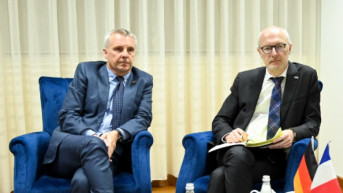
The French and German ambassadors to Kosovo, Olivier Géro and Jörn Rohde, called this evening in a joint interview for Klan Kosova for the swift establishment of stable institutions in Kosovo, emphasizing that they do not wish to interfere in domestic politics but are ready to offer advice. Regarding the Self-Determination Movement’s proposal to nominate Albulena Haxhiu as Speaker of Parliament, Ambassador Rohde stated that "when a strategy fails, it must be changed."
Responding to the question of whether Albulena Haxhiu should be replaced as the nominee for Speaker following multiple failed election attempts, Rohde reiterated, “when a strategy fails, it must be changed.”
He added that political parties are responsible for finding a solution to the current political deadlock in Kosovo.
“I use the term country first, then political party. Last week, while playing football, I used an analogy—if a strategy doesn't lead to the desired outcome, you must adjust the strategy. And adjusting the strategy may include changing team members. But again, it is the responsibility of the stakeholders to deliver results—it’s not our responsibility. We can only appeal as friends and offer good advice,” Rohde said.
He noted that the 19 unsuccessful attempts to constitute the parliament amounted to a “bad world record.”
“Electing a Speaker of Parliament in a democratic country is a very important act. Unfortunately, it has not succeeded, and we are now at the 19th round. This is not good for the country or for Kosovo’s reputation abroad,” he added.
Ambassador Géro emphasized that Kosovo needs functional institutions, as there are threats to democracy across the continent.
“Like every other country, Kosovo needs functional institutions—an assembly, a government, as well as an independent judiciary and media. This is in the interest of Kosovo, of its citizens, and of everyone, because there are threats to democracy across the continent,” Géro said, citing “attempts at election manipulation in Moldova and Romania” as examples.
He reminded that the EU assessed the elections in Kosovo as fair, as everything was in order on election day.
“I believe the people of Kosovo deserve functional institutions,” Géro added.
He stressed that it is not his place to determine who should lead the institutions, but to highlight the importance of having a partner in Kosovo to work with.
He added that during his May 12 meeting with caretaker Prime Minister Albin Kurti, in addition to the political situation, they also discussed Kosovo’s application to the Council of Europe, the Community of Serb-majority Municipalities (CSM), and the dialogue.
“And on all these issues, we need a government accountable to the parliament. We need partners. We are partners to Kosovo, but we need someone to engage with,” Géro said.
He reiterated that French President Emmanuel Macron was very clear in Tirana in calling for progress in the Serbia-Kosovo dialogue.
“President Macron was very clear and constructive in Tirana. He said we need to reengage in the dialogue and that we want Kosovo and Serbia to move forward. So, this is not about waning support from our country or from Europe—we are all aligned. We want to see progress,” Géro emphasized.
Rohde: Without Submitting the CSM Statute Draft to the Constitutional Court, No Progress Toward the Council of Europe
Rohde stated that regarding Kosovo’s bid for membership in the Council of Europe, Berlin and Paris have already made their position clear—that Kosovo must take concrete steps, including submitting the draft statute of the Community of Serb-majority Municipalities (CSM) to the Constitutional Court.
“We clearly expressed our stance. We want Kosovo in the Council of Europe as soon as possible. But that depends on steps Kosovo must take, as outlined in last year’s letter from Macron, Scholz, and Meloni. So, the ball is in Kosovo’s court. Submit the CSM draft to the Constitutional Court,” Rohde said.
He added that without this step, there can be no progress toward membership.
“Nothing has happened so far, and if this continues, one cannot expect different results. Inaction is not a solution,” the German ambassador emphasized.
Ambassador Géro said that France’s position is the same as Germany’s, and that the CSM does not pose a threat to Kosovo’s sovereignty.
“The CSM has been a longstanding issue under discussion for years. We’re seeing renewed fears that it might turn into a new ‘Republic of Srpska’, and I understand those concerns, because people in Kosovo have suffered and fought for a sovereign and functional state,” said Géro.
He pointed out that the EU-drafted statute does not grant the CSM powers similar to those of the Serb entity in Bosnia and Herzegovina.
“The Republic of Srpska has its own police and legislation—the CSM will not have that. The Republic of Srpska is enshrined in Bosnia and Herzegovina’s Constitution; the CSM will be within Kosovo’s constitutional framework. These are two entirely different concepts,” Géro concluded.


0 comments