
The International Day of the Disappeared was celebrated in Gracanica: The truth is there, but it is being hidden
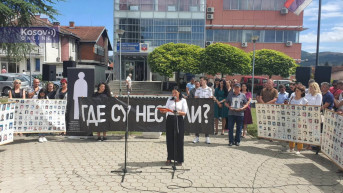
Representatives of the Association of Families of Kidnapped and Missing Persons in Kosovo gathered today in Gracanica, on the International Day of the Disappeared, carrying pictures of their loved ones to remind them of their unexplained fates.
Those gathered from the meeting sent a common question: "Where did they disappear?"
Silvana Marinkovic, representative of the Association of Families of Kidnapped and Missing Persons, said that after 24 years, families thought about their missing members every day and that they were the first thing on their minds every morning. Her husband, Goran, was kidnapped on the Pristina-Gnjilane highway in 1999. There are many to blame, she claims, for the fact that the fate of the missing still remains unexplained.
"Politicians, the international community, EULEX, and all those who were here during that period as a peacekeeping mission are to blame, and it turned out that they were there, as one of the officers told me, to protect the Albanians. They also showed that here. They, not only protected them, they helped them in the crimes they committed, we have evidence for that and we know that for sure. We know that after so many years they are protecting them, hiding all those crimes, and it is not in their interest that this scheme is starting to unravel, because in addition to the Albanians who committed the crimes, normally the international community and KFOR, which was in Kosovo in 1999, would also be condemned," Marinkovic points out.
She added that the only thing that Pristina had done was that it had banned the work of the Working Group for uncovering the fate of the missing, which, as she said, had begun to produce results.
"Thanks to the work of the Working Group, we received from many archives of KFOR, which was in Kosovo in 1999, information that would help a lot in the investigation. Pristina also forbids Veljko Odalovic from entering Kosovo, and thus the process of uncovering the fate of the missing is most endangered,” Marinkovic said.
Jasmina Zivkovic, President of the Association of Missing Persons in Strpce, whose father disappeared in 1999, says that she has been trying to find the truth for 24 years.
"The father disappeared on September 28, 1999, while he was accompanied by KFOR in Urosevac, at school, in broad daylight. Simply, I think the whole town saw what happened to my father and Uncle Marko who disappeared with him, but the whole town is silent. I hope that at some point someone will speak up and tell us what happened," Zivkovic said.
Zivkovic points out, that the perpetrators are to blame, but, as she adds, there are also indirect culprits.
"I am quite convinced and I believe that many family members are convinced that the truth is there, but it is being hidden. Who is hiding the truth? Anyone who has the power to hide the truth. In addition to the perpetrator, there are also international organizations that were present." Zivkovic said.
Sasa Perenic is looking for his brother Ranko, a journalist for Radio Pristina, who disappeared together with his colleague Djuro Slavuj on August 21 near Velika Hoca. He says that after 25 years, only hope remains.
"All those who are to blame for everything that is happening to us, they are all mute to our pleas, to our demands. They were willing to hear before, but unfortunately, they were only willing to hear as much as they wanted and as much as they needed. They simply did a test on us to find out how much we really know about our loved ones, whether we have any information, whether we have potential kidnappers, and all that. When they put together their big mosaic, as you all witnessed, today there is none," Perenic said.
He, like other members of the families of the missing, claims that the international community is to blame for not protecting the Serbs.
"All those who are responsible for all that are silent, reluctant to help us, to tell us what is happening. Of course, because many of them were themselves participants in those events, as it still happens today, the fewer Serbs, the fewer headaches," Perenic said.
On behalf of the Red Cross of Serbia and Kosovo and Metohija, Darko Gvozdenovic addressed those present at the meeting and said that the missing must not be forgotten.
"No one must be forgotten. Shedding light on the fate of missing persons is a civilizational, legal, and moral obligation toward their families. This obligation is not and cannot be less important over time. In addition to obvious emotional problems, the families of missing persons are exposed to numerous social and economic difficulties. In solving the fate of the missing, it is important to have the entire humanitarian aspect of this problem. The Red Cross of Serbia, and thus of Kosovo and Metohija, pays special attention to the issue of missing persons in armed conflicts, as a humanitarian issue of inestimable importance for families, but also for entire communities. Solving the fate of the missing is a priority of the Red Cross service." Gvozdenovic said.

comments