
Kosovo Summit for Peace and Democracy held: Kosovo-Serbia dialogue at a standstill
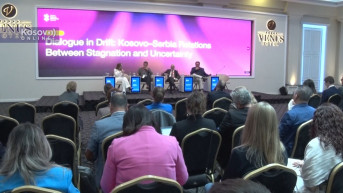
The Kosovo Summit for Peace and Democracy, organized by the New Social Initiative, the Kosovo Civic Alternative and the European Institute of Peace, was held today in Pristina. Participants said that the Kosovo-Serbia dialogue was at a standstill, that reconciliation could not be imposed and that civil society had to become a driving force for civic engagement.
Executive Director of the New Social Initiative Milica Andric Rakic said in her opening remarks that there had been no progress in the Kosovo-Serbia dialogue and that civil society therefore had to serve as a driving force for civic energy.
“When we launched the summit in 2022, we hoped to inject some momentum into the dialogue process, which at the time seemed to be moving far too slowly. Unfortunately, every year since then we have had to open the same event by acknowledging that things have only gotten worse. I wish I could break that tradition today, but honesty is the best policy, and there is really no denying that the deterioration has continued. That is why this year we chose the word ‘entropy’ to describe what we see around us. In physics, entropy is the simple fact that any system left to itself tends toward disorder. Things fall apart when there are not enough people willing to invest the energy needed to hold them together,” she said.
Speaking about the consequences of such a situation, Andric Rakic pointed to the erosion of trust and the fatigue of institutions, politicians and citizens, while also stressing the responsibility of civil society to persevere.
“Unfortunately, this seems like an accurate description of our situation here in Kosovo, but also of the global situation. Dialogue is disappearing, trust is quietly draining away, and the people who should be investing energy—the institutions and politicians, but all of us along with them—are tired. Nevertheless, those of us in civil society must persevere. We need to be the driving force of civic energy, and we have a responsibility to find momentum even in the most difficult circumstances,” Andric Rakic said.
Senad Sabovic of the European Institute of Peace said that it was easy to advocate European values when the climate was favorable, but considerably more difficult—and more important—to do so when the environment became less welcoming.
“Kosovo is going through a prolonged institutional crisis and a period of polarization. The normalization process has lost considerable momentum. The September 16 judgment of the Specialist Chambers understandably stirred strong emotions throughout Kosovo. For all of these reasons, I believe the fact that we have gathered here today is certainly noteworthy. We have brought together an impressive group of people from different countries, communities, institutions and organizations, with different professional backgrounds, who may not agree on everything but share a willingness to engage seriously with the challenges we face,” Sabovic said.
Speaking about the role of civil society in overcoming the current challenges, Sabovic stressed the importance of keeping the European perspective and dialogue alive despite divisions.
“I particularly hope that today we can explore what civil society can do under these circumstances, how it can keep the European perspective alive, preserve dialogue despite divisions and prevent the current sense of stagnation from becoming a permanent feature. The European Institute of Peace and our partners in the Kosovo Civic Alternative remain committed precisely to that. We believe in building trust, maintaining relationships and preparing the ground for progress, and that is the spirit in which we co-organized this summit,” Sabovic said.
The keynote address was delivered by European Commission Principal Adviser for Reconciliation and Normalization in the Western Balkans Marko Makovec, who said that the focus had to be on young people, who had a different outlook on the future. He emphasized that reconciliation could not be imposed, but had to come from local communities and institutions.
“The European Union provides them, and all of us, with the framework in which this can be achieved. We will also try to improve our instruments in order to help you, but the decision has to come from local communities and local governments. We cannot impose reconciliation from abroad. The practice and historical experience of the European Union, beginning with the great reconciliation between Germany and France and followed by certain other conflicts that we successfully overcame despite tensions, show that reconciliation is a long-term process measured in generations, not in months, years or election cycles,” Makovec said.
The summit also included a panel titled “Dialogue at a Standstill: Kosovo-Serbia Relations between Stagnation and Uncertainty.”
Executive Director of the Balkan Policy Research Group Naim Rashiti said that the dialogue had three dimensions—Kosovo, Serbia and the European Union—and that each side frequently shifted blame or responsibility onto the others.
“Something good happened in Kosovo that had been missing for a long time, and that is cooperation between the Self-Determination Movement and the PDK. It represents the first historic bridge created through the election of the President. We have an exceptionally credible President in office, which will bring change to this political landscape. We saw this a long time ago, but we want to continue building on it. A PDK-led government concluded the agreement in 2013, while a Self-Determination-led government concluded the Brussels Agreement in 2023. Throughout this decade, they fought each other and blamed one another for the substance of agreements that neither side actually liked. We hope, and will strongly advocate, that these two parties find a way to implement both agreements, from 2013 and 2024, which is of crucial importance. Until we see these two main political forces cooperating, there will be no major progress in the dialogue or in other processes and state-building agendas,” Rashiti said.
He said that Kosovo had to take two aspects of the process into account.
“The first aspect is the constitutional order in terms of community rights, which represents the largest component of community rights and a significant part of the Brussels dialogue requiring additional arrangements for the exercise of community rights in this environment. The interest of civil society across all ethnic groups in Kosovo is to ensure that Kosovo implements both aspects,” he added.
According to Rashiti, Kosovo and the EU should build a parallel process for implementing the dialogue, alongside the agreements reached in Brussels.
“That worked very well after Vienna and Ahtisaari, and we need to return to that path. The formal format in Brussels serves only to draft arrangements. Implementation is a separate process that the EU and Kosovo need to re-establish—something that worked very effectively in the past but no longer does. This requires a new dialogue between the EU and Kosovo to ensure that Kosovo implements the agreements in connection with its ambitions for membership in international organizations. But it also means that the EU needs to change the process to some extent, as well as its approach to the question of what the dialogue actually represents,” Rashiti said.
Diplomat and former Secretary General of the Regional Cooperation Council Goran Svilanovic said that after the Brussels Agreement was signed, he had expected progress in the dialogue, but that this had not happened.
“Things are happening on the ground, but there is no dialogue. I have great respect for Sorensen, but nothing is happening for various reasons. I am not part of the blame game, so I am not blaming the authorities here, those in Belgrade or the EU. I am simply saying what I see: there is no dialogue, but there are changes on the ground that are effective, that sometimes affect people’s lives and sometimes do so dramatically. It was better when we were actually talking to one another, against all odds, and trying to reach agreement on something. I will tell you quite frankly, I genuinely had hopes after the Brussels agreements were signed, but that is not happening,” Svilanovic said.
Executive Director of the NGO Center for Affirmative Social Action Marko Marinkovic stressed that the conditions Kosovo had to meet on its path toward the EU were clear.
“One is the standard set of rules, although Kosovo still does not have the legitimacy for that, but I think there is a parallel process in which Kosovo is trying to establish democratic standards aligned with EU standards. We are talking about democratization, economic harmonization and geostrategic political alignment with EU values. That is something Kosovo has been successful at. But there are additional conditions for Kosovo, namely that it must acquire the right to enter the process. And that depends on the five countries that do not recognize Kosovo. That is where the game has changed,” Marinkovic said.
He noted that although EU member states that do not recognize Kosovo’s independence monitor the democratization of Kosovo society, particularly the treatment of non-majority communities, their principal reason for not recognizing Kosovo was fear of setting a precedent.
“The precedent is that part of a state—in this case Serbia—seceded from the parent state without its consent. The five countries have similar issues involving ethnic minorities and fear that such a precedent could also be applied to them. What these countries are looking for is not democratic institutions, but some form of consent from Belgrade,” he said.
0 comments