
Kurti: I wanted to sign the agreement and annex in Ohrid
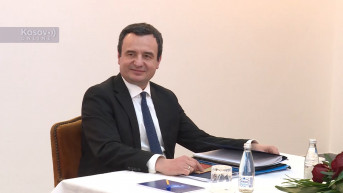
The Prime Minister of Kosovo, Albin Kurti, said tonight that he had come to Ohrid with the intention of signing the basic agreement and the annex on implementation, but that the other side, as on February 27, had refused to do so.
"We reached an agreement on the annex that will regulate the implementation of the basic agreement. On the other hand, as on February 27, we had a refusal to sign the annex, as well as the earlier agreement," Kurti said.
He added that it was now up to the European Union to "make the status of the annex legally binding".
"I hope that the annex will soon be published on the website of the EU External Service. You will see what is in it and what is not in it,” Kurti said.
When asked if there had been any discussion about the elections in the north of Kosovo and the return of the Serbs to the institutions, Kurti also said that they had not discussed it, stating that these were internal matters of the institutions in Kosovo.
"We will make all the necessary decisions so that the elections can take place," Kurti said.
He also said that someone from Belgrade had ordered on November 5 that the members of the Serb List resign collectively, as well as the mayors of four municipalities, and more than 400 police officers...
"It was a mistake. You cannot be an authentic politician and represent the citizens if you start with collective resignations, just because someone from Belgrade ordered you to do so. They should represent and serve the citizens, not one person in another state," Kurti said.
When asked if he advocated for the return of the Serbs to Kosovo and for their rights, Kurti said that he advocated for the rights of everyone in Kosovo, both those who were here and those who had left and wanted to return and had their property in Kosovo.
As he said, many had already sold their property, houses, and land.
"But there are also those who have their own private property, and of course, I stand for the rights of all people, regardless of nationality or religion," Kurti said.
He said that the agreement signed in 2013 and 2015 had not been about the Community of Serbian Municipalities, but about the Community of Serb-majority Municipalities, emphasizing that there were no municipalities in Kosovo formed by national and ethnic affiliation.
As he stated, according to Marti Ahtisaari's proposal, the municipality in Kosovo was strong, that is, a citizen could not live without a municipality.
"That's the structure, some municipalities have greater responsibilities, and our Constitution, which has Ahtisaari's proposal, is such that it does not allow the municipality to be disparaged, which is a tendency in Belgrade," Kurti said.
He points out that the mayors of all municipalities were elected by direct vote of the citizens.
"It is difficult to take competencies from the municipality. Article 10 of the basic agreement, which means de facto mutual recognition of Serbia and Kosovo, implies that all 39 agreements will be implemented. This includes the one from 2013 and 2015, but I repeat that implementation cannot, nor does it have to conflict with our Constitution, and I told Vucic and EU representatives to prepare better and not repeat the mistake and lose another decade," Kurti said.
He states that in the annex it is written that talks are being started regarding the "self-government of the Serbian community" and he clarifies that the Serbian community and the CSM are not the same things.
"All this is being discussed, we have started these discussions, but we still need a lot to reach a concrete conclusion. I am the prime minister of all the citizens of Kosovo and I do not want to oppress or discriminate against anyone based on ethnicity. Because I am Albanian, I was discriminated against and I will not and I don't want to do that to anyone else," the Kosovo Prime Minister said.
He also said that solving the issue of missing persons had to be initiated as soon as possible in Kosovo and that there were currently 1,617 missing persons in that territory, of which, as he says, "the vast majority are Albanians, but there are also Serbs and Roma people".
"Last year on August 18, we agreed on a text of the agreement regarding missing persons, but unfortunately the President of Serbia did not want to sign it that day, just like today," Kurti said.
This is how Kurti answered the journalist's question about whether there had been an agreement on the problem of missing persons at today's meeting.
He emphasized that the issue of the missing should be brought up to date, regardless of nationality.
"There are 1,617 missing persons in Kosovo, among them the vast majority are Albanians, but there are also the Serbs and Roma people, and regardless of where they come from and what their national or religious affiliation is, we will do our utmost to reveal their fate as soon as possible and to enable implementation of justice," Kurti said.
He said that this issue had to be addressed wherever some had disappeared during the war, because, as he says, they are not the only victims, but also their families and relatives.

comments