
Kurti responds: Kosovo is the most democratic country in the Western Balkans
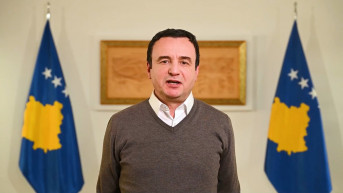
In a video message to the public, Kosovo Prime Minister Albin Kurti responded to the announcement of American sanctions on Kosovo, which are a consequence of the violence in the north, saying that Kosovo was the most democratic country in the Western Balkans, and that "democracy cannot be suspended, nor can it be held hostage."
In his address, Kurti stated that the mayors elected on April 23, despite the low turnout in the elections, due to the boycott which, he said, had been imposed on Kosovo Serbs, were still the only ones who had the legitimacy to be in municipal buildings and at the service of citizens.
Therefore, they have the full, unconditional, and unwavering support of the government.
"Democracy cannot be suspended or held hostage, its implementation is a guarantee of peace and security, regardless of the threat or danger," Kurti said.
He also said that Kosovo was the most democratic country in the Western Balkans, with security and government institutions that were professional and shared a value orientation with Western societies.
"Yesterday it was finally proven to all of us who we are dealing with - groups of extreme right with masks, who vandalize, attack, burn everything they do not consider Serbian and who raise nationalist and chauvinist symbols... Extremists have their own names. They are not a people. The Serbian community must be freed from them. We identified most of them yesterday and today. There cannot be individuals or groups above the law and more powerful than the state. Such are multimillionaire criminals like Milan Radojcic and Zvonko Veselinovic. They are big businessmen and 'owners' of smuggling, who condition their poor workers with violent protests. In fact, this is the path of their bosses in Belgradec - the path of Aleksandar Vucic, Aleksandar Vulin, and Ivica Dacic," Kurti claims.
He stated that he knew that yesterday and today there had also been peaceful demonstrators at the rallies, but that the protests had not been peaceful.
"The protest that attacks the police who maintain order and enforce the law, KFOR members who maintain peace and stability, and journalists who report on the happenings on the ground, is not a protest for the municipality, but for the government. In Kosovo, power can only be obtained through elections. Not through violence and crime," Kurti added.
According to him, the police and KFOR represent the border between "violent extremists and peaceful institutions".
Kurti also said that in the last few hours, Kosovo institutions had intensified communication with international partners, because the common goal was to calm the situation.
"But, in addition to worries, yesterday it was shown before our eyes that we also have threats and dangers in common," Kurti assured.
He wished the injured a full and speedy recovery and thanked the mayors of the municipalities who, he said, despite the difficulties, had shown a sincere will to serve the citizens, which was proven even in situations like that.
He also thanked the Kosovo policemen, who, "despite the tensions and attacks, performed their duties with the highest professionalism", as well as the KFOR members who, "despite foreign intentions to destabilize, maintain peace and security".
"I thank the journalists and media who, despite the dangers and uncertainty, brought us the real face of the violent militia protests in voice and image. And I especially thank the citizens of Kosovo for their trust and support," Kurti said.
Kurti's address followed Hovenier's statement on the introduction of US sanctions.
The American ambassador announced the decision to cancel Kosovo's participation in the joint action "Defender of Europe 2023", adding that at the moment the US did not have much enthusiasm to react to some of Kosovo's interests, such as engaging with unrecognized countries or actively working to improve Kosovo on the Euro-Atlantic path.
These decisions followed yesterday's events in the north, when KFOR violently broke up a peaceful Serb protest in Zvecan, throwing tear gas and stun grenades. On that occasion, more than 50 Serbs were injured, three of them seriously.
The Serbs in the municipalities of Zubin Potok, Zvecan, and Leposavic are peacefully protesting, not wanting to allow the new mayors in the north to enter the buildings of the municipalities that function according to the Serbian system, and after the elections that were boycotted by the Serbian community, and in which the mayors were elected from among Albanians with only four percent of voters, of whom only 13 were the Serbs.
By the way, this year alone, 73 ethnic incidents were recorded in Kosovo in which the Serbs were the object of the attack. Since the beginning of 2021, that is, since Albin Kurti came to power, as many as 350 attacks on the Serbs have been recorded.
Only in the past few months, there have been frequent arrests of the Serbs, former members of the Kosovo Police, in Jarinje, who left the service a few months ago, together with other Serbs from the north who left Kosovo's institutions, as well as detention and harassment of people because of license plates or documents.
In addition, the Kosovo authorities are avoiding implementing the decision to return the property to the Visoki Decani Monastery, which the Constitutional Court made back in 2016.
Also, during the last year and this year, Pristina made several decisions on the expropriation of land in private and social ownership in the north of Kosovo, and on some plots, they have already built bases for the needs of the special police.
In Kosovo, despite all that, the campaign to boycott products from Serbia is not abating.
0 comments