
Macut: Serbia remains committed to implementing reforms under Growth Plan for Western Balkans
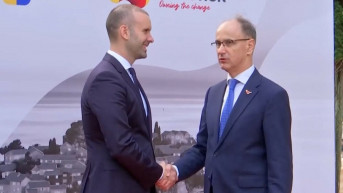
Serbian Prime Minister in a caretaker capacity Djuro Macut said today that Serbia remained committed to implementing reforms under the Growth Plan for the Western Balkans, with the aim of gradually integrating into the EU Single Market, an important step toward full membership, which remained Serbia’s strategic objective.
“Regional stability is therefore not merely a political objective, but an essential necessity. Through the enlargement process, as well as continued investment in peace and prosperity across the continent, the Berlin Process represents one of the key instruments for achieving that stability. A stable and connected Western Balkans is, at the same time, an integral part of a secure and strong Europe,” Macut said at the Berlin Process Summit during the panel “A Region on the Move: The Western Balkans Shaping Europe’s Common Future.”
As reported by RTV, Macut said he hoped that the Western Balkan countries and EU member states would continue to foster mutual understanding, patience and constructive cooperation.
“Because only together can we build our common European future—step by step,” Macut stressed.
He said he did not wish to respond to what he described as unfounded and inappropriate accusations made by the representative of the provisional institutions in Pristina ahead of the summit.
“There is a time and place for that, and it is certainly not today, here in neighboring Montenegro.
Nevertheless, it is important to point out that gatherings such as this are repeatedly misused for such purposes, demonstrating a complete lack of respect for their true purpose and significance,” Macut said.
He assessed that the Berlin Process had proved to be a valuable framework for inclusive regional cooperation, in which joint initiatives were translated into concrete projects and agreements that strengthened trust and contributed to the development of good-neighborly relations.
“That is precisely why we believe that the Berlin Process must preserve its original nature—its inclusiveness, development-oriented approach and focus on the future. The remaining open political issues in the region have their own separate, already established frameworks for resolution, with clearly defined mandates and dynamics. We are convinced that these mechanisms should complement one another, but that none of them can or should replace another by blurring their fundamental differences. Preserving those distinctions is the best way to safeguard what we have jointly achieved through this process,” Macut said.
According to him, the region’s socioeconomic convergence with the European Union represented an aspect of European integration whose value citizens could directly recognize and experience in their everyday lives.
“The Common Regional Market, Green Lanes, reduced roaming costs and accession to the Single Euro Payments Area (SEPA) bring tangible benefits to citizens and businesses. In this context, we welcome the start of negotiations on including the region in the ‘Roam Like at Home’ regime,” Macut said.



comments