
Nesic: While there are Serbs in the institutions of Bosnia and Herzegovina, there will be no recognition of Kosovo
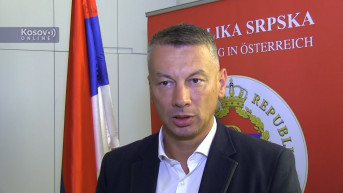
As long as there were Serbian representatives in the institutions of Bosnia and Herzegovina, there would be no recognition of Kosovo, Minister of Security of Bosnia and Herzegovina, Nenad Nesic said, adding that in this way Republika Srpska was actually "on the defensive side" of Kosovo, acting on principle, unlike Bosniak politicians.
"As long as we, the Serbian representatives, are in the Council of MinisteRepublika Srpska, the Parliamentary Assembly of Bosnia and Herzegovina, the House of Peoples, the Presidency of Bosnia and Herzegovina, the recognition of Kosovo by Bosnia and Herzegovina is impossible. I do not know under what conditions and circumstances I could vote for the independence of Kosovo. Besides Serbia, Republika Srpska is on the defensive side of Kosovo and protects the territorial integrity of Serbia and behaves on principle, unlike some countries," Nesic told Kosovo Online in Vienna, where he was on an official visit.
With the statement that the President of Serbia, Aleksandar Vucic, always points out that he respects the territorial integrity and sovereignty of Bosnia and Herzegovina, he points out that, on the other hand, Bosniak politicians do not respect the territorial integrity of Serbia.
"They would recognize Kosovo, but they cannot, because of the 'evil' Serbs, who do not allow them to do so. While we are here, there is no chance of recognizing Kosovo," Nesic said.
He states that everything that happens in the region has repercussions on Bosnia and Herzegovina, so everything that happens in Kosovo affects Bosnia and Herzegovina, especially the Serbs.
"For all the Serbs, Kosovo is a sacred land and we cannot treat this issue as if it is far away," the Minister added.
He says that the security situation in Bosnia and Herzegovina is good and without major challenges, except for the continuous fight against organized crime and illegal migration, which he discussed with his Austrian colleague in Vienna.
The crisis in Bosnia and Herzegovina, he points out, is mainly caused by politicians who come, mostly, from the Bosniak corps, who constantly raise national tensions, because they are not ready to talk about other things, such as increasing pensions and salaries.
"That's why they are causing a crisis, but Bosnia and Herzegovina can only exist in the form in which it was established in the Dayton Agreement, with the constitutional order resulting from the Dayton Agreement," Nesic said and added that he fully supported Milorad Dodik, who, he said, was sparing no effort. to preserve Republika Srpska and its competences.
"A Serb can only live if he has freedom, and the Republika Srpska is synonymous with freedom," Nesic is clear.
That is why, he notes, the sanctions imposed on the officials of Srpska have no justification and show the double standards of the international community.
"What is valid for some other peoples in the Balkans is not valid for the Serbs. The vast majority of the EU supports the independence of Kosovo, although there is no element of independence, in relation to the Serbs, who are the constitutive people of Bosnia and Herzegovina. But, unfortunately, we are not allowed the right to express our will, to have the right to self-determination, to make a decision in a future referendum in what form we want to live in Bosnia and Herzegovina or outside it," Nesic said.
He emphasizes that it is the Serbs who are protecting the Dayton Agreement and the constitutional order, while on the other hand, as he says, aggressive Bosniak politicians are destroying the Dayton Agreement, and they have the support of the international factor.
"We, the Serbs, have to defend ourselves with diplomacy and dialogue. Republika Srpska must defend itself with memory, with unity, which is necessary at this moment, because the challenges before the Serbs will be both great and difficult," the Bosnia and Herzegovina Minister noted.
When asked about the statement of the President of the European Council, Charles Michel, about 2030 as a possible year for joining the EU, Nesic replied that if Bosnia and Herzegovina, and the region, did not become a member of the EU by 2030, the Union would lose all meaning.
"If we are not a member by then, the question is whether we should be on that path. Indeed, the European path is the common commitment of all peoples in Bosnia and Herzegovina, but it cannot last indefinitely," Nesic warned.
When it comes to the "Open Balkan" initiative, he says that Bosnia and Herzegovina does not participate in it, because certain politicians cannot distinguish between economic development and politics and lead the country forward.
"Now there is no political agreement for Bosnia and Herzegovina to become a part of the 'Open Balkan'. I stand for a market without borders and obstacles, for the free flow of goods and people, which would contribute to everyone, to create a market with more than 15 million inhabitants, to become more interesting to investors ... But, obviously, there is no political will. I am waiting for us to become a member of the EU, whether we will - no one can say now, and Euroscepticism among citizens is growing," Nesic said.
He also said that the strengthening of Serbia suited Srpska the most, reminding that a large number of investments in the Republika Srpska had come from Serbia.
"Vucic restored Serbia, and Serbia and Republika Srpska are one. In our minds, borders do not exist, we are one nation, history, culture, one religion. The Serbs, no matter how much we try to divide them, no one can divide them. We can only want Serbia to be even stronger, economically, economically, militarily, and politically. This guarantees a strong Republika Srpska, but above all, it guarantees peace and stability in the region, because nobody wants to play with a strong state, which Serbia is now," Minister Nesic concluded.

comments