
Pata: The EU is unable to implement the enlargement agenda

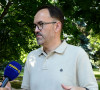
Albanian analyst and political editor of the daily newspaper Tema, Ylli Pata, told Kosovo Online that the Balkan tour of the President of the European Council, Antonio Costa, carries primarily a political message and is intended to clarify the direction the European Union will take regarding the Western Balkans. However, he points out that the region’s integration process has lost significance due to internal problems and that the European Union has failed to turn the enlargement agenda into a genuine political priority.
According to him, developments are expected that could change the EU’s priorities regarding the integration of the region.
“I think that the issue of enlarging the bloc, more than being a question for the European Union itself, is increasingly becoming a matter that will be resolved by the most powerful EU member states, with Germany and France playing the leading role. I believe that the summit in Tivat, rather than reflecting a common position of the European Union, will be a political signal from Germany, especially following the letter Chancellor Merz circulated regarding Ukraine and Moldova. New developments are expected that could alter the EU agenda, this time to the detriment of our countries,” he said.
He assessed that Montenegro is the closest to the EU because, as he put it, the European Union itself created that country.
“Montenegro may be closer to the EU, and that is because this is considered a geopolitical issue. That is because Montenegro was created by the European Union. Let us not forget the 2006 referendum, when the European Union, with Mr. Solana, set the referendum threshold at 55 percent, which was an almost ‘mathematical’ result. I think Montenegro will continue along the path of integration, while I fear that Albania will remain on the Greek calendars,” Pata said.
Speaking about Serbia’s integration into the EU, he identified Germany’s goal of playing a significant role in the Belgrade-Pristina dialogue as the main issue, while noting that Albania is also part of that process.
“I believe that Serbia’s problem, as we know, is precisely the issue of Kosovo. I think that in the negotiations among the major powers concerning Kosovo, the European Union has so far played no role, while Germany has wanted to have its own role. I believe that this is the essence of the problem. Germany wants an important role in the negotiations between Serbia and Kosovo, and this will be an issue in the future. Albania is also part of this ‘game’; whenever Albanians are involved, it concerns a country that is very close to us,” Pata assessed.
When it comes to Kosovo, Pata emphasized the involvement of Germany, as well as other major powers, in an effort to impose their own influence.
“I think Germany has demonstrated its influence regarding Kosovo, but other major powers have also intervened here. Let us not forget that the case of sending Thaci to The Hague for trial was a very strong intervention by Chancellor Merkel, specifically to stop an agreement between the United States and Russia regarding Kosovo. Merkel strongly supported Albin Kurti, influencing Thaci’s arrest, because Germany is the country that finances the Specialist Chambers. She did so precisely to send a signal that Berlin should be the main actor in this matter,” he concluded.

0 comments